By Cafesba , 4 October 2025

With the establishment of the SCAA in the United States, evaluation standards were established to define whether a coffee is specialty.

 1. Fragrance: The aroma of the coffee grounds and the liquid. 

2. Flavor: Evaluation upon sipping the liquid. 

3. Aftertaste: Lingering aftertaste after swallowing. 

4. Acidity: Pleasant brightness and juiciness. 

5. Body: Texture and weight on the tongue. 

6. Balance: Harmony of all elements.

By Cafesba , 4 October 2025

As the number of specialty coffee businesses increased, the Specialty Coffee Association of America (SCAA) was founded in 1982.
Led by Donald Schoenholt of Gillies Coffee in Brooklyn, New York, and Ted Lingle of California roaster Lingle Bros, the association was founded by a core of members including Waldenhauffer of Coffee, Tea and Spice in San Francisco, Peter McLaughlin of Royal Coffee, and coffee importer John Randall.

By Cafesba , 4 October 2025

Against this backdrop, a trend began where high-quality coffee was supported by a fan base that was particular about flavor.
The term Peetniks was even coined to refer to the core fans of Peet's Coffee in Berkeley, California.
Such coffee also focuses on the origin of the beans.
Because they are particular about the origin of the beans, they do not pursue quantity over quality like commodity coffee, but rather they are particular about beans imported from specific producing areas in order to pursue high-quality beans even if the production lot is small.

By Cafesba , 4 October 2025

Specialty coffee businesses sprang up one after another in the 1990s, but the foundations for this began in the late 1960s.
At the time, commodity coffee was traded in containers, which contained burlap bags filled with coffee harvested from various growing regions.
The idea arose to see if these burlap bags could be sold individually,
or if small-lot burlap bags could be sold to small-scale roasters.
From the late 1960s, a wave of small-scale roasters began to open in the United States.
Peet's Coffee, founded in Berkeley, California in 1966,

By Cafesba , 4 October 2025

After the coffee crisis of 1989, commodity coffee prices became a kind of financial product, leading to price instability. Furthermore, under the Doi Moi policy implemented in 1986, the emerging Robusta coffee producer Vietnam rapidly increased its supply through national policy, threatening even Brazil, the leading coffee-producing country. This led to a decline in export prices from Latin America and Africa.
When prices fell, farmers in coffee-producing countries were unable to sell their coffee, even if they lowered the price, and their incomes fell.

By Cafesba , 4 October 2025

The price of commodity coffee is set on the New York Mercantile Exchange for Arabica and on the London Mercantile Exchange for Robusta.
The standard price for Arabica is cents per pound (about 453g), and for Robusta it is dollars per ton (1,000kg).
In reality, coffee importers and producer-exporters often make contracts to purchase a certain amount of coffee of a specific quality over a specific period, such as the next three years.
This is called a forward contract.

By Cafesba , 4 October 2025

Major convenience store chains' huge distribution networks for coffee are supported by procurement from trading companies, but these primarily consist of commodity coffee.
Not only in convenience stores, but also in the regular coffee, instant coffee, and canned coffee sold in supermarkets, as well as much of the coffee served in cafes and coffee shops, all are commodity coffee.
Currently, the price of commodity coffee is determined by the New York Mercantile Exchange and, for some Robusta varieties, the London Mercantile Exchange.

By Cafesba , 4 October 2025

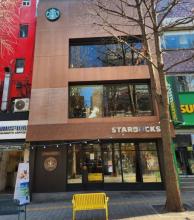
Major convenience stores have a large number of stores, with Starbucks having 2,000 stores in Japan and 7-Eleven having 20,000.
Starbucks is a major cafe chain and has the largest number of stores in Japan, but the huge distribution network of convenience stores far surpasses even those of major cafe chains.
FamilyMart has 16,000 stores and Lawson has 14,000, so if each of these stores had a cafe, they would be the largest cafes.
The beans supplied to these stores by roasters are also on a large scale.

By Cafesba , 4 October 2025

One of the reasons for the rise of convenience store coffee is the improvement of coffee machines.
While Seven-Eleven's coffee machines previously required customers to choose the size of their coffee when brewing, the machine automatically determines the size and brews the coffee when a cup is placed in the machine.
Improvements have been made to improve service, including adjustment of brewing temperature, precise control over bean grinding, and multilingual touchscreens.

By Cafesba , 4 October 2025

Convenience stores sell canned coffee and self-service coffee from coffee machines. They also sell drip bags and other coffee machines, but for the convenience of being able to drink it on the spot, canned coffee or machine coffee are the best.

Canned coffee is excellent for long-term storage because it's stored in a can, which is why it's popular not only at convenience stores but also at mass retailers and vending machines.

Self-service coffee machines grind and brew the beans on the spot in a coffee maker, allowing you to enjoy a fresh aroma and flavor.