
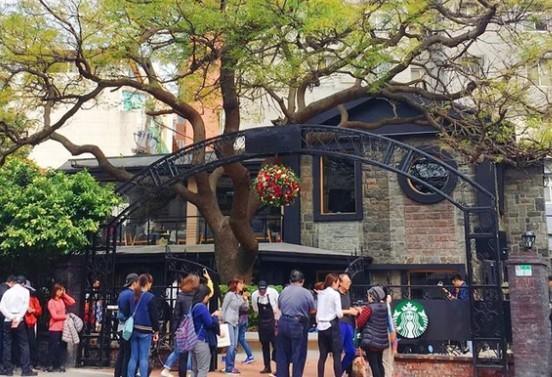
Starbucks expanded into markets across Asia between approximately 1996 and 2000.
On this website, I have previously written about Starbucks’ entry into Japan in 1996 and its expansion into China and South Korea in 1999.
The first Starbucks store in Japan opened in Ginza in 1996
Shinsegae Group's Jeong Yongjin's Promotion of Starbucks in Korea
Starbucks, which spread café culture to China
This concentrated push into Asia reflected the strategy of then-CEO Howard Schultz, who publicly stated that Asia would become Starbucks’ largest growth market in the 2000s. The success of the company’s first Japanese store—where customers lined up from the opening day and sales greatly exceeded expectations—is said to have accelerated Starbucks’ subsequent expansion throughout Asia.
In Taiwan, Starbucks opened its first store in Tianmu, Taipei, in 1998.
The company that undertook the operation of Starbucks in Taiwan was Uni-President Enterprises Corporation, also known as the Uni-President Group. The group already owned Uni-President Coffee, which had sold the carton-packaged coffee beverage Café Plaza since 1986.
Uni-President was Taiwan’s largest food and beverage conglomerate. In addition to its food and beverage production network, it controlled President Chain Store Corporation, the operator of 7-Eleven in Taiwan.
Uni-President would later become involved not only in operating Starbucks in Taiwan, but also in managing Starbucks stores in eastern China, particularly in and around Shanghai.
Uni-President’s Expansion into Mainland China in the 1990s
After 1979, China began attracting investment from around the world under the reform and opening-up policies of Deng Xiaoping’s government.
Taiwan, however, remained under martial law and continued to officially prohibit investment in mainland China.
Martial law was lifted toward the end of Chiang Ching-kuo’s administration. Under the succeeding government of Lee Teng-hui, restrictions in the economic sphere were gradually relaxed. In 1992, the Act Governing Relations between the People of the Taiwan Area and the Mainland Area came into force, allowing investment, technical cooperation, and trade with mainland China.
On March 1, 1993, Taiwan’s Ministry of Economic Affairs subsequently introduced the Regulations Governing Permission for Investment or Technical Cooperation in the Mainland Area. Investments were thereafter administered under three categories: permitted sectors, prohibited sectors, and sectors requiring individual review.
Against this background, major Taiwanese corporations began expanding actively into China. Uni-President’s entry into mainland China began in 1992.
Xinjiang Uni-President Enterprises Food Co., Ltd., established on January 13, 1992, became Uni-President’s first factory in mainland China.
Why was its first factory established not on the economically dominant eastern coast, but in the Xinjiang Uyghur Autonomous Region, far to the west?
In 1992, demand for tomato juice was high in Taiwan, while the supply of processing tomatoes was insufficient.
Uni-President took an interest in tomatoes grown in Xinjiang, whose long hours of sunlight and large temperature differences between day and night produced desirable color, flavor, and solid content. It therefore established its first mainland Chinese company in Ürümqi.
The immediate reason Uni-President General Manager Gao Qingyuan decided to invest in Xinjiang was to secure a reliable supply of high-quality tomatoes.
Kunshan Uni-President Enterprises Food Co., Ltd., meanwhile, was established in May 1993 and began production in 1994.
It was located in Kunshan, Jiangsu Province, immediately west of Shanghai and close to Suzhou, Wuxi, and Changzhou—in other words, directly at the center of the East China market. The factory was situated in the Kunshan Development Zone, in a county-level city ranked first among China’s top 100 counties. It had registered capital of US$96 million and total investment of US$143 million.
The Kunshan facility followed a “market-oriented location” model. It was designed to supply large quantities of everyday consumer goods, including instant noodles and beverages, to the enormous East China consumer market centered on Shanghai.
Kunshan occupied a pivotal position in what Uni-President called its “T-shaped strategy”: an expansion strategy covering the coastal consumer markets and the Yangtze River basin.
How Starbucks and Uni-President First Connected
In August 1996, Xu Zhongren, general manager of President Chain Store Corporation, was reading the Japanese retail-industry newspaper Nikkei Ryutsu Shimbun in Taiwan when he noticed an article about Starbucks opening a store in Ginza, Tokyo.
Xu had achieved major success with Taiwan’s 7-Eleven business and was known as the “godfather of Taiwan’s retail industry.”
He visited the Ginza store himself and came away with the impression that “drinking coffee at Starbucks had itself become a form of enjoyment and an experience.” He consequently began considering bringing the brand to Taiwan.
Xu instructed President Chain Store’s food-service team to contact Starbucks headquarters in the United States.
At first, however, Starbucks did not respond. Several Taiwanese companies were seeking a partnership with Starbucks at the time. Reports suggest that Sun Dawei, who had been involved in McDonald’s Taiwan operations, was among those who had made contact with Starbucks at an early stage.
Later, while evaluating potential Taiwanese partners, Starbucks approached Prince Housing & Development Corporation, a company with experience in property development.
For Starbucks, expanding its store network in Taiwan required more than brand management and food supply. It also required:
the ability to secure attractive store locations;
experience in lease negotiations and store development;
knowledge of urban commercial districts; and
expertise in building design and construction management.
Prince Housing had close ties to the Uni-President Group and introduced Starbucks to Xu Zhongren of President Chain Store.
Starbucks did not immediately select Uni-President.
Xu was invited to give a proposal presentation in Seattle, but the invitation list included two other companies in addition to Uni-President. It was therefore a competitive selection process involving several candidates.
The Partnership Between Starbucks and Uni-President in Taiwan
Xu Zhongren appointed Xu Guangyu to represent the company.
With only two or three weeks remaining before the presentation at the end of October, Xu Guangyu hurriedly collected information, prepared the proposal, and flew to Seattle.
Although Xu had already visited the United States seven or eight times, it was his first visit to Seattle. He later recalled, with a certain youthful freshness, that the city’s cool autumn weather and courteous atmosphere made him feel “as though he were falling in love.”
Negotiations with the American side proved difficult.
Xu Guangyu suggested that Uni-President might consider partnering with a secondary brand or developing a brand of its own. Xu Zhongren, however, refused to compromise, insisting that “if we are going to do it, we should work with the leading brand.”
His principle was that when entering an unfamiliar business, the fastest route to success was to partner with the best company in the field and absorb the complete operating knowledge of a business that had already proven successful.
Uni-President then gave Starbucks headquarters in Seattle a thorough presentation emphasizing what it regarded as its greatest strength: the overwhelming success and distribution network of 7-Eleven in Taiwan.
Uni-President operated more retail stores than any other company in Taiwan through its 7-Eleven network and possessed the expertise needed to secure the best locations and properties.
It had successfully localized an American chain-store business for the Taiwanese market, covering everything from product development and logistics to employee training.
It had already established a powerful supply chain covering the whole of Taiwan.
For Starbucks, the greatest obstacles to overseas expansion were local real-estate conditions and the construction of a reliable supply chain.
Uni-President’s extensive infrastructure and retail expertise were therefore extremely attractive to Starbucks headquarters.
Even after Uni-President was selected as the final candidate, negotiations nearly collapsed.
Drawing on its experience with 7-Eleven, President Chain Store wanted eventually to expand Starbucks through a franchise system. At the time, however, Starbucks strongly emphasized company-operated stores as a means of protecting the brand, with only limited exceptions such as airport locations.
Negotiations stalled over this disagreement. Xu Zhongren then wrote directly to Howard Schultz, after which Schultz visited Taiwan.
Establishment of President Starbucks Coffee Corporation
Based on its successful experience with 7-Eleven, Uni-President initially envisioned developing Starbucks through a franchise model.
Starbucks in the United States firmly rejected this proposal and refused to compromise on its requirement that the stores be company-operated.
Uni-President ultimately conceded. Rather than introducing a broad 7-Eleven-style franchise network, it agreed to establish a joint venture with Starbucks and operate stores directly under that company. In doing so, Uni-President accepted Starbucks’ strict system of brand control.
Looking back on the decision years later, Xu Guangyu said that “the supervision and exacting standards of a master in a particular field can become a means through which we learn.”
He acknowledged that Starbucks had made the correct decision. Because the stores were directly operated, quality remained consistent across all locations from the beginning, expansion proceeded rapidly, and the company was able to achieve profitability, establish the brand, and lay the foundations for future growth within three years.
The two sides consequently agreed to establish the joint venture President Starbucks Coffee Corporation.
Xu Guangyu led its launch as the company’s first general manager.
From a capital perspective, Starbucks did not initially make a large investment.
When the joint venture was established in 1998, Starbucks held only 5 percent of the shares. President Chain Store Corporation held 50 percent, while Uni-President Enterprises Corporation held 45 percent.
This represented one of Starbucks’ standard overseas expansion models, known as a licensing arrangement. In many overseas investments, Starbucks initially acquired a stake of only 5 percent.
By allowing a local company to provide most of the capital and assume primary responsibility for operations, Starbucks could limit its risks while maintaining a connection between headquarters and the local market. Once Starbucks had gained a better understanding of the market and local policies permitted it, the company could gradually increase its shareholding and strengthen its control.
Starbucks later increased its stake in the Taiwanese operation to 50 percent. Similar patterns were repeated in Japan—where Starbucks purchased the shares held by Sazaby League and made the Japanese operation a wholly owned subsidiary in 2015—and in various regions of China.
Taiwan’s First Starbucks Store Opened in Tianmu
Tianmu was selected as the location for Taiwan’s first Starbucks store.
After the Second World War, Tianmu developed as a residential district for American military personnel. It subsequently remained home to the Taipei American School, the Taipei Japanese School, foreign expatriates, diplomats, and their families.
Western-style restaurants, imported-food stores, and beer pubs had appeared there relatively early, giving the neighborhood a way of life resembling that of “a small American town.”
In Taiwan in 1998, espresso-based lattes, English-style product names, ordering at a counter and collecting one’s own drink, walking around with a paper cup, and paying approximately NT$100 for a cup of coffee were not yet natural or familiar practices for most consumers.
Tianmu can therefore be regarded as the market in which the American Starbucks system would be easiest to introduce and explain.
The neighborhood contained a concentration of expatriates and Taiwanese residents who had returned from abroad, many of whom had already experienced Starbucks in the United States or Japan. It was also an affluent residential district whose consumers had the purchasing power to accept coffee priced at approximately NT$100 per cup—around three times the price charged by existing local chains.
Tianmu was also removed from the central office districts that served as the main battleground for lower-priced chains such as Ikari Coffee and Dante Coffee, which sold coffee for around NT$35. This allowed Starbucks to establish its brand identity in a relatively calm environment.
In other words, Tianmu was arguably the safest testing ground in Taiwan: a place where the brand’s earliest customers were likely to understand it correctly.
From the second store onward, Starbucks expanded into central urban districts, growing to ten stores during 1998.
The Tianmu store therefore appears to have served less as a high-volume flagship than as a showcase that presented the Starbucks brand and its worldview accurately. Once that image had been established, the company moved into the main centers of consumption for its full-scale expansion.
Uni-President Takes Responsibility for Starbucks in East China
Starbucks learned how to operate through local partnerships from its joint-venture experience in Japan and replicated the model when it entered China in 1999.
The company divided Greater China into three regions.
The rights for Hong Kong and Guangdong were granted to Hong Kong-based Maxim’s Group. The northern region centered on Beijing and Tianjin was assigned to Beijing Mei Da Coffee. The rights for Taiwan and the Jiangsu-Zhejiang-Shanghai region were granted, through successive agreements, to Taiwan’s Uni-President Group.
What is important is that none of these three companies was a purely mainland Chinese enterprise.
Maxim’s was a Hong Kong company. Uni-President was Taiwanese. Beijing Mei Da, which was responsible for northern China, was also a company established by venture-capital interests and led by a Taiwanese entrepreneur.
Sun Dawei, who had helped make McDonald’s successful in Taiwan through Kuanda Foods, obtained the agency rights for the China region in 1999 and established Beijing Mei Da.
Starbucks therefore deliberately selected not mainland Chinese corporations, but companies with proven experience in chain restaurants and retailing within Greater China.
One reason was that, in the late 1990s, few mainland Chinese companies possessed experience in modern chain-store management. Companies capable of satisfying Starbucks’ partner-selection criteria—including corporate reputation, quality-control capabilities, and the ability to train employees according to Starbucks standards—were largely found among Taiwanese and Hong Kong businesses.
At the time, two imitation cafés using the confusingly similar name “Shanghai Starbucks” already existed in Shanghai, eventually resulting in litigation. This illustrates the relatively undeveloped state of the mainland Chinese market at the time.
Uni-President had already operated food and beverage businesses in mainland China before the establishment of Shanghai Starbucks.
In East China, it possessed production and sales bases in places such as Kunshan. It had therefore accumulated experience dealing with Chinese administrative procedures, employment practices, procurement, logistics, and business customs.
Starbucks itself described Uni-President as an integrated company with operations in mainland China and Southeast Asia, covering food manufacturing, retailing, and logistics.
President Chain Store also had the chain-management capabilities required to operate large numbers of retail locations.
Starbucks needed a partner capable of managing not only store properties, but also the stable supply and administration of milk, bread and cakes, paper cups, warehousing and distribution, employee training, and store development.
Uni-President Enterprises could handle food manufacturing, while President Chain Store could take responsibility for retailing and store operations.
A system combining the capabilities of the two companies had already proven successful in Taiwan and could therefore be transferred to East China. Articles featuring people involved on the Taiwanese side have similarly explained that Uni-President possessed a distinctive ability to combine manufacturing resources with experience managing several thousand chain-store locations.
Taiwanese employees also spoke Chinese, placing them in a favorable position to train and communicate with local employees in Shanghai.
Moreover, because Taiwan already had a well-developed chain-café market, the Uni-President team possessed experience in selling premium-priced coffee, appealing to the urban middle class, adapting Western brands for Chinese-speaking consumers, and developing products for Taiwanese and wider Chinese markets.
コメント