
The first Starbucks store opened in Seoul in 1999.
The man who drove Starbucks in Korea was Jeong Yongjin, current Chairman of the Shinsegae Group.
Jeong's experience working at Starbucks during his time as a student at Brown University in the United States led to his active promotion of its introduction to Korea.
In the early 1990s, Jeong studied economics at Brown University in Rhode Island.
At the time, Starbucks was wildly popular among local university students. Jeong was deeply impressed by the "third place" culture of a Starbucks store near campus, where students would line up to buy coffee and then freely study or chat inside.
He wasn't just captivated by the taste of coffee; he believed that if this culture were introduced to Korea, it would bring about a tremendous change, especially among young people. At the time, teahouses and instant coffee were the norm in Korea, so espresso-based takeout coffee was a novel concept.
A returnee from the family that founded the Shinsegae Group in the early 1990s, he was of the same generation as the Orange Tribe and had a unique sensibility.
He joined the Shinsegae Group in 1995 and was assigned to the Strategy Team in the Shinsegae Strategic Planning Department.
It was around this time that he began to fully promote the brand's introduction.
In 1997, he was promoted to Managing Director of the Planning and Coordination Department, and Shinsegae signed a licensing agreement with Starbucks Coffee International (SCI) in the United States, marking the start of their official partnership.
In February 1998, Shinsegae and Starbucks' vice presidents agreed to a joint investment agreement to manage the brand.
The first store opened in front of Ewha Womans University in Seoul in July 1999.
At the time, the area in front of Ewha Womans University (Ewha Womans University) was a core commercial district attracting women in their 20s, the most trend-conscious people in Korea. Starbucks headquarters and Shinsegae Group set "female college students and nearby working women" as their core target for quickly adopting and spreading the new coffee culture (espresso, takeout).
At the time, Korean "taverns" (teahouses) and cafes were primarily spaces for sitting and relaxing. However, Starbucks needed to establish the "takeout" culture of drinking coffee on the street. The area in front of Ewha Womans University had a large, mobile population of students commuting to and from school, making it the perfect place to naturally expose people drinking coffee while walking and spread the trend.
While Apgujeong Rodeo Street was already a well-established area for the wealthy, Ewha Womans University (Ewha Womans University) symbolized the "place where new trends begin." Following the common belief at the time that "if something becomes popular in front of Ewha University, it will spread nationwide," the company emphasized the brand's freshness and sought to maximize its viral effect.
It is also said that Jeong Yongjin's mother, the group's chairman Lee Myung-hee, was a graduate of Ewha Womans University and had a strong attachment to her alma mater.
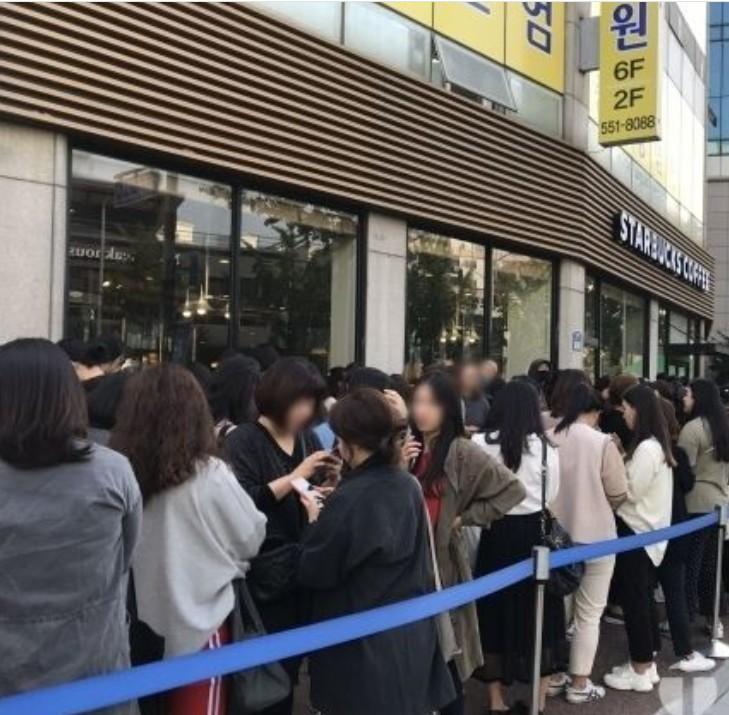
At the time, the culture of queuing at restaurants was not yet common in Korea. However, on opening day, a long line formed in the narrow alley in front of Ewha University, filled with students and young people eager to be among the first to experience the new trend.
Although it took 30 minutes to order and even longer to receive their drinks, the line itself created a powerful advertising effect (viral) that sent the message, "If you go there, you'll find something new."
The most iconic sight was the sight of female college students walking briskly with paper cups bearing the Starbucks logo.
The media at the time reported this scene as a "new fashion item." More than just a drink, the takeout cups functioned as a status symbol for those consuming sophisticated urban culture.
At that time, Korea did not have the now-common concepts of "caramel macchiato," "Frappuccino," or "tall" or "grande" size.
For young people, being confused by the complex menu at the ordering counter was an intellectual and exciting experience, as it made them feel like they were learning about a new culture.
At the time, coffee shops (taverns) were filled with cigarette smoke and people hunched over sofas, but Starbucks introduced a completely non-smoking policy and modern interiors with jazz playing in the background.
On the day of the opening, Managing Director Jeong Yongjin was also on site. He is said to have not just kept an eye on the store, but also closely monitored customer reactions.
The explosive success of this first store strengthened his belief that "the Korean coffee market would be completely transformed," and he stepped on the gas to aggressively expand his store network.
コメント