
Coffee Culture in Taiwan During the Late Qing Dynasty
In the mid-1800s, during the late Qing Dynasty, Chinese cities like Shanghai and Guangzhou were already thriving as trading ports and beginning to experience Western culture. This was due to their opening under the Treaty of Nanjing following the First Opium War (fought between Britain and the Qing Empire) in 1842.
Taiwan's initial exposure to Western culture was sparked by the opening of the ports of Tamsui and Anping in 1860. These ports were opened as a result of the Treaties of Tientsin and the Convention of Beijing after the Arrow War (the Second Opium War, fought between Britain, France, and the Qing). Consequently, Qing-era Taiwan also became a hub for international trade involving Western merchants.
Following the opening of these ports, British merchant John Dodd and Taiwanese merchant Li Chunsheng turned their attention to tea in northern Taiwan. They introduced tea seedlings and processing techniques from Fujian, successfully cultivating Taiwanese Oolong tea into a major export commodity. Oolong tea was noted not only for its sweet flavor but also for the white, gold, yellow, green, and red hues it displayed when brewed. After being presented to Queen Victoria of the United Kingdom, it was famously named "Oriental Beauty."
This elevated the reputation of Taiwanese tea, leading five major tea trading firms—Tait, Jardine Matheson, Boyd, Elles, and Hwa-lee—to open branch offices in Dadaocheng near Tamsui, exporting massive quantities to the UK and the US. In 1869, the highly successful export of nearly 130,000 kilograms of Oolong tea to New York pioneered the expansion of Taiwanese tea into Western markets. From then on, "Formosa Tea" became renowned globally.
While Taiwan began exporting as a tea-producing nation through international trade, there was not yet a custom of drinking coffee at the time.
However, because Dadaocheng was both a production hub for Taiwanese tea and a gathering place for trading companies, a rich tea culture flourished. There were standard teahouses, as well as high-end chayi guan (tea art houses) and chalou (tea pavilions). The tea trading companies in Dadaocheng all had tasting rooms where foreign buyers, brokers, and quality inspectors would compare different teas. Although these were commercial spaces, their function as places where "people gather to drink tea" closely resembled the tasting counters of modern specialty coffee shops.
Peddlers known as chadan (tea bearers) carried hot water and tea leaves on shoulder poles, selling tea by the cup to laborers at markets and ports. There were also rest stops called chating (tea pavilions) located along roads, mountain passes, and ports, offering tea to travelers for free or at a low cost. Additionally, there was the charitable custom of fengcha (offering tea), where pots of tea were placed in front of temples and private homes to provide free tea to passersby.
Because tea was so deeply rooted in the daily lives of the people—both culturally and industrially—there was not yet any room for coffee to emerge.
At that time, there were no hotels for foreign merchants in Taiwan; they stayed in guest rooms at various consulates or in the bedrooms of trading companies. While these facilities stocked Western liquor and coffee for Western residents, it was not yet enough to sustain a café culture.
Coffee Cultivation in Taiwan
Gradually, however, things began to change. Around 1884, a man named Bruce from the British trading firm Tait & Co. reportedly brought 100 coffee seedlings from Manila (Philippines) and planted them around Sanxia in Taipei (present-day New Taipei City) and Yangmei (present-day Taoyuan City). While this did not reach a commercial scale and remained mostly at an experimental or garden level, it successfully proved that "coffee could grow in Taiwan."
In 1895, following the First Sino-Japanese War, Taiwan came under Japanese rule. During the colonial period, the Japanese administration promoted a policy of "Agriculture for Taiwan, Industry for Japan." From the very beginning, Taiwan was assigned the role of producing goods that could not be grown on the Japanese mainland.
At the time, the major Western powers were already monopolizing tropical plantation crops in their respective colonies:
United Kingdom: Black tea in India and Ceylon
Netherlands: Coffee and sugar in Java
France: Coffee and rubber in Indochina
United States: Sugar in the Philippines and Hawaii
Given this context, it was an inevitable imperial strategy for Japan to produce tropical crops in Taiwan—such as coffee, rubber, quinine, and vanilla—which were completely impossible to cultivate on the mainland.
The Office of the Governor-General established the Bureau of Productive Industries, with Bunzo Hashiguchi appointed as its first director. In 1896, under Hashiguchi's direction, Sojiro Yokoyama sowed coffee seeds in Puli, Nantou County. This marked the first official experimental cultivation under Japanese rule.
Hokkaido Imperial University (formerly the Sapporo Agricultural College) produced many talented individuals in agricultural research who were heavily relied upon by the Bureau of Productive Industries, contributing significantly to the development of Taiwan's agriculture. Agricultural scholars from the Sapporo lineage, such as Inazo Nitobe, effectively used Taiwan as a testing ground to update Japan's cold-climate agricultural science for tropical environments.
Coffee beans produced in Taiwan were presented at the Tokyo Industrial Exhibition in 1907 and at the enthronement ceremony of Emperor Taisho in 1915, receiving high praise.
Growing Demand for Coffee in Japan
As discussed on the following pages, coffee was rapidly gaining popularity in Meiji-era Japan.
Japanese Coffee Shop (Kissaten) Culture
Japan's Coffee Roasting Industry During the Belle Époque in Europe
From the late Meiji era to the Taisho era, coffee spread among the middle class as a "symbol of civilization and enlightenment." Since the Meiji Restoration, the Japanese had begun to embrace coffee as a beverage that carried the essence of cultural flourishing.
The problem was that, at the time, Japan relied on 100% imports (primarily from Brazil) for its coffee. By governing Taiwan, Japan acquired its own coffee production base. To curb the outflow of foreign currency and achieve self-sufficiency, producing coffee within its own territory was a highly rational economic choice.
1930: A coffee experimental station was established in Gukeng, Yunlin County.
1938: Shudo Sasao succeeded in the full-scale cultivation of coffee at the Hokkaido Imperial University's experimental forest in Puli.
The conditions in Taiwan's mountainous regions—specifically the diurnal temperature variation, moderate rainfall and sunlight, and well-drained soil—were a perfect match for growing Arabica coffee. The proof of this exceptionally high quality prompted major Japanese companies (like Mitsubishi and Kimura Coffee Store, now Key Coffee) to begin investing in large-scale plantation development, causing industrialization to accelerate rapidly.
1941: The total coffee cultivation area across Taiwan expanded to approximately 1,000 hectares.
The Evolution of Cafe Culture in Taiwan Under Japanese Rule
The Early Days: Promoting Taiwanese Tea (1895–1900s)
When Taiwan came under Japanese rule in 1895, policies were put in place to export Taiwanese tea, sugar, and camphor both within and outside the empire. The kissaten (cafes or teahouses) of this era were less like modern cafes and more akin to exhibition-style dining spaces designed to promote and sell Taiwanese tea.
A pivotal event was the 1900 Paris Exposition. The Taiwanese delegation established a "Taiwanese Teahouse" at the expo, serving Taiwanese tea to visitors and earning highly favorable reviews. Prompted by this success, organizations such as the Dadaocheng Tea Merchants Guild began utilizing the "cafe" format to market Taiwanese tea at exhibitions and venues both in Japan and abroad. In other words, the initial form of the cafe in Taiwan was not rooted in coffee culture, but was rather a modern promotional space for Taiwanese tea.
The Introduction of Coffee and Western Culture (1897–1912)
Following the onset of Japanese rule, Western culture also began to spread across Taiwan. In 1897, Seiyoken opened primarily in the suburbs of Taipei's Ximen (West Gate), serving Western food and wine. The opening advertisement published in the Taiwan Daily News included the phrase "Coffee and Tea Room," marking the beginning of coffee being served to the general public.
In 1912, Hatsutaro Shinozuka founded Café Lion, Taipei's first "liquor-serving" cafe featuring waitresses who entertained customers. This establishment reportedly hosted regular gatherings attended by bureaucrats from the Office of the Governor-General of Taiwan, merchants, doctors, lawyers, scholars, journalists, Buddhist monks, painters, and calligraphers of the time.
The Rise of Cultural Salons (1930s)
The year 1931 saw the opening of Cafe Werther (Wéitè Kāfēi). Its founder, Yang Cheng-chi, was a graduate of Meiji University, a former reporter for the Taiwan Nichinichi Shimpo, and the older brother of the painter Yang San-lang. Opened on the second floor of an intersection in Taipingcho 3-chome, the cafe was named after Goethe's The Sorrows of Young Werther. Initially launched as a pure coffee shop (a "coffee salon") aiming to be a gathering place for intellectuals, the business struggled. By the following year, it was forced to pivot into a bar-style cafe with waitresses. Nevertheless, Cafe Werther was a crucial establishment that would later become the starting point for Dadaocheng's cultural network.
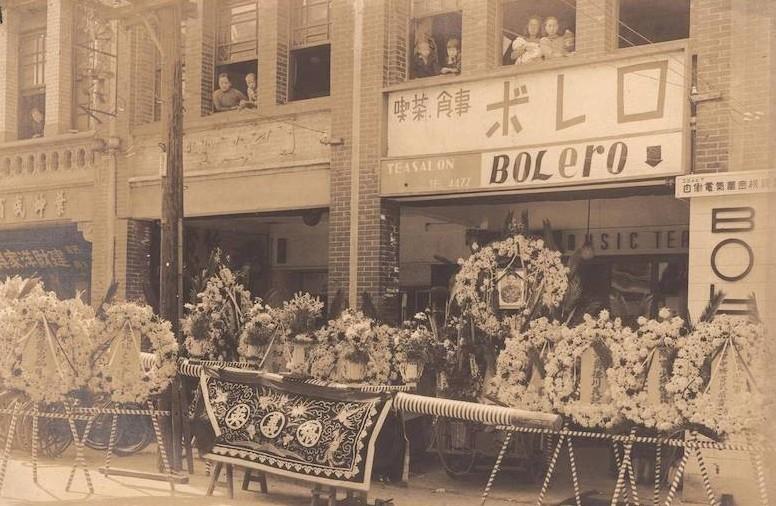
The most iconic establishment in Taiwanese cafe history is Bolero (Bōlìlù), which opened in Dadaocheng in 1934. Founded by Liao Shui-lai, a lover of classical music, the cafe was named after the famous composition by French composer Maurice Ravel. The interior was equipped with high-end audio equipment, and canvases were hung on the walls for customers to create impromptu art.
The names of those who gathered there reveal a microcosm of the Taiwanese cultural scene of the era. Painters like Kuo Hsueh-hu, Chang Wan-chuan, and Yang San-lang, along with writers such as Chang Wen-huan and Lu Ho-jo, became regulars. Liao Shui-lai himself acted as both a manager and a patron to the painters, cementing Bolero as a deeply significant location in Taiwanese art history.
What is particularly interesting is the flow of human resources. Bolero's founder, Liao Shui-lai, had previously served as the head chef at Cafe Werther, while Wang Ching-chuan, who would later found Sansuitei, had worked in accounting at Werther. In this sense, Cafe Werther served as a kind of "training ground for talent."
Opened in 1939, Sansuitei was actually a Taiwanese restaurant. However, because its owner, Wang Ching-chuan (affectionately known as Gu-quan), loved literature and the arts and generously supported writers, many cultural figures gathered there. Writers such as Lu Ho-jo, Chang Wen-huan, and Wu Yung-fu, as well as Japanese intellectuals dissatisfied with the "Japan-first" supremacy—including archaeologist Takeo Kanaseki and Taihoku Imperial University's Dean of Literature Minehito Yano—also became regulars.
Just as in Japan, various types of cafes continued to open across Taiwan, and in 1937 (Showa 12), the volume of imported coffee beans reached its peak for the entire Japanese Empire.
コメント