
Until 1960s, under the one-party authoritarian regime of the Kuomintang led by Generalissimo Chiang Kai-shek, Taiwan achieved steady economic growth. This was bolstered by U.S. aid, as Taiwan served as a critical Cold War outpost against the Soviet Union and communist China.
By the 1970s, however, the international landscape shifted dramatically. In a geopolitical reversal, Taiwan found itself politically isolated from the international community as the People's Republic of China (PRC) took its place. While Taiwan officially severed diplomatic ties with nations like Japan during this period, it utilized creative, unofficial workarounds to sustain economic and trade relations. It was during this era that a Taiwanese enterprise began importing green coffee beans from a Japanese trading company, paving the way for Taiwan's very first coffee shop chains.
Global Recognition of the PRC as China's Sole Legal Representative and the Isolation of Taiwan
Beginning in the 1960s, tensions escalated heavily within the Eastern Bloc between the Soviet Union and China. Meanwhile, the United States entered full-scale ground warfare in the Vietnam War in 1965. Recognizing the Soviet Union's role as the primary backer of North Vietnam, Washington sought to exploit the growing Sino-Soviet rift by approaching China.
In 1969, a military clash erupted between Soviet and Chinese forces over Zhenbao Island (known in Russian as Damansky Island), a small island on the Ussuri River border. Following this conflict, the U.S. and China rapidly grew closer, shaking America's long-standing commitment to defending Taiwan.
The geopolitical tides completely turned between the late 1960s and the early 1970s. A wave of newly independent nations in Asia and Africa joined the United Nations, steadily tipping the balance of support toward the PRC.
On October 25, 1971, the UN General Assembly adopted Resolution 2758, commonly known as the Albania Resolution. This resolution recognized the PRC as "the only legitimate representative of China to the United Nations" and expelled the representatives of Chiang Kai-shek (the Republic of China) from the UN. Although the U.S. tried to pass a "dual representation" proposal—which would have admitted the PRC while preserving the ROC’s seat—the initiative failed, and the Albania Resolution was carried. Consequently, the ROC withdrew from the United Nations.
Following this exit, a domino effect occurred throughout the 1970s, as a vast majority of nations severed ties with the ROC to establish formal diplomatic relations with the PRC. As noted in previous discussions, the U.S. followed suit under President Jimmy Carter. The ultimate symbol of this new diplomatic era was the introduction and sale of Coca-Cola in mainland China.
After the end of the Cultural Revolution, China's coffee culture began in hotels catering to diplomats, tourists, and businesspeople.
To establish diplomatic ties with the PRC, nations had to agree to three strict conditions:
- Sever all diplomatic relations with the Republic of China (Taiwan).
- Terminate the Sino-American Mutual Defense Treaty.
- Withdraw all U.S. military personnel stationed in Taiwan.
Establishing ties with the PRC required an absolute break from Taiwan—a condition the United States ultimately accepted.
Domestic Progress under Chiang Ching-kuo’s "Ten Major Construction Projects"
Following its withdrawal from the UN, Taiwan faced severe diplomatic isolation. This triggered a widespread realization across the island: "We can no longer rely on the international community; we must build our own economic foundation by our own bootstraps."
Ten Major Construction Projects
In 1972, the year after the UN withdrawal, Chiang Kai-shek’s son, Chiang Ching-kuo, was appointed Premier of the Executive Yuan. Chiang Ching-kuo was married to Chiang Fang-liang, a lady of Russian descent who loved Russian Taffy (Russian soft candy) and frequently visited Taipei's famous Astoria Cafe (Minsei Kafeikan).
When the First Oil Shock struck in 1973, it dealt a massive blow to Taiwan's highly export-dependent economy, causing domestic prices to skyrocket.
In response, Chiang Ching-kuo announced an ambitious, large-scale infrastructure program in 1973 known as the Ten Major Construction Projects.
This initiative allowed the government to inject public investments into the economy, propping up domestic demand and creating employment opportunities. Taiwan needed to transition from simply processing imported components for re-export to establishing its own heavy industries, such as steelmaking, shipbuilding, and petrochemicals. Consequently, core enterprises like China Steel, the Kaohsiung Shipyard, and major petrochemical facilities were integrated into the plan.
Because the national treasury was already strained, announcing a massive investment of roughly 30 billion New Taiwan Dollars (TWD)—an amount that far exceeded the state budget at the time—provoked fierce backlash. Intellectuals, citizens, and even financial officials within the government raised alarms, claiming that spending such astronomical sums during a crisis would bankrupt the nation, dismissively calling it a mere "political stunt."
Undeterred, Chiang Ching-kuo pushed forward with iron will, famously stating:
"If we don't do this today, we will regret it tomorrow." (今日不做,明天就會後悔)
It was Chiang Ching-kuo's down-to-earth leadership style that ultimately transformed public anxiety into trust. Dressed in simple work clothes, he made countless visits to active construction sites. The media widely broadcasted images of him sweating alongside laborers in harsh environments and sharing the exact same boxed lunches (bento).
Just as global stagnation threatened to halt export industries and flood the streets with the unemployed, these massive infrastructure projects served as a critical safety net, creating jobs for tens of thousands of citizens. Public works successfully distributed wages back into the hands of workers, anchoring domestic consumption.
By the late 1970s, as foundational mega-projects like the Sun Yat-sen Freeway and Taoyuan International Airport opened one after another, public support for his vision became absolute.
Coffee Culture During the Era of the Ten Major Construction Projects
The Ten Major Construction Projects—specifically the Sun Yat-sen Freeway, railway electrification, Taichung Port, and Taoyuan International Airport—fundamentally transformed Taiwan's domestic logistics and economy.
These projects established the necessary structural conditions to revolutionize retail and consumer behavior:
Rapid Distribution: Goods could be swiftly transported to regional and local shops.
National Reach: Food manufacturers were suddenly able to market and sell products on a nationwide scale.
Scalable Business Models: Successful urban business formats could easily expand and replicate in cities outside of Taipei.
Rising Middle Class: Urban residents saw a marked increase in disposable income and opportunities to spend.
National Market Formation: Widespread advertising and unified branding created a true nationwide consumer market.
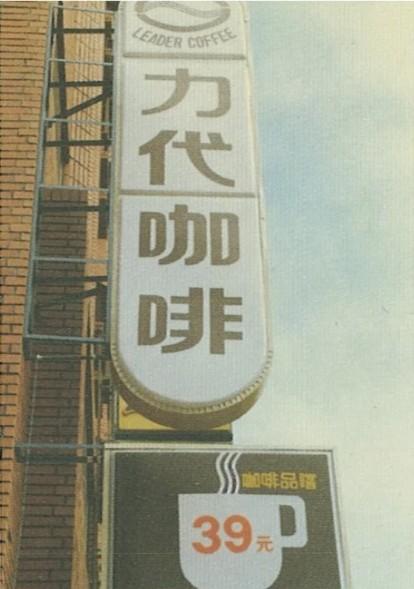
A key characteristic of coffee shops founded during this period, such as Leader Coffee (Raidai Kōhī / 力代咖啡), was their ability to leverage this infrastructure to rapidly expand their footprint as commercial chains.
Leader Coffee (力代咖啡)
The predecessor to Leader Coffee was Baifu Western Restaurant (Hyakufuku Saikan), which opened in 1968 at No. 72 Chengdu Road in Taipei's Ximen-ding district, directly across from the Grand Theater (Daiseikai Gigun). At the time, Ximen-ding was a bustling entertainment hub packed with movie theaters, heavily driven by the booming popularity of Wuxia (martial arts) films. The restaurant thrived as moviegoers consistently stopped by for meals or refreshments.
The founder, Lu Zheng-xiong, initially started out serving coffee inside his Western-style restaurant located right in the heart of this theater district. However, he quickly ran into major supply issues common to the era:
Unstable supply lines for imported coffee beans.
Inconsistent quality of arriving beans.
Unpredictable roasting standards.
An inability to consistently secure the volume required for expansion.
Plagued by these issues, the founder realized that relying on third-party distributors was unsustainable. He decided to take matters into his own hands, formulating a plan to directly import green coffee beans and manage the roasting process completely in-house.
The breakthrough came via a powerful partnership with Japan. Lu Zheng-xiong traveled across the sea to pitch his vision to Ishiromitsu Co., Ltd. (Ishamitsu Shōsha), one of the largest specialized green coffee bean trading houses in Japan's Kansai region. Teruo Ishimitsu, the head of the company at the time, was deeply impressed by the Taiwanese founder's passion and recognized the vast potential of the untapped Taiwanese market.
Securing this massive backing (Dingli Zhichi / 鼎力支持) from Ishimitsu allowed Leader Coffee to establish a direct, stable import pipeline for high-quality green beans from around the world—a feat that was virtually unprecedented in Taiwan at the time. This formidable procurement capability became their ultimate weapon, laying the groundwork for their subsequent low-cost, rapid chain expansion.
Having secured a robust supply chain, Lu Zheng-xiong officially incorporated the business as Lidai Food Co., Ltd. in 1975. The first standalone, dedicated coffee shop opened at No. 117, Section 3, Ren'ai Road in Taipei under the name Leader Coffee (力代咖啡). From there, the company aggressively rolled out a network of directly-operated and franchised locations.
Years before Japan’s Doutor Coffee Shop popularized its iconic, budget-friendly 150-yen coffee model in 1980, Leader Coffee successfully executed a near-identical business model in Taiwan: a modern, highly affordable cafe designed for everyday use by regular office workers. By offering coffee at the disruptive price point of 39 to 49 TWD, they completely broke the traditional pricing structure of the market.
How Trade Thrived Despite Severed Diplomatic Ties with Japan
In 1972, official diplomatic relations between Taiwan and Japan were formally severed. This begs the question: How was Leader Coffee able to seamlessly conduct business with a Japanese trading house like Ishiromitsu Co., Ltd.?
The answer lies in a mutual, pragmatic consensus reached between Tokyo and Taipei at the time of the split: "While official diplomatic ties must be cut, economic, trade, and private-sector exchanges must be maintained at all costs."
To facilitate this, both sides established dedicated "private organizations" that operated as de facto government agencies to handle practical, everyday affairs. Japan established the Interchange Association, Japan (now the Japan-Taiwan Exchange Association), while Taiwan set up the Association of East Asian Relations (now the Taiwan-Japan Relations Association).
Because these functional "embassies and consulates disguised as private entities" were set up almost immediately, critical business operations—such as issuing trade visas, processing bank letters of credit (L/C), and executing customs clearance procedures—continued to function smoothly without skipping a beat.
While concluding formal bilateral Free Trade Agreements (FTAs) or tax treaties was politically impossible at the state level, these practical window organizations routinely signed "memos of economic cooperation" with one another. This effectively granted the two sides the exact same benefits as formal bilateral treaties, successfully preventing double taxation and securing preferential tariff treatments.
コメント