
The End of the Japanese Colonial Era
In 1937, Japan's coffee imports reached their peak. However, following the Marco Polo Bridge Incident, the Second Sino-Japanese War escalated into a full-scale conflict. As this further developed into the Pacific War in 1941, controls on foreign exchange, shipping, and imports tightened, and luxury goods like coffee were deprioritized. Furthermore, when the Pacific War broke out between Japan and the United States in 1941, Brazil quickly aligned with the US Allies and severed diplomatic ties with Japan in 1942. This caused imports from Brazil to plummet.
Meanwhile, in Taiwan, the land area dedicated to coffee cultivation continued to expand until around 1942, reaching 1,000 hectares. During this period, Taiwanese coffee was highly anticipated not merely as a luxury agricultural product, but as an alternative supply source to secure coffee within the empire without expending foreign currency. As imports from places like Brazil and Indonesia became increasingly difficult after 1937, the Japanese side had a strong incentive to boost Taiwanese coffee production. However, a caveat remains: despite the increase in cultivation acreage, it did not translate to a stable, mass supply to the Japanese mainland. As the Pacific War intensified, coffee plantations became unsustainable due to shortages of shipping vessels, fertilizers, and labor, alongside the prioritization of food production. Left unmaintained, the plantations were once again ravaged by pests and diseases—such as coffee leaf rust, which had plagued Taiwanese coffee since the 1930s—causing yields to skyrocket downward. Ultimately, World War II left many coffee plantations devastated, and the Pacific War came to an end with Japan's defeat in 1945.
Following the war, the Japanese government withdrew from Taiwan, and the island came under the control of the Republic of China (ROC).
When World War II ended with Japan's defeat in 1945, the Nationalist Government of the ROC, led by Chairman Chiang Kai-shek, took over Taiwan from Japanese rule in accordance with the Cairo Declaration (an event known as the Retrocession of Taiwan). In September of the same year, the Taiwan Provincial Administrative Executive Office was established, and Chief Administrator Chen Yi accepted Japan's surrender. Initially, many Taiwanese residents welcomed the return to their homeland. However, the Benshengren (Han Chinese who had resided in Taiwan since before the war) were excluded from the provincial government, corruption ran rampant regarding the seizure of Japanese assets, and the officials and soldiers from the mainland were incompetent and undisciplined, leading to widespread social chaos. Coupled with soaring inflation, resentment among the Benshengren intensified rapidly. This conflict between the Benshengren (the local Taiwanese) and the Waishengren (mainlanders who arrived after the war) created a deep rift that would define Taiwanese society for decades to come.
The February 28 Incident (The 228 Incident)
The February 28 Incident began as a minor clash over the crackdown on illicit cigarettes and escalated into island-wide anti-government riots, followed by a massive massacre perpetrated by the Nationalist Government's military. In postwar Taiwan, tobacco and alcohol were state monopolies, and selling untaxed "contraband cigarettes" without a permit had become a means of survival for the impoverished. On February 27, 1947, at 7:30 PM, when Monopoly Bureau enforcement officers arrived near the Tianma Tea House in Taipei City, the black-market vendors had already fled. The only person caught was Lin Jiang-mai, a 40-year-old widow who possessed a small stock of cigarettes. The officers confiscated all of her cigarettes and cash, regardless of whether they were state-manufactured or private. Lin Jiang-mai practically fell to her knees, begging, "If you take everything, I won't be able to feed my family. Please, at least return my money and the state-made cigarettes." Ignoring her pleas, one of the officers, Ye De-gen, struck her on the head with the barrel of his pistol, causing her to bleed. The surrounding crowd grew furious at the sight, and in the ensuing chaos, a bystander was shot and killed by an officer, triggering the Taipei Roundpart Contraband Cigarette Incident. The day following this event gave the incident its historical name.
The next day, February 28, the situation took a decisive turn for the worse. When citizens marched to protest, the government opened fire on them with machine guns, causing numerous casualties. Enraged by this, citizens rioted in the streets, beating Waishengren. Once a group of citizens seized a radio station to call for an island-wide uprising, the political riots spread across all of Taiwan. At this juncture, the Taiwanese side sought a political resolution rather than a violent one. To resolve the crisis, the 228 Incident Settlement Committee—composed of intellectuals and local elites—was organized across various regions of Taiwan. On March 7, the committee in Taipei demanded reforms from Chen Yi, including the eradication of corrupt officials, the implementation of provincial autonomy, and the appointment of Benshengren to government agencies.
However, this dialogue was essentially a trap. When military reinforcements arrived from mainland China on March 8, Chen Yi abruptly reversed his stance. He declared the 228 Incident Settlement Committee an illegal organization, ordered its dissolution, and crushed the movement through indiscriminate massacres by the reinforcing troops. While the scale of the casualties was catastrophic, the exact number remains unknown to this day, with estimates ranging from 28,000 to 40,000 deaths. It was only after the lifting of martial law in 1987 that investigations and compensation regarding the incident were finally implemented. Yet, the official number of victims remains unconfirmed, and movements seeking accountability for the injustices committed under the past Kuomintang (KMT) regime have still not reached a final resolution.
The Chinese Civil War
At the time, the civil war between the ROC Nationalist Government and the Communist revolutionary army, which had been ongoing since before World War II, resumed in China. The revolutionary army, gaining the support of local peasants, began capturing major cities. Driven out of the mainland, the ROC Nationalist Government retreated to Taiwan. Realizing their impending defeat on the mainland during the latter half of the civil war, President Chiang Kai-shek began transforming Taiwan into a rear base, relocating gold, silver, foreign currency, cultural treasures, as well as engineers, bureaucrats, and military personnel to the island. In May 1949, the Nationalist Government declared martial law in Taiwan. By October 1949, with the capture of Beijing, Nanjing, and Shanghai, the Communist victory on the mainland became absolute, and Mao Zedong proclaimed the founding of the People's Republic of China (PRC).Then, in the same month, the People's Republic of China attempted to seize control of Taiwan in order to liberate the people from the oppression of the Kuomintang, but was defeated by the Kuomintang army in the Battle of Guningtou (Battle of Kinmen Island), failing to seize Taiwan, and from then on the Republic of China has effectively controlled Taiwan.
Consequently, Taiwan's coffee industry embarked on a trajectory entirely distinct from that of mainland China. Following the end of Japanese rule in 1945 and the ROC government’s takeover, the plantations, enterprises, and distribution networks established during the colonial era underwent major restructuring. Between 1945 and the early 1950s, Taiwan experienced a convergence of postwar chaos, the 228 Incident, the relocation of the Nationalist Government after the civil war, and land reforms. As a result, coffee policies were sidelined. The land area dedicated to coffee cultivation reportedly plummeted from roughly 1,000 hectares in 1942 to a mere 7 hectares by 1951.
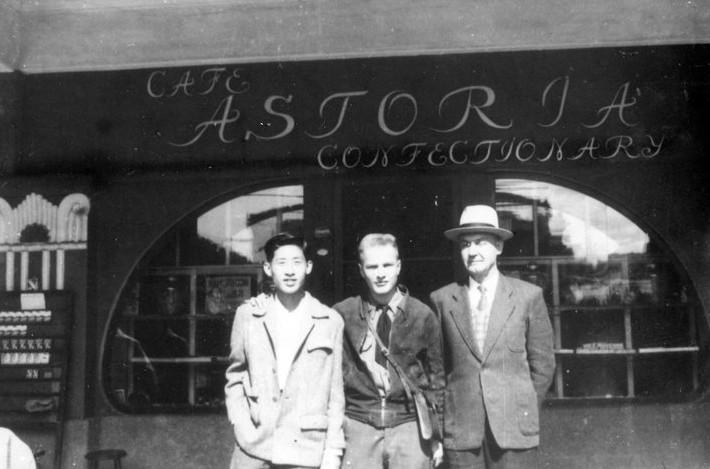
The cafes that opened in Taipei between the early postwar years and around 1948 were mostly established by those who had arrived in Taiwan alongside the Nationalist Government. However, due to the postwar recession and the fact that coffee was treated as a luxury item subject to high taxes, many cafes were forced to close or change businesses. Rare exceptions that managed to survive include the state-affiliated China Friendship Club and the Cafe Meridian, which originated in Shanghai. The most iconic establishment of this era, however, was Cafe Astoria (later known as the Astoria Coffee House).
Café Astoria (Later Known as Astoria Coffee House)
The founder, George Elsner, was originally a military officer of the Russian Imperial Army. Following the political upheaval in Russia, he fled to China and sought out a compatriot who was running "Cafe Astoria" in Shanghai. The name "Astoria" originates from this Shanghai era. As a consequence of the Chinese Civil War, the establishment eventually moved to Taiwan. Originally founded in Shanghai in 1922, Cafe Astoria relocated to Taiwan in 1949, and its building is now registered as a historical structure in Taipei City. After arriving in Taiwan with the Nationalist Government in 1949, Elsner teamed up with fellow Russians and local Taiwanese, including Chien Chin-tsui (a graduate of Chien Kuo High School), to establish the "Astoria Russian-Style Bakery" in the Wuchang Street area to sell Russian pastries. They turned the second floor into "Café Astoria," which focused on Russian-style light meals and coffee.
In the 1950s, Café Astoria was far from an ordinary spot where everyday citizens went for a casual cup of coffee; it was a highly exclusive venue. In its early days, its Russian light meals, coffee, and pastries attracted many foreign diplomats, high-ranking officials, and prominent figures. The official website describes the Astoria of the 1950s as a "mysterious and magnificent symbol." Faina Chiang (Chiang Fang-liang), the Russian-born wife of Chiang Kai-shek's eldest son, Chiang Ching-kuo, visited the shop numerous times. Her favorite treat, Russian Marshmallow (Russian Taffy), was said to be a confection enjoyed by the Russian imperial court and became the shop’s signature product.
Located at No. 7, Section 1, Wuchang Street, the building was constructed between 1948 and 1949. Its architectural structure was typical of the late Japanese colonial period and early postwar era; the division and proportions of the facade inherited the traditional Japanese townhouse (machiya) format, decorated with a simple, modern Art Deco style using a washed-finish (araidashi) technique. It was designed by Lin Qing-feng, a prominent architect who studied in Japan and whose representative works include the Taiwan Cement Building.
Suppression of Free Speech Under Martial Law
Under martial law, all freedoms of civil life were legally restricted. Decrees were enforced that curtailed citizens' liberties and fundamental human rights, including the rights to assembly, association, speech, publication, and travel. The government utilized martial law and related regulations to arrest, court-martial, imprison, and execute suspected communists and dissidents (mostly activists outside the ruling KMT party, known as the Dangwai). Crucially, the military held jurisdiction over the judiciary. The Martial Law Act stipulated that during its enforcement, the supreme commander of the martial law zone would oversee administrative and judicial affairs. The Taiwan Garrison Command, which was responsible for execution, rigorously carried out these measures under the direct instructions of Chiang Kai-shek. This domestic "Red Scare" was effectively justified and accelerated by external military tensions, namely the Taiwan Strait Crises (1954–1955) and the Korean War (1950–1953).
The severity of the suppression is illustrated by individual incidents. In 1952, acting on intelligence that communist guerrillas were hiding in Luku Village (Shiding Township, Taipei County), authorities arrested the villagers en masse, and 36 people were executed (the Luku Incident). A single tip-off was enough to target an entire village for crackdowns.
Escalating Tensions in the Taiwan Strait: From Café Astoria to Mingxing Coffee House
Café Astoria’s original owners from its days at No. 7 Avenue Joffre in Shanghai came to Taiwan alongside the KMT. They partnered with the 18-year-old Chien Chin-tsui to carry on the legacy of Café Astoria at No. 7, Section 1, Wuchang Street in Taipei. When it opened on October 30, 1949, local Taiwanese initially kept their distance from the Russians due to the prevailing anti-communist and anti-Russian political climate. To avoid causing worry to his family, Chien did not initially invest as a shareholder, contributing only to the interior decoration costs. As the situation in the Taiwan Strait grew tense in the 1950s, partners like Burin and Ribilov emigrated abroad one after another, leaving Elsner as the sole Russian remaining in Taiwan.
The decision made to protect the remaining Russian led to a change in ownership. Concerned that Elsner might lose his livelihood and be unable to stay in Taiwan, Chien Chin-tsui bought out Astoria entirely with his own capital and retained Elsner as an advisor. Under its new ownership, Astoria reopened and put up a Chinese signboard reading "明星" (Mingxing/Astoria).
Mingxing Coffee Shop became particularly famous around the time of this change in ownership, from the late 1950s to the 1960s. In front of the shop, the poet Chou Meng-tieh ran a bookstall, which became a gathering place for writers and poets. Literary figures such as Huang Chun-ming, Ji Ji, and Bai Xianyong frequented Astoria, transforming the cafe into a living archive of Taipei’s literary history. In this respect, rather than being just an ordinary coffee shop, Astoria evolved into something akin to a literary cafe, an intellectual salon, and a hub for people associated with publishing houses and magazines.
Comments