
Taiwan's coffee story after 1990 is essentially a revival narrative.
The island had a substantial coffee industry under Japanese colonial rule — by 1945 production had reached 967 hectares, the historical peak — but after World War II coffee farming declined as tea and other crops took priority.
Through the 1970s and 80s, coffee was a marginal crop, and the modern industry only really took shape from the 1990s onward.
A few forces drove the comeback.
The most distinctive feature of the post-1990 industry is its close relationship with tea.
Taiwanese farmers, many of whom traditionally grew tea, began experimenting with coffee cultivation, applying their deep knowledge of terroir and processing techniques.
After natural disaster, taiwan coffee production industory was grown up
Rising domestic coffee consumption and café culture created local demand for premium beans.
Government policy also played a role:after natural disaster (particularly the devastation of the 1999 Jiji earthquake and subsequent typhoons), the government encouraged farmers to switch to cash crops with better soil and water conservation effects, creating an opportunity for the revival of domestic coffee plantations. Gukeng Township in Yunlin— the historic heart of Japanese-era coffee — began actively promoting itself as "Taiwan's coffee hometown" in the early 2000s, with an annual coffee festival that helped put domestic beans back on the map.
This is especially visible in Alishan, Chiayi County, which emerged as the country's premier growing region.
Alishan sits at roughly 1,000–1,400 meters, an elevation well suited to Arabica, and much of its skilled labor force came from tea picking — work that arguably demands even more precision than harvesting coffee cherries.
Many farms literally converted from oolong to coffee, carrying over expertise in shade-growing, soil management, and controlled fermentation.
The industry deliberately chose quality over quantity.
Taiwan's annual production is only around 1,000 tonnes — a tiny fraction of global output — but it commands high unit prices and pursues a specialty-market strategy.
Alongside Alishan, the main regions today include Gukeng in Yunlin, Dongshan in Tainan (known for washed processing), Guoxing in Nantou (honey processing), and Pingtung at lower altitudes.
Now, it is necessary that you point the existence of Zhang Lai-en for telling story about the revival coffee history of Taiwan.
Evangelist of Taiwan coffee production: Zhang Lai-en
Zhang grew up on Hebao Mountain, traditionally known locally as “Coffee Mountain.”
His grandfather and father had both worked in the area’s coffee gardens, which had expanded under Japanese colonial agricultural enterprises and were later operated by public authorities after 1945.
As a child, Zhang reportedly helped his family weed, prune, pick and dry coffee.
By the 1960s and 1970s, however, commercial coffee cultivation in Gukeng was declining because:
- imported coffee was cheaper;
- local harvesting required expensive manual labour;
- Taiwan had a very small domestic coffee market;
- farmers could earn more from bamboo shoots, citrus, tea or betel nut.
While most neighbouring farmers converted their land, Zhang continued operating approximately two hectares of coffee trees inherited from his family.
Accounts of Gukeng’s history often describe his garden as one of the very few commercially active coffee farms remaining in the area during the 1980s.
Zhang realised that Taiwan no longer possessed a functioning commercial chain for producing local coffee.
He therefore began working from the beginning:
raising seedlings → cultivating trees → harvesting cherries → processing beans → roasting → brewing and selling coffee.
This was unusual at the time.
Farmers normally produced an agricultural commodity and sold it to another company; Zhang gradually developed what would now be called a farm-to-cup or vertically integrated model.
Initially, he sold some of his beans to beverage processors.
Contemporary accounts mention their use in products such as AGV’s Longines Coffee—浪琴咖啡.
But Zhang wanted Taiwanese beans to be sold as coffee in their own right rather than disappearing anonymously into processed beverages.
Opening of Barden Coffee : all through from production to sell coffee
Zhang approached coffee shops and tried to persuade them to buy his Taiwanese beans.
Most shops were accustomed to imports and showed little interest.
One frequently repeated story says that a prospective buyer looked at his beans and asked whether they were cassia seeds—決明子(chinese herbal medicine), illustrating how unfamiliar locally grown coffee had become.
He consequently decided to roast, brew and sell the coffee himself.
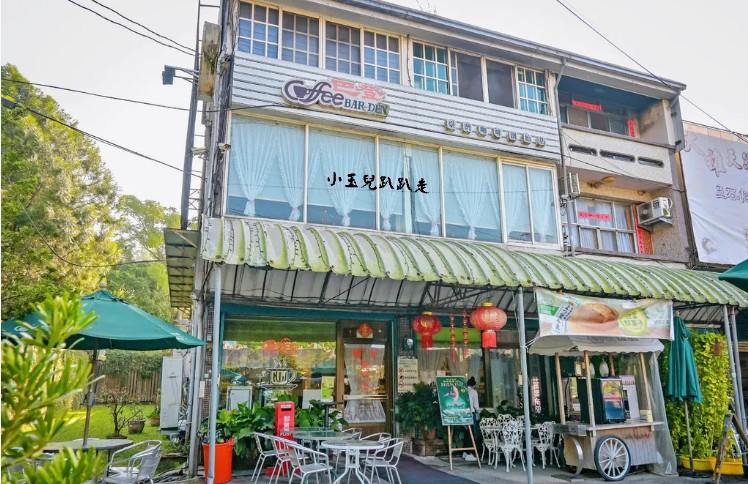
He opened Barden Coffee beside the Earth Mother Temple at the foot of Hebao Mountain.
The name Barden—巴登 was explained by the business as a play on:
巴: Brazil, then popularly regarded as the representative coffee country;
登: to ascend or reach the summit.
The intended message was roughly “surpass Brazil and attain the highest level.”
Risk of local cafe in 1980s
Opening a coffee shop in rural Gukeng during the 1980s was risky. Taiwan was still overwhelmingly associated with tea, the café was far from a major city, and most consumers did not know that coffee was grown locally.
Zhang later recalled periods when he drank more coffee himself than he sold.
He and his wife, Chen Lihua, studied coffee by visiting cafés in Taipei and Taichung, remembering how drinks tasted and experimenting when they returned home.
Early roasting involved simple equipment rather than modern specialty-coffee machinery.
Barden eventually became known for preparing coffee with the siphon method, direct sales of Taiwanese beans and products such as coffee jelly and coffee desserts.
More importantly, it showed that domestically grown coffee could be marketed as a premium regional product instead of competing directly with inexpensive imports.
Revibal of coffee history in 1990s
When Hsieh Shu-ya became mayor of Gukeng Township, she began investigating the district’s largely forgotten coffee history.
Zhang was then the area’s most visible producer who both grew coffee and served it commercially.
His knowledge and surviving farm gave local officials tangible evidence that Gukeng’s coffee tradition was not merely a historical story.
In April 1999, the township organised a Hebao Mountain cultural event that introduced local coffee history to the public.
This occurred before the September 1999 earthquake, although the earthquake and subsequent floods and landslides later gave coffee promotion an additional role in reconstruction and tourism development.
A May 1999 event at Barden Coffee, described as a discussion of “the past and present lives of Taiwanese coffee,” helped residents recall the period when Hebao Mountain had been covered in coffee trees.
Zhang later appeared with another local coffee veteran, Huang Gengzi, in a short historical film prepared for the 2003 Taiwan Coffee Festival.
After the festival, coffee planting and café tourism expanded dramatically.
One contemporary report estimated that Gukeng’s planted area rose from less than one hectare in the late 1990s to approximately 122 hectares in 2004.
Zhang did not personally create all this development, but his farm, café and historical testimony supplied the revival with continuity and authenticity.
Focusing on quality and sustainability
In later years he has focused on quality and sustainability.
He runs several estates in Gukeng — coffee groves, orange orchards, and ecological farms — grown organically and pesticide-free, composting coffee grounds and fruit pulp for fertilizer, and supplying produce for the meals served in his cafés.
He converted land previously farmed with agrochemicals to natural and organic methods, building an organic coffee estate on Hebao Mountain.
On a personal consumer level, Lee was a known supporter of Taiwan's domestic cafe culture.
After his presidency, he famously made visits over four consecutive years to "Three Idiots" (三個傻瓜), a well-known coastal coffee shop in southern Taiwan.
Taiwan coffee production model is like Panama.
In this web site, I told about Panamanian specialty coffee past
Panama demonstrated that a relatively small coffee-producing country did not need to compete with Brazil, Colombia or Vietnam in volume. Instead, it could create extraordinary value through:
- an exceptional variety—especially Geisha;
- high-altitude microclimates;
- precise harvesting and processing;
- clearly identified estates and microlots;
- international competitions and auctions.
Hacienda La Esmeralda’s Geisha won Best of Panama in 2004 and established a record auction price at the time.
That success transformed Geisha into an international symbol of luxury specialty coffee.
This model was particularly attractive to Taiwan.
Change from Growing coffee to justifing its high costs 2010s
By 2011, Taiwan reportedly had approximately 763 hectares of coffee, producing around 824 metric tons. Nantou, Taitung, Pingtung and Chiayi each had more than 100 hectares at that time.
The central question was no longer whether Taiwan could grow coffee, but whether it could produce coffee good enough to justify its high costs.
Consequently, farmers and agricultural agencies placed greater emphasis on:
- selective hand-picking of ripe cherries;
- washed, natural and honey processing;
- controlled fermentation;
- drying and moisture management;
- variety identification;
- cupping and defect evaluation;
- estate traceability.
In 2012, the Agriculture and Food Agency organized the first national evaluation of domestically produced specialty coffee beans.
The aim was to establish quality grading and encourage farmers to improve varieties, cultivation and post-harvest processing.
Many new producers adopted a vertically integrated “seed to cup” model.
A single family or cooperative might grow the trees, harvest cherries, process and dry the beans, roast them, operate a café and sell packages directly to consumers.
This structure allowed growers to capture far more value than conventional commodity farming.
Recent recognition of specialty coffee
Recognition has accelerated in recent years.
At the 2020 national specialty coffee evaluation held by the Agriculture and Food Agency, estates from the Alishan area swept the Special Prize and multiple First Prizes, and in 2024 Taiwan hosted its inaugural Cup of Excellence, becoming the 17th country worldwide and third in Asia to qualify, with the top 20 coffees all scoring above 87 points.
The high prices — a 227-gram bag of Alishan beans can sell for NT$800–1,500, two to three times the price of imported specialty beans — remain somewhat contested, with debate over how much reflects genuine quality versus a "Made in Taiwan" premium.
Coffee tourism, with farm stays and tastings in places like Alishan and Gukeng, has also become an important income stream for these small, family-run operations.
コメント