
In 1990s Taiwan, coffee culture came into full bloom. While low-priced chain coffee shops such as Doutor (羅多倫), Dante (丹堤), and Ikari (怡客) proliferated, there was also the spread of independent cafés with literary, musical, and countercultural leanings—concentrated in Taipei's student districts—along with the growing popularity of Italian-style coffee such as espresso, cappuccino, and caffè latte.
Moreover, thanks to the liberalization of the press, publishing, and expression that followed the lifting of martial law, 1990s Taiwan also saw cases in which cafés became linked to social movements and avant-garde art.
The most emblematic of these cafés was Tianmimi Café (甜蜜蜜咖啡館).
Taiwan's Democratization Movement After the Lifting of Martial Law (The Wild Lily Student Movement)
For decades, freedom of speech, assembly, and association in Taiwan was severely restricted under martial law (in effect from 1949). Martial law was lifted (解嚴) in 1987, and this was quickly followed by the liberalization of the press (the lifting of the newspaper ban, 報禁解除, in 1988), the legalization of forming political parties, and other rapid changes.
The years surrounding the lifting of martial law were a period in which long-suppressed social movements erupted all at once: labor movements, environmental movements, Indigenous movements, women's movements, and many others became highly active.
When Chiang Ching-kuo died in 1988, Vice President Lee Teng-hui was elevated to the presidency. Lee was the first president of benshengren (本省人, native Taiwanese) origin, and he was eager to advance democratization. However, conservative old-guard factions remained strong within the Kuomintang at the time, and his power base was not yet secure.
Amid all this, one major problem still remained: the "Eternal Parliament" (萬年國會). Most of the representatives of Taiwan's National Assembly and the members of the Legislative Yuan were legislators who had been elected on the Chinese mainland in the 1940s. Even after fleeing the mainland and coming to Taiwan, they clung to their seats for decades without ever standing for re-election. On the pretext that elections held in Taiwan could not re-select representatives of the mainland, they continued to hold power for life even as they grew old. This was a major obstacle to democratization and a focal point of intense public discontent.
In March 1990, when the National Assembly convened over matters including the selection of the president (then chosen by indirect election), these aged representatives of the "Eternal Parliament" made moves to further expand their own powers and terms of office. In other words, privileged legislators who never faced re-election were, of all things, attempting to extend their power even further. This ignited public outrage.
In protest, on March 16, 1990, a handful of students began a sit-in on the plaza of the Chiang Kai-shek Memorial Hall in Taipei—this was the beginning of the movement. The protest spread rapidly, and at its peak thousands of students gathered on the plaza and continued the sit-in. They adopted the white "wild lily" (the Formosa lily, a wild lily native to Taiwan) as the symbol of their movement, which gave the "Wild Lily Student Movement" (野百合學運) its name. The lily blooming in the wild was regarded as a symbol of purity and of a spirit rooted in the land of Taiwan.
The students' principal demands were: the complete re-election of the parliament (the dissolution of the "Eternal Parliament"); the abolition of the Temporary Provisions Effective During the Period of National Mobilization for Suppression of the Communist Rebellion (動員戡亂時期臨時條款, the special law that underpinned the martial-law-like state of emergency); the convening of a National Affairs Conference (國是會議, a conference to deliberate the direction of national policy); and the announcement of a clear timetable for democratization.
President Lee Teng-hui showed a broadly receptive attitude toward the students' demands and met with student representatives for dialogue. Subsequently, the National Affairs Conference was in fact convened; in 1991, the aged representatives of the "Eternal Parliament" retired, the Temporary Provisions were abolished, and the complete re-election of the parliament was realized. The Wild Lily Student Movement became a major turning point on Taiwan's path toward full-fledged democratization (including the first direct presidential election in 1996).
Tianmimi Café: A Hub of Underground Culture, Social Movements, and Experimental Art Born Alongside Taiwan's Democratization
Tianmimi Café was born in Taipei in 1993 against this backdrop—a space that combined a coffee shop with a hub for underground culture, social movements, and experimental art. It served as an important "base" where students, artists, theater troupes, and underground musicians gathered to present their works and ideas.
The name "Tianmimi" (甜蜜蜜, "sweet as honey") had been used in young people's publishing activities even before the café existed. In 1991, a National Taiwan University student wrote an essay titled "A Tianmimi Afternoon" (甜蜜蜜的午後), and in 1992 students at Fu Jen Catholic University put out a newspaper called Tianmimi. These publications carried satire on politics and society, pranks and mischief, anarchistic expression, and writings and images mocking established authority. The young people in this circle became the café's first regulars and collaborators in running it. In other words, the very people involved in this underground publishing, parody, and anarchist discourse became the café's members.
Those who gathered as customers were not only veterans of the student movement. They included:
- Actors and directors from the little theater (小劇場) scene
- Contemporary artists
- Underground bands and experimental musicians
- Filmmakers
- Journalists covering culture and the arts
- Young creators who found it difficult to enter established cultural institutions
These people mingled together, serving simultaneously as customers, performers, organizers, and helping hands around the shop.
The interior of Tianmimi was no refined Western-style café. Wu Zhong-wei used salvaged scrap materials, old furniture, and everyday objects as interior decoration, gradually adding objects and rearranging them over time. As a result, the shop as a whole is said to have looked not like a fixed interior but like a giant, constantly changing installation artwork. This style attracted attention as "polan yishu" (破爛藝術)—that is, "junk art" or "the art of scrap and refuse"—and Wu Zhong-wei came to be introduced in the media as an "amateur artist" and "the representative figure of junk art."
But this was not merely a poor-man's aesthetic. Embedded in it were:
- A revolt against expensive, refined art
- A revolt against the notion that only museums and theaters count as legitimate cultural spaces
- A commitment to building one's own place out of discarded materials
- An attitude that prized taking action first over technical polish
The founder, Wu Zhong-wei (吳中煒), did not start Tianmimi as a profit-making venture in the ordinary sense; what he valued was creating a base where people could gather on an ongoing basis. There is testimony that conveys his character. Chen Shu-qiang (陳淑強, Wu Zhong-wei's junior high school classmate), who was involved in setting up the Tianmimi shop, has said that everyone gathered mainly for Wu Zhong-wei's sake, and that they were greatly encouraged by the idea he championed: "We can do anything—there's nothing we can't do." The 1994 "Taipei Broken Life Festival," too, was reportedly built entirely by themselves—with no sponsors and no money whatsoever, under the most minimal conditions, scavenging materials on their own with the unpaid help of friends.
Wu Zhong-wei's co-founder was Su Jing-jing (蘇菁菁). In her own words: "What was I feeling when we opened this place? It wasn't to make money—it was just to have fun, to find like-minded friends. Tianmimi was something like a base; it was about creating a shared place where everyone could interact, clash with one another, and perform." And: "My job was the kitchen (laughs). For food, once I decided we'd make these two or three dishes that day, that was it. Simple things like fried rice, curry rice, or rice with sauce over it, plus a side dish or two. You want something else? We don't have it—this is all there is. Whether you eat or not is up to you (laughs)."
This unvarnished testimony captures the essence of what Tianmimi was. She has also said, regarding the shop's "underground" character, that they were not deliberately trying to break some mold; rather, the people who came naturally had that quality, and the result was that they were drawn to one another.
Seen this way, what a fascinating pair this couple makes. On one side was Wu Zhong-wei, the agitator who fired people up with "we can do anything" and conjured festivals out of piles of junk; on the other was Su Jing-jing, the realist who, in that chaotic base, made fried rice every day and kept the shop running. The legendary space of 1990s Taiwanese counterculture was sustained not only by grand ideals, but also by the everyday reality of "all we've got today is curry."
In November 1993, when the Tianmimi café that Wu Zhong-wei ran fell into financial trouble, he was entirely unconcerned. Instead, one customer who had seen an interesting performance there called together his friends from the little theater scene, and in a lighthearted spirit they set out to stage performances to earn enough for Wu Zhong-wei to pay the rent. This circle of comrades kept expanding, and in January 1994 an unprecedented relay of performances was realized—16 productions and 25 performances over the course of half a month. Ironically, however, Tianmimi could not escape closure before the activities even began.
It was what happened after losing the shop that etched his name into history. A few months later, Wu Zhong-wei launched something even more astonishing—the "Taipei Broken Life Festival"—moving the space of activity from Tianmimi's interior of a mere dozen or so ping out into the vast open air.
The First Taipei Broken Life Festival (September 1994)
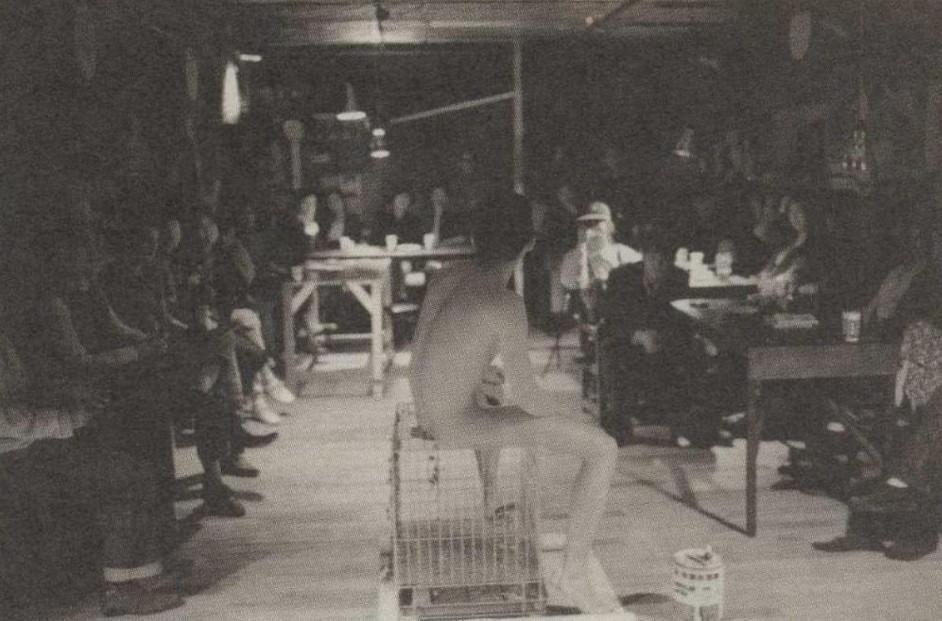
The festival was held from September 2 to 5, 1994, under the Yongfu Bridge in Taipei (on the banks of the Xindian River in the Gongguan area). Its contents were a grab bag of every kind of marginal expression: noise, rock, little theater, S&M performance, installations, experimental short films, and more.
The lineup of performers has been preserved in the records. From the little theater scene came Li Zhi-hong's "Mothra" (摩斯拉), Zhong Qiao's "People's Theater" (民眾劇場), and Dan Tang-mo and Chi Ta-wei's "Pink Labyrinth" (粉紅迷宮), among others. The musical acts included the student-movement-affiliated rock/noise bands "431," "LTK Commune" (濁水溪公社), and "Zero and Sound" (零與聲); the rock bands "Guroopi" (骨肉皮) and "Dunhuang" (敦煌); foreign musicians residing in Taiwan; the Hong Kong solo noise units PNF and 1-666; and the Japanese noise band Monellaphobia, led by Kensuke Kobayashi, whose first visit to Taiwan drew particular attention.
Entirely characteristic of Wu Zhong-wei was what went on behind the scenes of the production: most of the stage equipment was assembled from materials Wu Zhong-wei had borrowed from here and there—and, at times, "liberated." Over the four consecutive nights, the event drew a cumulative audience of more than 1,000 people, and it was repeatedly subjected to police inspections over noise complaints and nude performances. The final day closed with a ritual in which the members of "431" offered up a single acoustic guitar.
In contrast to the large-scale, government-produced cultural events of the day, the Broken Life Festival's freedom, alternative spirit, and DIY ethos won widespread acclaim. It came to be regarded as the first great gathering of Taiwan's alternative culture, and the media even dubbed it "Taiwan's Woodstock."
The Second Wave (1995): The Air Rupture Festival and the Post-Industrial Arts Festival
The following year, 1995, the movement expanded further. It is said that any account of the 1990s noise movement cannot omit the 1994 Broken Life Festival, the 1995 Air Rupture Festival (空中破裂節), and the Post-Industrial Arts Festival (後工業藝術祭, also called the Second Broken Life Festival).
Of these, the "Air Rupture Festival" was an astonishing sustained event: Wu Zhong-wei "built a village" on wastelands and ruins along Taipei's riverbanks, constructing stages out of scavenged (and at times stolen) discarded concrete formwork, scaffolding, tent canvas, and generators. He created a platform for dismantling the modern order of life, economy, space, and aesthetics, inviting everyone to come and "reside" there (駐村), holding poetry readings, improvised music, theater, and installation-making—and, it is said, he sustained this format for an entire month. Not a one-night event, but a month-long anarchist encampment village—less a festival than an experiment in another way of living.
Trace the Genealogy of Today's Taiwanese Outdoor Festival Culture and Indie Music Scene, and You Arrive at the Taipei Broken Life Festival
The Taipei counterculture circle of the mid-1990s was composed almost entirely of intellectuals—left-leaning students, young artists, little-theater people, bands, art journalists—yet its most radical instigator was Wu Zhong-wei, an artist whose formal education ended at elementary school. After dropping out of school, he had worked as a construction laborer, a carver of Buddhist statues, a street vendor, and a scrap collector.
With his innate anti-middle-class aesthetic, he opened up an organic wasteland and welcomed every form of participation with open arms. It has been said that anyone who could dig out from deep within their body the desire to be liberated from Western modernity and from martial law could melt into this homegrown anarchist utopia.
The two Broken Life Festivals and the Air Rupture Festival became the starting point for many subsequent forms of sound-based activity, leading to the outdoor music festivals, the rave movement, and the noise movement from 1995 onward. One of the participating bands, LTK Commune, released the album The Revenge of the Taike (台客的復仇) in 1999, setting vernacular slang and the styles of Taiwanese-language song to raucous guitars and electronic sounds—a milestone that inverted the meaning of the word "taike" (台客). It has further been pointed out that, years later, the name of the "Simple Life Festival" (簡單生活節, a major Taipei music festival held since 2006) so closely resembles "Broken Life Festival" that it is likely no coincidence.
In other words, if you trace the genealogy of today's Taiwanese outdoor festival culture and indie music scene back to its source, you arrive at those four days in 1994 under a bridge—roaring noise blasting from a stage built of borrowed and pilfered materials, under repeated police inspection. A festival that began as the "sequel" to a single failed café became the wellspring of a current that vast.
コメント