
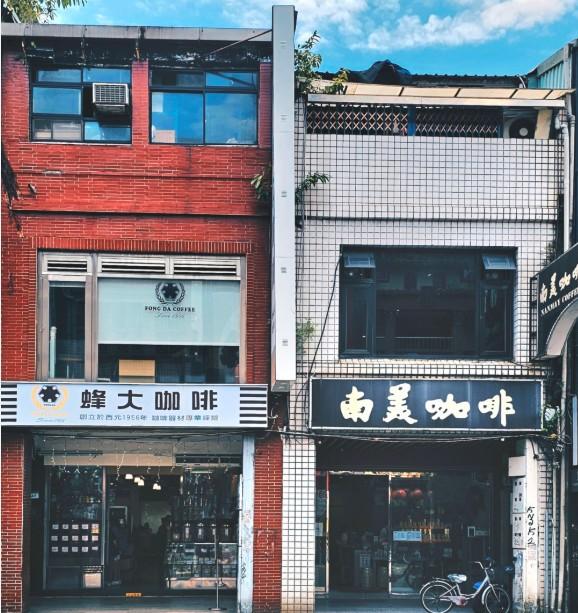
Around 1960, when Astoria Coffee in Taipei's bookstore district became famous as a gathering spot for the publishing industry and writers of the era, specialized coffee shops began opening in Taipei's Ximending area.
Prominent among these were Fonda Coffee (Fong Da Coffee) and Nanmei Coffee, both located on Chengdu Road.
Following the relocation of the Nationalist Government to Taiwan in 1949, a massive influx of capital poured into Chengdu Road, where Fonda Coffee and Nanmei Coffee were situated. Alongside movie theaters, department stores and entertainment facilities emerged one after another, and upon the completion of the Chung-Hwa Market Bazaar, the area became the nation's largest commercial and entertainment hub.
Additionally, while not a specialized coffee shop, Florida Bakery—a bakery catering to US military personnel stationed in Taiwan—was located on Zhongshan North Road.
Fonda Coffee (蜂大咖啡)
There is an interesting reason why the character for "bee" (蜂) is included in the shop's name.
The founder, Mr. Cao Zhiguang, originally raised bees on the roof of his home and established the business in 1956 under the name "Honey King" (蜂蜜大王), selling honey and agricultural products.
From there, the business expanded into various honey-infused beverages, including black tea and coffee.
It is said that although the founder engaged in beekeeping early on, he nearly lost his life due to the bees, which led him by a twist of fate to pivot to the coffee business.
Another more specific account suggests that the original name was "Honeybee King" (蜜蜂大王), and while he managed a beekeeping business in his early years, the labor was so grueling that he transitioned to coffee.
Initially, he sold coffee to promote his honey, but because the flavors of the two clashed too drastically, the "coffee on the side of honey" eventually saw coffee take center stage.
This sequence of events explains why the name "Fonda" originates from the beekeeping business.
During the 1950s and 1960s, Japan was experiencing an unprecedented "Jun-kissa" (pure coffeehouse) boom, where siphon brewing techniques and service hospitality were highly refined.
Mr. Cao Zhiguang invited professional artisans from Japan to introduce coffeehouse expertise and operational know-how to his shop.
He roasted beans himself using a German-made Probat roaster located at the back of the shop, and while selling various types of coffee beans, he also provided a modest space for dining, which gradually earned the establishment its reputation.
In an era when coffee was still a luxury imported commodity, this was a classic business model that combined a coffeehouse with the retail sale of beans and equipment.
While iced coffee and cold brew coffee are taken for granted today, the conventional wisdom in 1950s and 1960s Taiwan dictated that coffee must be consumed hot.
Fonda Coffee is recognized as one of the very first shops in Taipei to introduce "iced-drip (cold brew) coffee."
Another signature feature of the shop is the traditional Chinese pastries displayed at the storefront.
According to the owner, these baking techniques were learned from a pastry chef in Macau and are now handcrafted and passed down by his son. Signature items like the Hetangsu (walnut cookies) maintain traditions dating back to the shop's founding.
These pastries are frequently described as "Hong Kong-style" or "Cantonese-style."
The glass candy jars are lined with Hong Kong-flavored Chinese pastries such as Hetangsu (walnut cookies), Baoisand (abalone pastry), and Ji-zai-bing (chicken biscuits). The Ji-zai-bing, one of their signature items, is introduced as a savory Cantonese dim sum pastry with a unique flavor profile resembling the salted pork filling found in mooncakes.
By serving homemade Hong Kong-style dim sum alongside Western-style breakfasts, Fonda established a unique coffee culture pairing coffee with Hong Kong-style pastries during an era when pairing coffee with Western cake was the standard norm.
Nanmei Coffee (南美咖啡)
Located right next to Fonda Coffee on Chengdu Road in Taipei's Ximending is Nanmei Coffee.
The business originally began in 1956 as a grocery and confectionery shop before formally establishing Nanmei Co., Ltd. in 1962.
It is regarded as the first specialty shop dedicated exclusively to importing, roasting, and selling coffee beans, with its "Premium Nanmei Coffee" serving as the flagship product.
While Fonda Coffee functions as a full-fledged café packed with tourists, Nanmei Coffee caters to a largely local clientele; in addition to serving food and drinks, it operates as a highly specialized retailer of coffee beans and equipment.
In terms of the menu, it also retains an old-school coffeehouse style.
The shop appeals to customers with reasonably priced coffee (particularly pour-overs), and its breakfast menu includes options such as club sandwiches, toast with two sunny-side-up eggs and ham, ham and egg toast, and plain waffles.
The signature Nanmei Coffee is described as an easy-to-drink brew featuring a charcoal-roasted aroma, which initially delivers a pleasant bitterness and a subtle acidity upon the first sip.
In Taiwan during the 1950s and early 1960s, there were no coffeehouses or roasters that sourced green beans from around the world to offer "home-roasted" coffee (the mainstream consisted mostly of pre-processed coffee imported from overseas or instant coffee).
Consequently, it was an era when there were no instructors to teach roasting, and specialized coffee roasters did not even exist within the country. Therefore, Mr. Wang developed his original blends and roasting techniques through trial and error using tools such as:
Hand-roasting in iron woks (such as Chinese woks)
Adapting traditional Taiwanese "tea-drying machines" (used for drying or roasting tea leaves)
By applying techniques from tea and bread-making, he repeatedly scorched beans through countless failures and experiments to figure out how to apply heat to green coffee beans to draw out their unique aroma, rich body, and mellow bitterness.
Through this painstaking process of trial and error, he eventually established the roasting techniques and secret blending ratios for the "Premium Nanmei (Special Blend)" that would later become the shop's signature product.
After establishing this foundation through self-taught methods and getting the business on track, Mr. Wang became one of the first in Taiwan to import professional, large-scale German roasters (such as Probat), which are considered the pinnacle of the industry. This enabled the stable, high-quality mass production of roasted coffee.
Florida Bakery (福利麵包)
Florida Bakery on Zhongshan North Road is deeply intertwined with the United States' defense of Taiwan following the outbreak of the Korean War.
With the start of the Korean War in 1950, the United States resumed its support and defense of the Republic of China government in Taiwan.
In 1951, the Military Assistance Advisory Group (MAAG) established a massive military compound, the Headquarters Support Activity (HSA) Taipei, near the intersection of Zhongshan North Road and Minquan West Road in Taipei.
The decisive turning point was the Vietnam War. The Taipei US Military Hostel was established on August 26, 1963, as a lodging facility for US military personnel stationed in Taiwan. Later, during the Vietnam War period from 1965 to 1972, it served as a Rest and Recuperation (R&R) destination for hundreds of thousands of US military personnel stationed in Vietnam.
As a result, an American-style entertainment district emerged rapidly across the Zhongshan North Road area. From 1965 onward, the commercial districts and streets surrounding the Taipei US military base—such as Qingguang Market, An'an Street, Shuangcheng Street, Dehui Street, Jilin Road, and the northern section of Linsen North Road—were lined not only with imported goods shops, restaurants, and boutiques, but also bars and nightclubs that could not be found anywhere else in Taipei at the time. The area quickly took on a heavy American flavor, forming a concentrated entertainment hub where Americans gathered.
Florida Bakery was founded in 1949, and its predecessor was a famous department store in the French Concession of Shanghai. The business relocated to Taiwan following the Nationalist Government's move and was established by inviting a French chef and an experienced pastry artisan from Beijing.
Its English name, Florida Bakery, is said to originate from the US state of Florida.
In its early years, it served primarily as a supplier to the Military Assistance Advisory Group (MAAG). Due to the superior quality of its French bread and its skilled techniques in making Chinese pastries, it became a famous establishment of the era, even supplying in-flight meals for China Airlines and leading trends in the Taiwanese baking industry. Its location was right in the heart of the US military entertainment district on Section 3 of Zhongshan North Road, adjacent to the Qingguang Market and the Shuangcheng Street Night Market, and within a 10-minute walk from both MRT Minquan West Road Station and Zhongshan Elementary School Station—putting it right in the center of the US military sector.
In 1956, Florida Bakery received international certification for food hygiene, becoming the only A-grade bakery in all of Taiwan to meet US evaluation hygiene standards. This led to its adoption by the US Military Assistance Advisory Group in Taiwan, China Airlines, and the Grand Hotel's catering division (the airline catering manufacturing department operated by the Grand Hotel Taipei).
In particular, it is said that the sandwich bread frequently consumed by the US military was exclusively purchased from Florida Bakery. Furthermore, as one of the few bakeries in the 1950s capable of making multi-tiered cakes, it expanded its market share through the concept of "customization." Organizations that hosted frequent events, such as the US Military Officers' Club, became its primary customers, securing the bakery a vital position within the US military economy.
コメント