
Starbucks opened in front of Ewha Womans University in 1999 and was a huge success.
This sparked a cafe boom in Korea as well.
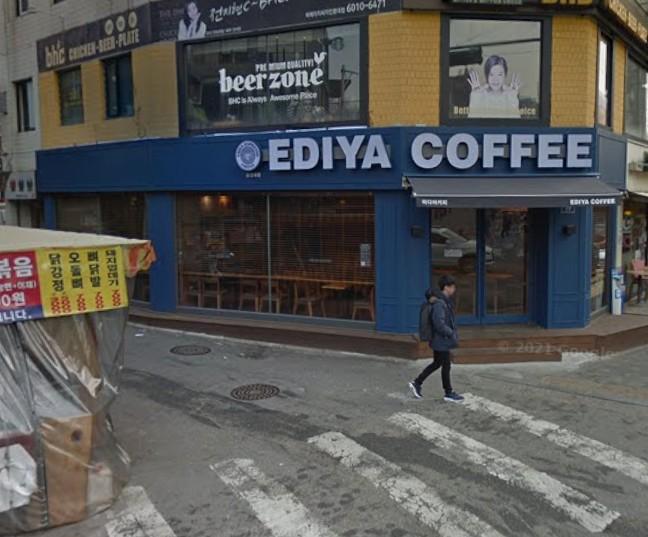
In March 2021, Korean-owned cafe Ediya Coffee opened in front of Seoul Central University.
Ediya Coffee interpreted Starbucks' stance: "The culture of drinking coffee as something cool is here to stay, but only a limited number of people can afford 3,000 won every day."
As a result, they priced their coffee at 1,500 won, halfway between instant coffee (500 won) and Starbucks (3,000 won).
At the time, sales in the Korean restaurant industry relied on delivery by motorcycle.
Ediya followed Starbucks' example by deliberately not offering delivery (at the time) and sticking to a takeout model, where customers would come to the store and pick up their coffee.
This allowed them to achieve the "ultimate cost shift" by completely eliminating complex logistics costs and using the savings to improve the quality of the beans.
They also chose a "prime 1.5 location" (a small property in a back alley or near a university) rather than a main street.
The interior of the store also did away with fancy sofas and chandeliers, instead featuring a simple counter primarily for takeout.
Thanks to these efforts, the start-up capital for the first store (at Chung-Ang University) was an astonishingly low 15 million won (about 1.5 million yen at the time), a fraction of the going rate at the time.
Like Starbucks' Jeong Yongjin, founder Ga Cheol was of the same generation as the Orange Tribe, but unlike Jeong and the Orange Tribe, he studied chemistry at a university in Korea and got a job at a textile company called Koryohapdo in 1991.
However, three months after joining the company, his brother, who ran a bowling alley, was involved in a traffic accident, and Ga Cheol took over the management of the alley.
At the time, he said he had no knowledge of bowling, no operational know-how, and no customers.
"Monthly operating costs continued to arise, but with no customers, it was extremely difficult. I had no spare money at home and was no longer in a position to provide support. I lived a hellish life day by day, and I felt completely exhausted."
CEO Ga didn't think the reason bowling alleys weren't popular was due to a problem with their location or facilities.
He concluded that when bowling wasn't widespread, few people enjoyed it, and at the same time, there was no interest.
He also concluded that ordinary people avoid bowling because of the stereotype that it's expensive, and he put himself in the customer's shoes.
"First, I thought I had to get people to love bowling. I also began to let residents know that it was a low-cost way to improve their health and foster friendships."
"I first mobilized instructors to give free bowling lessons to housewives in the neighborhood. At the same time, I frequently organized bowling tournaments and events.
As word of mouth from housewives spread among local residents, more and more people started visiting the bowling alley with their friends and family.
Office workers also started visiting after work.
Having made some seed money from running the bowling alley, Ga ventured into the food and beverage industry.
He launched the "Korean Pizza Mac" brand, with the idea of making affordable pizza accessible to everyone.
He started his business in Pyeongchon New Town in 1994.
At the time, there were well-known brands like "Pizza Hut" in Korea, but their high prices made them difficult for the average person to afford.
So he made a big bet by introducing large pizzas to Korea for the first time at the low price of 9,900 won.
To compete with Pizza Hut, Ga launched the brand "Korean Pizza Mac" as a domestic Korean brand, which received a positive response.
"The pizza tasted similar and the price was low, so many customers came. I expanded into the franchise business, and at the time we had 37 stores in Korea and 6 overseas (in China)."
Ga's strategy emphasized the domestic brand. At the same time, he attracted customers with a low-price strategy.
By 1997, he had opened 17 directly operated stores throughout Seoul and the greater Seoul area, and two in China.
However, at the end of 1997, the IMF currency crisis occurred, sales plummeted, and he was unable to repay his loans.
His company also ran into financial difficulties, and he was forced to sell and liquidate all of its stores.
After streamlining his business, he had several new business ideas, but drawing on his experience at Pizza Mac, where he launched a franchise business to compete with major foreign chain Pizza Hut,
he decided to start a coffee business to rival Starbucks.
On the opening day of the first Ediya Coffee store, Ga saw students lining up, drawn by Ediya's 1,500 won price tag,
and was convinced that his "low price, high quality" strategy perfectly matched a market need (a gap).
It was such a huge success that over the next three years, the company quickly opened over 100 stores.
コメント