
A Streetside Bookstall Sparks a Literary Haven
In 1959, a small street-side bookstall was added beneath the eaves of Astoria. At the time, the Russian owner, George Elsner, and his partners were looking for ways to let go of the business, and internal shareholder disputes were ongoing. With no attention to spare for the stall outside, it was left completely to its own devices. The following year, Chien Ching-chui became the sole owner of Astoria, yet he still had no idea that the man sitting right at his doorstep was a poet whose works frequently graced various newspapers and magazines.
The turning point came when Chou Meng-tieh collapsed right in front of the shop. Chien Ching-chui recalled, "I didn't know him at all back then. The day he collapsed in the corridor, I called an ambulance to rush him to the hospital. When Chou Meng-tieh woke up, he said, 'I'm sorry, I haven't eaten for three days.'" It was only then, upon realizing that Chou lived a life where selling a single book meant securing his next meal, that Chien discovered his identity.
Chou was both a customer of the café and a fixture of its storefront. While Chou Meng-tieh sold poetry collections at the first-floor entrance, upstairs in the restaurant, writers like Huang Chun-ming, Pai Hsien-yung, Lin Hwai-min, and Sanmao treated the café as a second home, turning out one masterpiece after another.Seeing the frail Chou Meng-tieh haul heavy secondhand books every single day, the owner couldn't bear it and offered a solution: "Mr. Chou, from now on, when you close up for the day, just leave your books at the teahouse at No. 5 Wuchang Street. Stop carrying them back and forth. I’ve already spoken with the teahouse owner." In truth, Chien Ching-chui had already bought back the properties at No. 7 and No. 5 Wuchang Street, and had asked the teahouse owner to clear out space after hours specifically for "Old Chou."
Chou Meng-tieh’s presence formed the core of this literary salon. Every Wednesday night from 7:00 to 9:30, Chou’s literary gatherings were regularly held on the second floor, creating a vibrant cultural salon where people discussed poetry and art.
The Literati Who Gathered at Astoria
"The modern poetry and modern fiction of Taiwan blossomed amid the aroma of Astoria." This famous quote belongs to Pai Hsien-yung. His connection to this establishment was closely tied to their Russian borscht (Luosong soup). In fact, the table of contents in Chien Ching-chui’s memoir explicitly features a section titled "Pai Hsien-yung and ASTORIA’s Borscht."
From a literary history standpoint, the café's most crucial role was serving as a hub for magazine editing. In the large room on the third floor, Modern Literature and Literary Quarterly were edited. Modern Literature, spearheaded by Pai Hsien-yung, became one of the monumental pillars of modern Taiwanese literature born right out of this café.
Sanmao, immensely popular as a writer of travel and wanderlust, was also a regular. Chien Ching-chui's memoir contains a striking chapter title: "Sanmao, Staying Later Than the 'Goodnight Melody'." The "Goodnight Melody" was the song played on television at the end of the broadcast day back then; the anecdote of her staying even later than that speaks volumes about her long visits. Sanmao truly used Astoria like a second home.
The sheer comfort of Astoria is best captured by an anecdote from the female writer Ji Ji. She would always order a single 16-yuan lemonade at Astoria Café and sit there all day long, completing her work Belonging to Seventeen right at her table. In the winter of 1964, she wrote in a submission to the United Daily News that she drank lemonade simply because she disliked coffee, which she viewed as a thick, muddy liquid.
This policy of "never chasing away customers who overstayed" was the exact reason why the literati gathered here. Even if someone ordered a lemonade and sat all day, the owner never drove them out; conversely, it was said the owner would look surprised if someone actually ordered the borscht.
The chapter title regarding Huang Chun-ming, a standard-bearer of nativist literature, is "Huang Chun-ming's Child-Rearing Table." This offers a glimpse into how his actual daily life unfolded in the café, as he would write his manuscripts at Astoria's tables while simultaneously looking after his children. Huang Chun-ming was also one of the contributors to Literary Quarterly.
Behind the glamorous literary socializing, however, the political tensions of the era also crept into the café. In 1966, Yu Tien-tsung, Chen Ying-zhen, Yao Yi-wei, Liu Da-ren, and Qi Deng Sheng founded the magazine Literary Quarterly on the third floor. Because of this publication, the Taiwan Garrison Command paid a visit to the café, making false accusations that the establishment was supporting leftists. Since Chen Ying-zhen and others were editing Literary Quarterly there, "men in black suits" from the martial law era stormed the café to conduct interrogations. In this way, Astoria became a place where the brilliance of Taiwanese literature intersected with the oppression of martial law.
The Owner’s Policy on Long-Staying Writers
When speaking of Chien Ching-chui, his extraordinary tolerance toward writers cannot be overlooked. This was deeply rooted in his own wartime experiences. Having lived through the chaos of war in his youth, he longed for a quiet "desk" where one could study in peace; thus, he provided writers with a free desk where they could write without anxiety.
This attitude is perfectly symbolized by his treatment of Huang Chun-ming. Huang recalled that at the time, spending dozens of yuan a day on a 6-yuan cup of coffee and a 15-yuan plate of fried rice was far more cost-effective than renting a decent room. Because Astoria never kicked out customers who stayed a long time, he finished masterpieces like Sayonara, Tsai Chien and The Young Widow right here. Later, when the second floor became crowded, Chien Ching-chui guided Huang Chun-ming to the third floor and set up a desk dedicated solely to his writing.
From the very beginning, great care was put into designing the café's atmosphere. While floors in Taiwan back then were typically made of yellow soil or rough cement, this café featured wooden flooring throughout. They would spread leftover coffee grounds along the floor paths so that a rich coffee aroma greeted guests the moment they walked up the stairs.
The legendary gourmand Tang Lu-sun praised the food here, noting it was far superior to the typical Japanese-style Western confectionery found elsewhere in Taiwan. Its quality was well-recognized within political and diplomatic circles too. Wang Yu-yuan, who passed the diplomatic exam and entered the Ministry of Foreign Affairs in 1974, recalled that back then, most of the pastries the Ministry used to entertain foreign dignitaries came from Astoria Café. Likely due in part to Chiang Ching-kuo's own affinity for the place, the ministry superiors all favored Astoria’s Western pastries.
Chongqing South Road: A Grand Bookstore Street
The gathering of the literati was heavily influenced by the café's ideal location.
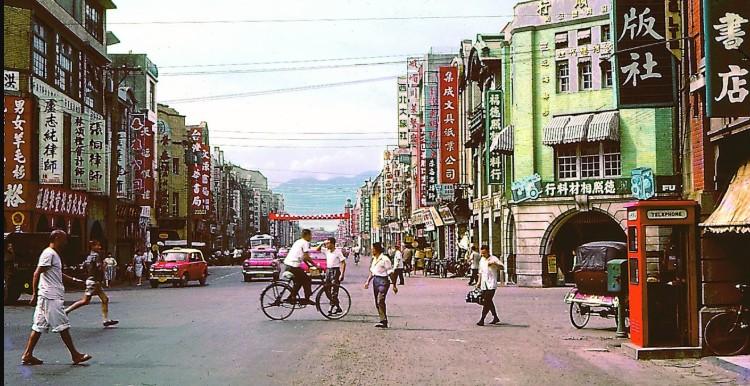
First was the sheer scale of the area. During its peak, Chongqing South Road—where Astoria Café is located—literally packed over a hundred bookstores into a span of just a few hundred meters. With the advancement of compulsory education, the number of people reading and buying books surged. Publishing houses and bookstores selling various books and stationery moved into the street one after another. This agglomeration effect created the extraordinary landscape known as "Bookstore Street." At its zenith, over a hundred bookstores stood shoulder-to-shoulder within a few hundred meters, while arcade hallways were lined with various book and newspaper stalls, making Chongqing South Road the most famous bookstore street of all.
In the 1960s, as bookstores lined Chongqing South Road, the district naturally drew in crowds of painters, writers, and poets. After browsing the bookstores, these literary figures would drop by Astoria for a cup of coffee. As it evolved into the ultimate gathering place for Taiwanese writers, Astoria Café earned the title of "Taipei’s Eternal Literary Landmark."
In addition to its geographical advantage of being close to Taipei Station, cram schools and government agencies were also concentrated here, leading many publishing houses that moved over with the Nationalist Government to choose this area as their base. It was a hub for intellectuals—dense with government offices and tutoring schools right near the station—which is precisely why bookstores clustered here. Writers would spend the entire day browsing this bookstore street, wrapping up their journey with a coffee at Astoria. The popular phrase of the era perfectly encapsulated the local culture:
"Read your magazines at Wenxing (a bookstore famous for Wenxing Magazine), drink your coffee at Astoria."
Comments