
This year, 2026, marks the 60th anniversary of the start of China's Cultural Revolution.
And during this Cultural Revolution, China also had a unique coffee culture.
■ The Beginning of the Cultural Revolution
After the end of World War II, China, under a communist regime, implemented the "Great Leap Forward" in the late 1950s. This rapid industrialization and agricultural policy, spearheaded by Mao Zedong, ended in a catastrophic failure, resulting in tens of millions of deaths from starvation due to unrealistic production increases and natural disasters.
As a result, Mao Zedong's leadership faced strong criticism, and to resolve this crisis, Liu Shaoqi (President) and Deng Xiaoping (General Secretary of the Party) took on the task of rebuilding the economy.
They adopted realistic policies (revisionist policies), such as the partial introduction of market principles, and successfully restored the economy.
Although Mao Zedong had stepped down from the front lines of leadership, he developed a strong sense of crisis, believing that the policies of Liu Shaoqi and others were a "return to capitalism."
Mao Zedong was deeply wary of the emergence of criticism of Stalin in the Soviet Union and the resurgence of capitalist elements (revisionism).
Believing that China was following the same path, he plotted to eliminate the power-holders within the party, labeling them as "capitalist roaders" (power-holders following the capitalist path).
Unable to control the bureaucratic party organization, Mao Zedong transcended party boundaries, directly addressing the masses, primarily young people (the Red Guards), and attempting to disrupt the established order.
From the early 1960s, the cult of personality surrounding Mao Zedong was intentionally strengthened, including the dissemination of "Quotations from Chairman Mao," spearheaded by Lin Biao. This formed the basis of the popular enthusiasm that supported the Cultural Revolution.
■The Cultural Revolution Gathers, Primarily Among Students
The catalyst was in May 1966, when Nie Yuanzi and others at Peking University displayed large-character posters criticizing the university authorities.
Mao Zedong's support for these posters caused the movement to rapidly spread from universities to middle and high schools.
Within schools, a small group of politically conscious students began calling themselves "Red Guards" and spontaneously formed organizations.
From June 1966 onward, classes were suspended in schools nationwide.
This was a critically important event.
Students suddenly lost the structure of their daily lives. With no more studying or exams, a vast amount of time and energy had nowhere to go.
Revolutionary activities filled that void.
Studying Mao Zedong's quotations, creating large-character posters, and participating in critical rallies became part of their daily routine, and revolutionary activities became the new "normal."
As a prerequisite, the young people who became Red Guards were raised within the education system of the People's Republic of China from birth.
From a young age, they joined the "Young Pioneers," wore red scarves, sang revolutionary songs, and learned stories of class struggle.
Textbooks were filled with revolutionary heroic tales and hatred of imperialism and feudalism, and the value system that "fighting on the right side" was the noblest human act was naturally internalized.
In other words, the ideological groundwork had already been laid before the Cultural Revolution began.
From August to November 1966, Mao Zedong reviewed over 11 million Red Guards in Tiananmen Square a total of eight times.
Young people from all over the country saw Mao Zedong, weeping, and some even fainted from excitement.
For many young people, this experience was the greatest emotional moment of their lives, solidifying their resolve to "dedicate their lives to Chairman Mao."
In this overwhelming collective euphoria, akin to a religious conversion experience, individual rational judgment dissolved away.
■Activities of the Red Guards during the Cultural Revolution
The Red Guards' most representative activity was the "Destroy the Four Olds" campaign, which aimed to destroy old ideologies, cultures, customs, and traditions.
This included the destruction of traditional books and paintings, temples, Buddhist statues, historical buildings, and tombs, the rejection of traditional clothing, hairstyles, and customs, and the confiscation and burning of old works of art and family records in homes.
In short, they viewed "old China" as an enemy of the revolution and attacked it.
The Red Guards openly criticized those labeled as "counter-revolutionaries," "bourgeois," or "those following the capitalist path" in schools and workplaces.
The Red Guards targeted party officials, teachers, intellectuals, and capitalists as "enemies of class." In public rallies called "criticism rallies," targets were forced to wear tricorn hats, hang tags listing their crimes around their necks, and subjected to verbal abuse and physical assault while standing for extended periods.
They were routinely forced to engage in self-criticism and "confess" to fabricated crimes. This persecution resulted in many deaths or suicides, including high-ranking leaders like Liu Shaoqi and Peng Dehuai.
Red Guards raided homes deemed "bourgeois," confiscating and destroying books, artwork, musical instruments, Western-style clothing, and religious items. This often involved property confiscation and violence, making them a source of terror for the residents.
At Mao Zedong's urging, Red Guards were allowed to travel across the country by train free of charge. This was done under the guise of "exchanging revolutionary experiences" and served to strengthen cooperation among Red Guard organizations in various regions.
During the Cultural Revolution, public security (police) and judicial institutions effectively ceased to function.
No matter how violent the Red Guards' actions, they were neither arrested nor punished.
In fact, public security officials themselves became targets of criticism, putting them in a situation where they could not restrain the Red Guards' actions.
In a state where the rule of law had completely collapsed, there was no external deterrent against the escalation of violence.
■Coffee Culture During the Cultural Revolution
During the Cultural Revolution, coffee was also associated with the "Four Olds" and "Bourgeois Decadence."
Coffee was seen as a "Western" and "bourgeois" luxury item and was shunned as incompatible with revolutionary values.
During the Cultural Revolution, Western culture in general became a target of criticism, and the habit of drinking coffee was treated negatively as part of this criticism.
Simply drinking coffee could lead to suspicion of belonging to the "Five Black Classes" (a collective term for the five social classes considered "enemies of the revolution": landlords, wealthy farmers, counter-revolutionaries, subversive elements, and right-wingers).
Even in cities like Shanghai and Guangzhou, where coffee culture had taken root due to the presence of concessions, many cafes were closed or transformed into popular canteens.
Western-style shop names like "Chess" and "Renaissance" were forcibly changed to political names such as "Anti-Imperialist," "Red Guard," and "Workers-Peasants-Soldiers."
Simply owning a coffee grinder or cup could lead to suspicion of "counter-revolutionary" status, so many households discarded or hid their equipment.
Chandeliers and leather sofas were destroyed as "poison of capitalism," walls were plastered with large-character posters, and establishments were transformed into simple "mass eateries" with only basic wooden chairs and tables.
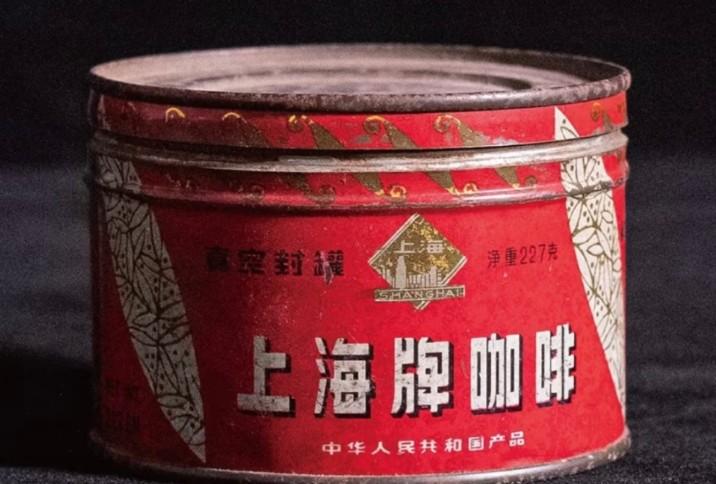
The Shanghai Coffee Factory, established in the 1950s, continued production on a small scale even during the Cultural Revolution.
Particularly famous is its "retro red can (Shanghai brand coffee)."
In Shanghai during the Cultural Revolution, this "Shanghai brand" coffee was reportedly brewed by boiling it in a cloth bag in a pot, or simply by pouring hot water over it in a cup (waiting for the sediment to settle) before drinking.
In those days, it was extremely rare for households to own modern drippers or siphons, and even if they did, there was a risk of being suspected of using illegal or unlicensed methods. Therefore, coffee was brewed using very primitive methods: boiling the grounds in a cloth bag (such as gauze) in a pot, or putting the grounds directly into a cup, pouring in hot water, waiting for the grounds to settle, and then drinking the liquid.
In his prose work *Shanghai Ode*, the writer Mu Xin fondly recalls C.P.C. coffee, the predecessor of Shanghai Brand Coffee, describing it as "freshly ground and brewed, from dusk when the bright lights were on until 3 AM the next morning."
For Mu Xin, coffee was a symbol of the sophistication and freedom of Shanghai as an international city in the 1920s-1940s.
*Shanghai Ode* meticulously depicts the food, clothing, and customs of Shanghai of that era, but its mention of coffee is not merely a memory of a beverage, but a memory of a civilization.
Mu Xin himself experienced harsh hardships during the Cultural Revolution, including imprisonment and the confiscation of his manuscripts.
In 1982, he emigrated to the United States and wrote "Shanghai Ode" in New York. Therefore, his recollections of CPC coffee were an act of looking back on an era he could never return to, from across the Pacific Ocean.
He himself stated that he wrote it relying solely on "memories like a candle in the wind."
I believe it was not so much the taste or aroma of the coffee itself, but rather a nostalgia for the entire atmosphere of the era in which it was consumed.
Cheng Naishan was a writer born into a prominent Shanghai family and is known for her works depicting the life of the upper class in old Shanghai.
She described Shanghai Pai Coffee (in its post-nationalization form) as "one of the few remaining petty-bourgeois scenes under the red flag."
This single statement speaks volumes.
"Under the red flag" refers to the Communist Party regime, and "petty bourgeois" is a class attribute that should inherently be criticized.
The red tin of Shanghai brand coffee represents the "ultimate status symbol" in Shanghai households at the time.
She lovingly documented the details of how Shanghai housewives conserved precious coffee grounds to serve to guests.
Cheng Naishan openly describes how the Shanghai brand coffee of that era contained soybeans and wheat.
However, instead of dismissing it as "fake," she viewed it positively as "the admirable pride of Shanghainese people who still wanted to drink coffee."
For her, the aroma of Shanghai brand coffee was the only "colorful memory" in the bleak era of the Cultural Revolution.
Her writing conveys a sense of solidarity with the citizens who, even in those difficult times, did not abandon their "Shanghai identity."
コメント