
Since sealing its borders in response to the COVID-19 pandemic in 2020, North Korea has pressed ahead with the construction of high-rise apartments and commercial facilities in Pyongyang while tightening its control over markets and foreign culture. It has reined in the markets (jangmadang), where the donju (the newly rich) had held the upper hand, and reorganized the economy under state leadership.
Since the pandemic, nearly all new cafés and restaurants have been state-led.
It was in this climate that Mirai Reserve, an upscale café modeled on Starbucks Reserve, opened.
The Rakrang Patriotic Kumgang Hall, which houses Mirai Reserve, may have involved investment from people connected to the Korean community in Japan, which could potentially violate UN sanctions or Japanese law. However, the true nature of its management has not yet been fully clarified, and there is no conclusive evidence of illegality.
And while the café would seem to run afoul of the regulations on foreign culture, North Korea itself tolerates this kind of Western-style consumer culture as a display of “affluence,” so it appears to be operating openly as part of a glamorous café culture.
State-Led Expansion of Housing and Commercial Facilities Since the Pandemic
Even amid the border closure brought on by COVID-19 in 2020 and ongoing economic sanctions, North Korea pushed forward with the construction of high-rise apartments, commercial facilities, and other buildings in the capital, Pyongyang.
Since 2024, it has also extended this development policy beyond Pyongyang to provincial cities.
In January 2021, at the Eighth Congress of the Workers’ Party of Korea, Kim Jong Un announced a plan to build 50,000 housing units in Pyongyang over five years.
The final phase of roughly 10,000 units was completed in 2026; a completion ceremony was held on February 16, and on the following day, February 17, the achievement of the 50,000-unit construction plan was announced.
A distinctive feature of this development is that it was not simply about increasing housing but about planned urban development.
The newly built districts include not only high-rise residential buildings but also wide roads, commercial facilities, and service facilities for residents’ daily needs.
Since the Pandemic, a Market-Centered Distribution System Has Been Brought Under State Control
During the pandemic in 2020, North Korea sealed its borders with China and Russia, and the government once again tightened control over areas such as market activity, where controls had loosened over the previous twenty-odd years.
North Korea used the pandemic to completely reorganize its market-centered distribution system under state leadership, and in the process many donju (the newly rich), having lost their footing, fell into decline.
In August 2023, a decree was issued to the effect that “trade in goods and the circulation of foreign currency outside state control are to be thoroughly prohibited.”
In the restaurant sector as well, private home-based eateries have become a direct target. According to Daily NK, while the number of official state-run restaurants in Sinuiju has grown in recent years, many people still prefer cheap and convenient home-based eateries, and the state takes issue with the fact that these operate outside its control.
Among residents, the crackdown is understood as an effort to bring all commercial activity under the management of the state’s socialist commercial system.
In June 2026, a crackdown on unlicensed home-based eateries reportedly began in Kaechon, South Phyongan Province, forcing small operators to either register or shut down.
Since the Ninth Party Congress in 2026, the squeeze appears to have intensified further. An economic directive dated March 31 reportedly ordered that donju and other private economic actors be placed completely under state control by October 10, the Party’s founding anniversary, and businesses run on private capital are said to be in the process of being absorbed by the state en masse.
Nearly All Restaurants Opened Since the Pandemic Are State-Run
Nearly all restaurants that have opened since the pandemic are state-run or state-led.
In parallel with the squeeze on private businesses, the state is building one restaurant after another to showcase “affluence.”
Over roughly six weeks from September to October 2026, 13 bulgogi restaurants opened: one in Pyongyang and one in each provincial capital.
The most recent opened on October 18 in Hyesan, Ryanggang Province, and the openings are described as part of a campaign to show that living standards are rising under Kim Jong Un’s rule.
The first restaurant opened on September 7 in Kanggye, Chagang Province, and Pyongyang’s Moranbong Bulgogi Restaurant held its completion ceremony on October 9, the day before the Party’s 81st founding anniversary.
Mirai Reserve
It was under these circumstances that the upscale café Mirai Reserve newly opened.
Menu prices at Mirai Reserve, an upscale Pyongyang café with Starbucks-like interior design, were reported through social media posts by Chinese visitors.
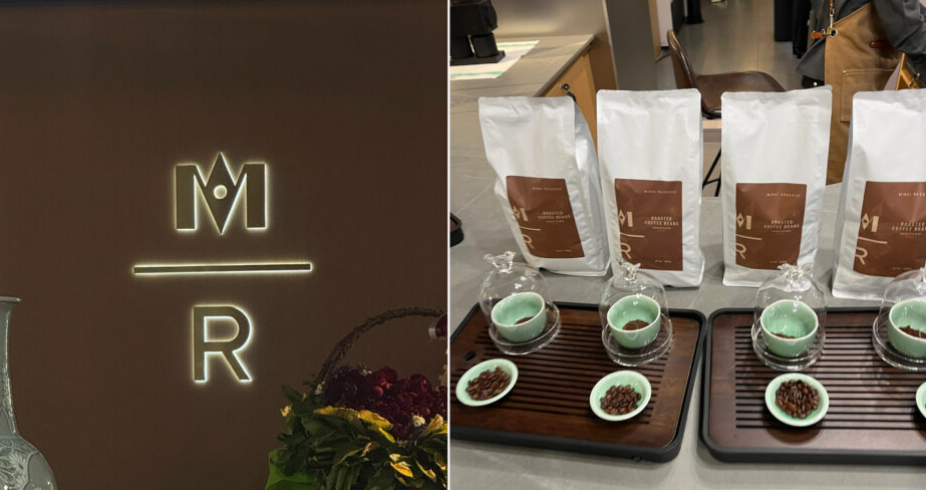
The interior features counters and furniture made largely of wood, leather chairs, subdued indirect lighting, shelves lined with books, photos of drinks, an original logo designed around the letter “M,” and displays of coffee beans.
These have been reported as design choices that strongly evoke Starbucks Reserve, Starbucks’ premium format.
However, Starbucks has not entered North Korea.
Starbucks itself has stated that it does not operate any stores in North Korea.
The menu items visible in the social media posts include iced Americanos, strawberry lattes, milk tea, cold drinks topped with whipped cream, cakes, and macarons.
In addition, an investigative article by NK Pro on June 12, 2025, confirmed that roasted coffee beans bearing the Mirai Reserve brand name were being sold and displayed.
This confirms that it is a specialty coffee shop that sells roasted beans as merchandise, rather than one that simply serves instant coffee.
On social media, the price of three cups of coffee was reported to be 25 US dollars.
This is unlikely to be a price range that ordinary Pyongyang residents could casually afford, and the café may be aimed at foreigners and relatively high-income residents.
A promotion featuring Labubu, the globally popular character, also drew attention.
A notice inside the café read: “We sell Labubu purchase vouchers. Customers who order coffee can buy them for 1 dollar, and customers who do not can buy them for 3 dollars. 100 vouchers can be exchanged for a Labubu.”
About the Rakrang Patriotic Kumgang Hall
According to a Chinese international student, there is a commercial facility for the upper class in Pyongyang called the Rakrang Patriotic Kumgang Hall, and Mirai Reserve is located inside it.
Instead of the Starbucks star, the logo uses a mark that is a stylized version of the letter “M.”
The interior is based on wood and leather, with dim lighting and large tables, and it has been reported that at first glance one would not find it strange if it were called “Starbucks Reserve Pyongyang.” The commercial facility itself is reportedly called “North Korea’s IKEA” among Chinese international students, and lamps and other items with the same product names and packaging as IKEA are said to be on display.
On June 12, 2025, NK Pro, a media outlet specializing in North Korea, pointed out that investment by people connected to the Korean community in Japan may have been involved in the Rakrang Patriotic Kumgang Hall, which houses Mirai Reserve.
Its reasoning was based mainly on the following points:
The brand name “Mirai” (meaning “future”), which derives from Japanese, is used.
Pyongyang has long had commercial facilities under the same “Mirai” brand operated by people with ties to Japan.
The word “Patriotic” in the facility’s name is sometimes used in North Korean media to describe investment projects by Koreans in Japan.
A delegation from Chongryon (the General Association of Korean Residents in Japan) was reported to have visited the facility in June 2025.
According to a June 2025 report by President Online, a student identified as K who is studying in Pyongyang said, “It is said that the Aeguk Sonnae Hall and the Rakrang Patriotic Kumgang Hall are joint ventures between Chongryon and ‘KKG,’ and that Mirai, a Korean-Japanese company, handles procurement.”
According to the article, KKG is a North Korean company called the Kumgang General Corporation, a conglomerate-like entity engaged in a wide range of businesses and said to be a foreign-currency-earning organ of the Workers’ Party of Korea.
However, this is circumstantial evidence. There is no conclusive evidence regarding who provided the funds, the amount invested, the timing of remittances, or who holds management control.
Japan’s Restrictions on Investment in North Korea
In fact, Japan restricts investment in North Korea.
From 2006 onward, Japan strengthened its own unilateral sanctions against North Korea.
The causes of these unilateral sanctions were the ballistic missile launches of July 5, 2006, and North Korea’s first nuclear test on October 9 of the same year.
The October nuclear test in particular was the decisive trigger, and Japan sharply restricted economic relations, including a total ban on imports from North Korea.
The direct causes of Japan’s major strengthening of its unilateral sanctions against North Korea in 2006 were the ballistic missile launches of July 5, 2006, and North Korea’s first nuclear test on October 9 of the same year.
The October nuclear test in particular was the decisive trigger, and Japan sharply restricted economic relations, including a total ban on imports from North Korea.
Relations between Japan and North Korea had already been deteriorating before 2006.
At the Japan–North Korea summit in September 2002, Kim Jong Il acknowledged the abduction of Japanese citizens, and five abductees returned to Japan in October of that year.
However, the Japanese government never received a satisfactory explanation regarding the fate of the remaining victims or the full truth, and normalization of Japan–North Korea relations did not progress.
For this reason, the strengthening of sanctions in 2006 was driven not only by the nuclear and missile issues but also by the long-running dispute over the abductions.
2016: Japan prohibited, in principle, payments to individuals and entities with addresses or other ties in North Korea.
In 2017, UN Security Council Resolution 2375 prohibited, in principle, joint ventures and cooperative entities with North Korean parties.
This resolution prohibits, in principle, nationals of UN member states and others from opening, maintaining, or operating new or existing joint ventures or cooperative entities with North Korean individuals or entities, with exceptions requiring prior approval from the Sanctions Committee.
Why Commercial Facilities Involving Koreans in Japan Still Exist
North Korea has a history of accepting funds and technology from Koreans in Japan.
In the 1980s, for example, Korean-Japanese businesspeople affiliated with Chongryon invested in North Korea’s light industry, agriculture and fisheries, and service sector.
It is said that about 100 joint ventures were launched between 1984 and 1989.
However, many of them failed due to management problems and other issues.
There have also been reports that around 2000, at the request of North Korean authorities, a Korean woman living in Japan invested about 50 million yen in a Pyongyang restaurant catering to foreigners.
In light of this history, it is possible that Mirai Reserve represents an expansion of a business previously run by people connected to Japan, or that a state organ within North Korea raised the funds and is running the café.
Given the strong legal restrictions, new investment from Japan after 2020 seems unlikely.
Do North Korean Authorities Not Regulate It?
What the North Korean government mainly regulates is private commercial activity beyond the reach of state control.
On the other hand, commercial activity by facilities directly run by state organs, or by businesses operating under state control, continues.
Therefore, even if funds from people connected to the Korean community in Japan were involved in Mirai Reserve, it may be operating as a state-controlled commercial facility.
However, even if the North Korean government permits it to operate, that alone does not make it compliant with UN sanctions or Japanese law.
This café is an interesting case for considering how commercial activity in North Korea unfolds under state control, but the true nature of its management has not yet been fully clarified.
The “Law on Rejecting Reactionary Ideology and Culture,” Which Cracks Down on Foreign Culture
The Law on Rejecting Reactionary Ideology and Culture, adopted in December 2020, is the main law used to crack down on foreign culture.
According to the full text obtained by Daily NK, the law defines reactionary ideology and culture as the rotten ideology and culture of hostile forces, beginning with publications of the “puppets” (meaning South Korea), as well as any unwholesome and alien ideology and culture that is not “our style.”
The main focus of punishment is bringing in and spreading large quantities of films and dramas from hostile countries or encouraging group viewing, with the death penalty as the maximum sentence.
South Korean-style speech and the use of foreign mobile phones are also subject to punishment.
Did Mirai Reserve Escape the Regulations on Foreign Culture?
Mirai Reserve appears to be modeled on Starbucks Reserve, but it does not seem to have become a target of this law.
There are four main possible reasons.
First, Starbucks is an American company, not a South Korean one.
Being popular in South Korea does not in itself make something “South Korean culture.”
The regulations center on South Korean cultural content such as dramas, music, and speech, and drinking coffee or a store’s interior style do not appear to be direct targets.
The reported menu items also use English names such as “Iced Americano” and “Strawberry Latte,” and no South Korean elements have been identified.
Second, the café does not use the Starbucks name or logo as is.
Instead of a star, the logo is a stylized letter “M,” with an “R” for “Reserve” also inscribed.
Since “Mirai” (mirae, “future”) is a common word in North Korea, the café can formally pass as a “homegrown brand.”
Third, it is located not in a facility for ordinary residents but inside a state-sanctioned, privileged facility.
One South Korean commentator points out that facilities in North Korea bearing the word “Patriotic” were mainly built with funds from Chongryon-affiliated Koreans in Japan and likely have links to outside capital.
On that basis, the commentator suggests that the café may be located in a facility similar to the foreign-currency stores once run for foreign visitors, diplomats and expatriates stationed in Pyongyang, and Chongryon members.
Crackdowns are mainly directed at the private conduct of ordinary residents, and facilities that the authorities approve and that earn foreign currency are thought to be treated differently.
Fourth, North Korea itself tolerates this kind of consumer culture as a display of “affluence.”
The authorities present the opening of coffee bars, upscale commercial facilities, and large restaurants as achievements in raising living standards.
There is also testimony that Western-style consumer culture is spreading, mainly among a segment of the upper class.
However, because the law’s definition includes broad wording such as “alien ideology and culture that is not our style,” Western-style shops could, in theory, be targeted if the authorities wished.
Ultimately, what gets cracked down on depends on the authorities’ judgment.
It seems most reasonable to view this as selective enforcement: “symbols of affluence” approved by the state are permitted, while residents’ spontaneous imitation of South Korean culture is punished.
コメント