
After Kim Jong Un came to power, North Korea aggressively pursued the urban redevelopment of Pyongyang.
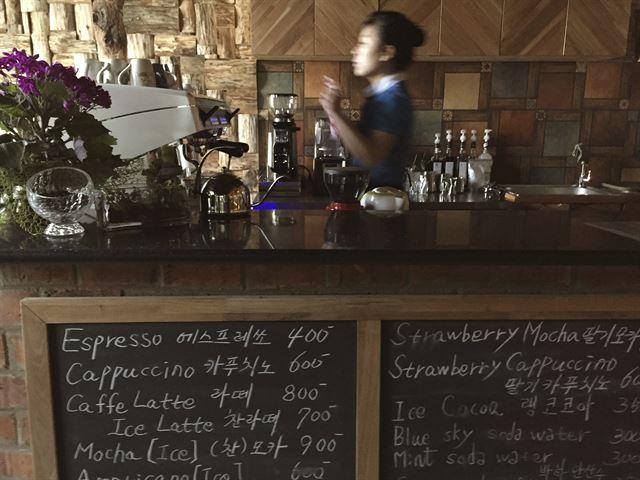
Against this backdrop, Kumrung Coffee Shop, a stylish café popular with affluent young people, opened in Pyongyang.
Korean Wave (Hallyu) culture also spread among young people. However, after the 2020 pandemic, North Korean authorities tightened restrictions, driven by the Kim Jong Un regime’s anxiety that South Korean culture was eroding the loyalty of the young.
As a result, it is unclear whether stylish coffee shops were able to stay in business.
Coffee drinking itself, however, had spread not only in Pyongyang but also among provincial officials.
Kim Jong Un’s Redevelopment Projects
Immediately after taking power in 2012, Kim Jong Un launched an aggressive redevelopment of Pyongyang, and in 2013 he greatly expanded the construction of sports and leisure facilities.
He carried on the redevelopment of Changjon Street in central Pyongyang, which had begun in the final years of Kim Jong Il’s rule, and built a complex of high-rise apartment buildings there.
In 2013, the Munsu Water Park was built.
On March 24, 2012, Kim Jong Un ordered the construction of a modern water park in Pyongyang’s Munsu district, and the Munsu Water Park was the result.
Construction units of the Korean People’s Army were mobilized for the project.
In October 2013, the Mirim Riding Club, a large-scale horseback riding and equestrian facility, was completed on the outskirts of Pyongyang.
Originally a cavalry training ground for the Korean People’s Army, it was converted on Kim Jong Un’s orders into a riding facility open to ordinary citizens.
In November 2015 came Mirae Scientists Street, a modern high-rise residential district.
Kumrung Leisure Centre
Amid this construction boom under the Kim Jong Un regime, the Kumrung Leisure Centre opened in Pyongyang on November 10, 2013.
It is a multipurpose complex offering sports, health, and entertainment facilities.
Also known as the “Kumrung Health Centre,” it opened in 2013 and is the smallest of the similar facilities in the area. It stands on the east bank of the Taedong River, across the Okryu Bridge and opposite the Ryugyong Health Complex, in the building between the Ryugyong Restaurant and the Golden Lane Bowling Alley.
With the long-established bowling alley joined by the newly built Ryugyong Health Complex, the Ryugyong Restaurant (which has a sauna and pool inside), and the Kumrung Leisure Centre, the area now has much more to offer than before.
In 2016, the Kumrung Coffee Shop, widely known as “North Korea’s first stylish café,” opened in the Kumrung Leisure Centre.
Kumrung Coffee Shop
The shop occupies the front of the Kumrung Leisure Centre (opened in 2013), which stands on the east bank of the Taedong River, across the Okryu Bridge, between the Ryugyong Restaurant and the Golden Lane Bowling Alley, opposite the Ryugyong Health Complex.
According to Koryo Tours, a travel agency specializing in North Korea, Kumrung was originally a soft-drink stand inside the Kumrung Leisure Centre, which opened in 2013.
Later, in 2016, a young North Korean woman who had taken part in a business training program for women run by Choson Exchange reopened it as a full-fledged coffee shop.
The head barista is said to have trained in China.
The shop welcomed its first customers in January 2016.
Photos of the interior show an atmosphere quite different from that of traditional North Korean tearooms.
With brick walls, wooden furniture, a chalkboard menu, an espresso machine, a coffee grinder, and latte art, its design would not have looked out of place in Seoul, Tokyo, or Beijing.
The menu reportedly included:
Espresso
Cappuccino
Café latte
Caramel macchiato
Hand-drip coffee
Strawberry smoothie
When the Associated Press visited on March 31, 2016, the shop was serving a wide variety of coffees.
The head barista, Ri Hyon A, told the AP that her personal favorite was the shop’s original hand-drip coffee.
In other words, by 2016 Pyongyang already had a group of people who had moved beyond simply drinking instant coffee and were enjoying different brewing methods and the flavor of the beans.
The Barista Trained in China
Another distinctive feature of Kumrung was its barista training.
The head barista had received professional coffee training in China.
According to the AP, she trained as a barista in Beijing and visited Starbucks while she was there.
As for the beans, Ri Hyon A explained that the shop had coffee beans flown in from China once a month.
The woman involved in running the shop had been a participant in business training offered by Choson Exchange, a Singapore-based nonprofit organization.
Choson Exchange ran training programs teaching management, marketing, entrepreneurship, finance, and related subjects to young North Korean businesspeople and others.
The organization itself visited Kumrung in 2016 and reported that a graduate of its workshops had opened a coffee shop in Pyongyang.
In short, Kumrung attracted attention not merely as a state-run eatery, but as a symbol of the semi-market business and entrepreneurial activity that spread during the Kim Jong Un era.
Not a Place for Ordinary People, but Popular with Well-Off Customers and Relatively Affluent Young Couples on Dates
On the other hand, it was not a place ordinary North Koreans could casually visit.
Choson Exchange recorded that when it visited in 2016, drinks cost around 4 to 8 US dollars each.
Even the organization’s own staff told the shop it was “too expensive.”
The shop explained that “many of the ingredients have to be imported by air.”
Given the general income levels in North Korea at the time, this was very upscale.
The clientele is therefore thought to have consisted mainly of Pyongyang’s wealthy, its emerging middle class, young people, couples, and foreigners.
Koryo Tours likewise described Kumrung as a place frequented not by the general public but by young people with money to spare and couples on dates.
Kumrung Coffee Shop May Have Been a “State-Run Restaurant with Private Investors”
After the “Arduous March” of the 1990s, market trading spread rapidly, and those who accumulated capital in the process became known as donju.
At first, their business was relatively small-scale: “buy goods from China → sell them at the market → use the profits to buy even more.”
By the 2000s, however, some merchants had accumulated tens of thousands of dollars or more, developing from mere market traders into wholesalers, transporters, investors, and financiers.
Because private enterprise is still, in principle, prohibited by law, these investors, called donju (“money masters”), partner with executives of state enterprises and run private businesses hidden inside officially recognized organizations that hold the legal right to operate.
Donju borrow the names of state enterprises or lease state-owned buildings to run their own businesses.
Researchers note that when they ask whether a restaurant is state-run or private, they often receive the contradictory answer that it is “a state-run restaurant with private investors,” and point out that ownership arrangements in which a business is effectively private but called state-run are now commonplace in North Korea.
Judging from how restaurants in North Korea generally operate, it is highly likely that Kumrung Coffee Shop took this kind of intermediate form: nominally state-run, but in practice operated by an individual.
Whether It Is Still Operating Is Unconfirmed
It is unconfirmed whether Kumrung Coffee Shop, which opened as North Korea’s first stylish café, is still in business as of 2026.
Many experts and human rights organizations believe that North Korea’s ideological control tightened significantly during the COVID-19 period from 2020 onward.
In parallel with border closures justified as infection-control measures, a series of harsh laws were enacted to keep out foreign culture.
In December 2020, a law was enacted that made spreading South Korean dramas, music, and films punishable by up to the death penalty, codifying into law a crackdown that had previously been carried out through ad hoc campaigns.
In September 2021, the Youth Education Guarantee Act was enacted, prohibiting young people from imitating foreign culture and requiring them to return to a “socialist way of life.”
Furthermore, in January 2023, the Pyongyang Cultural Language Protection Act was enacted, providing for the punishment of anyone using South Korean-style intonation or expressions.
Human rights organizations point out that North Korea used the prevention of COVID-19 as a pretext to tighten control, closing and reinforcing its borders and isolating the country and its people more than ever before.
According to Human Rights Watch, excessive measures justified as COVID-19 countermeasures were still in place in 2024.
It has also been reported that when Chinese mobile signals are detected in residential areas, authorities immediately search the location.
The border closure also helped block the inflow of South Korean dramas smuggled in on USB drives and SD cards.
Under these circumstances, it is unclear whether a stylish coffee shop that would look at home in Seoul could have continued operating.
Authorities’ Strong Sense of Crisis over the Spread of the Korean Wave
According to Daily NK, on July 13, 2024, closed trials over violations of the Reactionary Ideology and Culture Rejection Act were held simultaneously in Pyongyang and North Hwanghae Province, and two people were sentenced to death.
Research has also found that since the law took effect, enforcement agencies and their powers have expanded, with control reaching into citizens’ daily lives.
This is believed to reflect the regime’s strong sense of crisis over the spread of the Korean Wave.
Analysts say the laws reflect the Kim Jong Un regime’s deep anxiety that South Korean culture is undermining the loyalty of young people.
Coming as the country struggled with a prolonged pandemic and recovery from the previous summer’s typhoons and floods, the move was seen as an effort to tighten control over the population’s thinking.
On the economic front, a review of enterprise self-management and tighter controls on markets were under way during the same period, and many experts see this as part of a broader effort to reassert state control over both ideology and the economy.
Strict Restrictions on Korean Wave Culture, While Coffee Becomes Fashionable Even Among Provincial Officials
In the past, there have been reports of a couple who ran a bakery using “capitalist methods,” such as paying wages to employees, being caught and banished to the provinces along with their family.
For a shop like Kumrung, which may have originated as a private business, the way it was managed, rather than what it sold, could be what draws scrutiny.
That said, coffee culture itself does not appear to have disappeared.
Drinking coffee is permitted, and instant coffee such as the “Sambok” brand has been produced domestically in North Korea.
In addition, an RFA report on April 17, 2024 cited testimony that drinking coffee had become fashionable among provincial officials in North Korea, and that coffee was now being used for gifts and bribes in place of cigarettes, which had previously been the norm.
This shows that coffee, a luxury enjoyed in cafés like Kumrung in the 2010s, had by the 2020s become a valued gift even within provincial officialdom.
コメント