In the late 1980s, regimes across the communist bloc underwent rapid transitions one after another. With the end of the Cold War between the United States and the Soviet Union, North Korea—which had long relied on support from Eastern Bloc socialist nations—plunged into economic chaos and faced an acute food crisis.
North Korea gradually phased out its state rationing system, and famine struck its populace. The Kim Jong Il regime raised the slogan of the "Arduous March" and abdicated its responsibilities to local cadres and enterprises, telling them: "Do not rely on the central government; secure your workers' food on your own through self-reliance."
To survive, ordinary citizens began trading in the jangmadang (informal markets). The jangmadang economy expanded rapidly, and coffee emerged within these markets as a luxury commodity.
The Collapse of the Soviet Union
The turning point came with Mikhail Gorbachev’s reforms after he took power in 1985. Alongside perestroika (restructuring) and glasnost (openness), Gorbachev adopted a policy of non-intervention in the domestic affairs of Eastern European nations—abandoning the Brezhnev Doctrine in favor of what was colloquially dubbed the "Sinatra Doctrine."
Once it became clear that Soviet troops would not intervene to crush dissent as they had during the 1956 Hungarian Revolution or the 1968 Prague Spring, democratization movements swept through Eastern Europe. The fall of the Berlin Wall in November 1989 stood as the defining symbol of this transformation.
The fall of the wall also accelerated the disintegration of the Soviet Union in several distinct ways:
Socialist regimes across Eastern Europe collapsed like dominoes throughout 1989, culminating in the breach of the Berlin Wall on November 9, 1989.
The reunification of Germany in October 1990 stripped the USSR of its vital strategic buffer zone and heavily eroded its prestige as a superpower.
The protective barrier against the West—the satellite states of Eastern Europe, built at immense human and material cost since World War II—vanished practically overnight.
In December 1989, immediately following the fall of the wall, Gorbachev and U.S. President George H. W. Bush formally declared the end of the Cold War at the Malta Summit.
Shifting Ties Between North Korea and the Former Communist Bloc
Following the end of the Cold War, the terms of trade between North Korea and the Soviet Union underwent a fundamental transformation.
During the Cold War, the Soviet Union supplied North Korea with petroleum and other essentials at heavily subsidized "friendship prices," accepting payment via barter agreements or clearing accounts. However, around 1990, as part of internal economic reforms, Moscow instituted a policy requiring trade with socialist nations to be conducted at international market prices settled in hard currency (such as U.S. dollars)—a policy maintained by Russia after the Soviet collapse in 1991.
With virtually no foreign currency reserves, North Korea was effectively priced out of purchasing these critical resources. As a result, trade volumes with the USSR and Russia collapsed in short order.
Furthermore, Russia was grappling with severe domestic economic turmoil. Beset by hyperinflation and tumbling output in the early 1990s, Moscow could no longer afford unprofitable foreign aid. The former socialist states of Eastern Europe likewise transitioned to market economies, dissolving their preferential trade arrangements with Pyongyang.
In 1990, the Soviet Union normalized diplomatic ties with South Korea, a move North Korea viewed as outright betrayal. Ideological solidarity as a motive for propping up North Korea evaporated.
China, Pyongyang’s other primary patron, established diplomatic relations with South Korea in 1992 and subsequently began shifting trade with North Korea to hard currency settlement (though Beijing did maintain a baseline level of aid). Consequently, North Korea saw both of its major pillars of support weaken almost simultaneously.
North Korean agriculture was heavily dependent on imported inputs. Producing synthetic fertilizer required petroleum and coal, irrigation pumps relied on electric power, and tractors and logistics depended entirely on fuel.
The Phased Suspension of the Public Distribution System
As industrial and agricultural output deteriorated, ration allotments began to shrink. Just prior to the Soviet collapse, state media abruptly launched a campaign urging citizens to eat two meals a day "for health and labor discipline." In reality, this was a tacit admission that the state could no longer guarantee grain for three meals a day.
With the collapse of the Soviet Union in 1991, supplies of petroleum and chemical fertilizers were cut off, precipitating a steep decline in agricultural output. Faced with distributing scarce food supplies, the central government prioritized regions and social strata vital to regime preservation, deliberately abandoning provincial areas and heavy-industrial cities:
1992–1993: Rations were first halted in the northeastern mining and industrial heartlands (such as North Hamgyong, Ryanggang, and Jagang provinces), which were remote from breadbasket regions and ill-suited for local farming.
1993–1994: Distributions stopped across smaller provincial cities, inland coal-mining towns, and ordinary rural villages.
Ration distributions, originally scheduled twice monthly (on the 1st and 15th), dropped to once a month, with delays of several months becoming routine.
The quality deteriorated sharply: the proportion of white rice plummeted, replaced by poor-quality unhusked corn and coarse grains.
Rations were sustained until the very end only for the core elite: residents of Pyongyang, Korean Workers' Party cadres, military personnel, and state security organs such as the Ministry of State Security (secret police).
Following Kim Il Sung’s death in 1994, his successor, Kim Jong Il, pivoted to the Songun (Military-First) policy to secure regime survival. Whatever meager grain the state could requisition was directed straight into military depots as "military provisions," cutting grain supplies to the Public Distribution System (PDS) to zero.
The Arduous March
In July and August 1995, catastrophic floods devastated farmland, standing crops, and transport networks. Hydroelectric plants and coal mines were inundated, causing massive blackouts; electric locomotives ground to a halt, paralyzing the national rail network. This destroyed the physical means of transporting food to provincial regions.
It was around this time that North Korea began appealing to the international community for emergency food aid, confirming the onset of a full-scale famine.
From the autumn of 1995 onward, with the exception of a narrow privileged class—such as central organs in Pyongyang and high-ranking military officials—general public rations across North Korea dropped effectively to zero, both formally and informally.
In January 1996, state outlets, including Rodong Sinmun, introduced the slogan "The Arduous March" in their joint New Year editorial. The phrase originally referred to an arduous winter march through Manchuria in 1938–1939 by anti-Japanese partisans led by Kim Il Sung; it was repurposed to compel the population to endure severe hardship.
The regime abdicated all responsibility, instructing local party cadres and enterprise managers: "Do not rely on the center; secure your workers' food on your own through self-reliance." This marked the point where the state formally abandoned its obligation to provide basic subsistence. Ration books and ration tickets—once synonymous with survival—became worthless. Citizens were forced to turn to bartering and illicit trading in unauthorized black markets (jangmadang) simply to stay alive.
Kim Jong Il's Insulation from the Famine
As the supreme leader, Kim Jong Il did not rely on the ordinary distribution system. The leadership operated its own dedicated procurement networks, ensuring uninterrupted access to food and luxury goods.
Kenji Fujimoto, Kim Jong Il's former personal chef, testified that even after food shortages became acute in 1994, Kim's banquet tables were regularly laden with premium ingredients sourced globally. Fujimoto noted that Kim's residences housed massive cellars stocked with fine spirits from around the world, including Hennessy XO and Johnnie Walker. The Washington Post similarly reported on Fujimoto's accounts of purchasing pork from Denmark, caviar from Iran and Uzbekistan, and fresh seafood directly from Tokyo's Tsukiji market.
Beyond the regular state budget and public economy, North Korea maintained a parallel web of foreign-exchange-generating enterprises, trading firms, and financial entities directly under the control of the party leadership—most notably the Workers' Party's "Office 39." Investigations have extensively documented how intermediary brokers in China, third-country corporations, and circuitous shipping routes were routinely leveraged to procure luxury goods.
Even in 1997, when ordinary provincial citizens could not secure basic corn, Kim Jong Il's dining table continued to feature Japanese seafood, caviar, imported meats, and high-end liquor.
The Rise of the Jangmadang (Market) Economy
During the Arduous March, when survival was no longer possible via state rations alone, the North Korean populace rapidly developed decentralized methods to produce, forage, and barter for food. This evolution fundamentally reshaped North Korean society, transforming small-scale black markets and farmers' markets into the broader jangmadang economy.
Farmers' markets (nongmin sijang) had existed in North Korea since the 1950s. Collective farm workers were permitted to sell surplus produce grown on tiny household plots or livestock raised on the side. These markets operated periodically—roughly once every ten days—with strict limits on permissible goods and an outright ban on grain transactions. Under the socialist system, they were tolerated as marginal safety valves to supplement rationing shortfalls.
As state distributions collapsed in the 1990s, these modest markets expanded exponentially:
Banned grains began trading openly, operations shifted from periodic to daily, and stalls filled with manufactured goods and Chinese imports.
Commercial activity spilled beyond designated market boundaries, occupying railway station plazas, alleyways, and riverbanks. These informal gathering places became known as jangmadang.
Married women were the pioneers of this market trade. Under North Korean regulations, adult men were mandated to report to state workplaces, whereas housewives—classified as dependents—were largely exempt, affording them relative freedom of movement. Starting by selling off household heirlooms, they moved on to producing and selling street foods (such as tofu, bread, and rice cakes) and arbitraging goods across regional lines.
Farmers also served as critical suppliers, bringing grain hoarded from collective farms or cultivated on unauthorized mountain plots into the markets.
Individuals with external connections enjoyed an early comparative advantage:
North Korea's ethnic Chinese residents (Huaqiao): Benefiting from relative freedom of travel across the border, they imported Chinese textiles and daily necessities, serving as essential wholesale merchants.
Returnees from Japan and their families: Those receiving material goods and cash remittances from relatives in Japan leveraged these assets as initial trading capital and inventory.
Smugglers: Thrived along the Sino-North Korean border.
State, military, and party cadres: Foreign-exchange trading entities under institutional umbrellas funneled Chinese goods into domestic markets, while corrupt cadres used their authority to divert state-owned resources into private channels.
Consequently, the markets became intertwined with the financial interests of both marginalized citizens and entrenched elites.
Kim Jong Il's Tacit Toleration of the Markets
Kim Jong Il personally harbored a deep distaste for the markets, viewing them as hotbeds of "anti-socialist" sentiment that breached socialist doctrine and let in capitalist ideas and outside information. Nonetheless, the regime refrained from implementing a total crackdown due to several converging factors:
State Incapacity: The government could not feed its population. Given its inability to restore the PDS, dismantling the markets would have exacerbated starvation and sparked catastrophic unrest. The markets effectively assumed the survival functions the state had abandoned.
Enforcer Complicity: Regulatory agents were themselves reliant on the markets. Local party cadres and boanwon (police officers) also went without state rations and relied on bribes and kickbacks from traders to make ends meet. Even when top-down suppression orders arrived, field enforcers turned a blind eye or cut side deals.
Fiscal Revenue: The markets evolved into an indispensable source of state revenue. Market stall fees and associated levies sustained local municipal finances, while state-affiliated trading enterprises generated vital foreign exchange for the central regime.
Coffee as a Luxury Item in the Jangmadang
In the jangmadang of the 1990s, coffee was far from an everyday beverage; it was an exceptionally valuable imported luxury.
For households of ethnic Korean returnees from Japan or families with foreign ties, jars of instant coffee often arrived in care packages from abroad. Rather than consuming it themselves, recipients frequently sold these jars in the market for cash or used them as prestige gifts and bribes for party cadres. As the markets grew rapidly throughout the decade, high-value consumer imports traded alongside staple foods.
Between roughly 1996 and 1998, a single 100g jar of Japanese instant coffee could realistically be traded for approximately 10 to 25 kg of rice, or roughly 30 to 50 kg of corn.
Defector testimonies from the late 1990s provide detailed market price benchmarks:
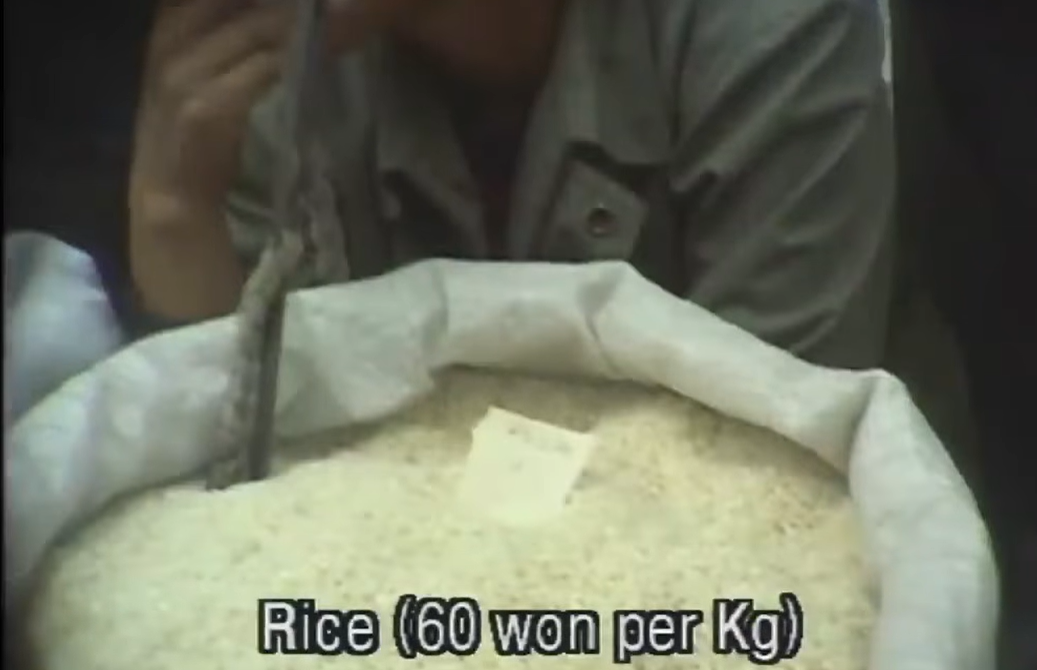
Rice: Typically traded at 60–80 North Korean won per kg in border regions, spiking up to 150 won/kg during the peak crisis period in the autumn of 1996.
Corn: Traded at approximately 35–45 North Korean won per kg.
In 1996, a 100g jar of instant coffee retailed in Japan for approximately 795 to 809 yen. With exchange rates hovering around 105 to 114 yen per U.S. dollar, an 800-yen jar was worth roughly $7 USD.
On North Korea's black market, the domestic currency depreciated sharply between late 1996 and 1997, trading at roughly 220 to 280 North Korean won to the dollar. A basic conversion yields:
7 USD×(220 to 280 won)≈1,500 to 2,000 won
Evaluating this figure against staple food prices:
- Against standard famine-era rice (80 won/kg):
1,500–2,000 won÷80 won/kg≈19 to 25 kg
Against peak-crisis rice in autumn 1996 (150 won/kg):
1,500–2,000 won÷150 won/kg≈10 to 13 kg
This aligns with an estimated purchasing power of roughly 10 to 25 kg of rice per 100g jar.
- Against corn (35–45 won/kg):
1,500–2,000 won÷(35–45 won/kg)≈33 to 57 kg
Accounting for transaction friction, regional variances, packaging condition, and brand value, a conservative estimate places the purchasing power of a 100g jar at around 30 to 50 kg of corn.
Assuming an adult requires approximately 500g of corn per day for basic subsistence:
30 kg÷0.5 kg/day=60 days
50 kg÷0.5 kg/day=100 days
On paper, liquidating a single 100g jar of Japanese instant coffee sent from overseas was worth enough to secure staple nourishment for one adult for two to three months.
This dynamic becomes even clearer when contrasted with nominal earnings. In the mid-1990s, the standard official state wage for an ordinary worker was roughly 100 won per month. An asset valued at 1,500 won was equivalent to 15 months of state wages. This disparity reflects the total decoupling of official socialist wage scales from real-market clearing prices during the Arduous March. Academic research confirms that the volume of rice purchasable with an official state salary collapsed dramatically between 1992 and 1996.
This calculation relies on theoretical conversion using Japanese retail prices and black-market exchange rates rather than direct transaction logs from the jangmadang. In reality, while an unopened jar of Japanese Nescafé commanded a premium as a rare, imported prestige item suitable for bribery, sellers desperate for immediate calories may have accepted steep discounts. Even so, for returnee families receiving instant coffee from relatives in Japan, liquidating the jar for dozens of kilograms of grain was incomparably more rational than consuming it.
コメント