
Kim Jong-il is said to have set out a new policy for operations against South Korea in 1976, ordering that agents be thoroughly "localized."
Localization did not simply mean learning to speak a foreign language. It meant enabling agents to assume the identities of Japanese, South Koreans, or others and blend into the societies of those countries.
For example, agents posing as Japanese were required to have natural Japanese pronunciation and conversational ability, knowledge of Japanese daily life and customs, knowledge of the background and personal history that a Japanese person would have, and the ability to behave like a Japanese person when traveling abroad.
To this end, North Korea abducted Japanese people and used them to teach agents Japanese and to disguise agents' identities, with the aim of furthering covert operations in Japan, South Korea, and elsewhere.
Then, from 1977 to 1983, a series of abductions targeting Japanese nationals took place in Japan and in Europe.
Among the abductees, Hitomi Soga, who married an American deserter, had coffee in her household.
Abductions of Japanese Nationals
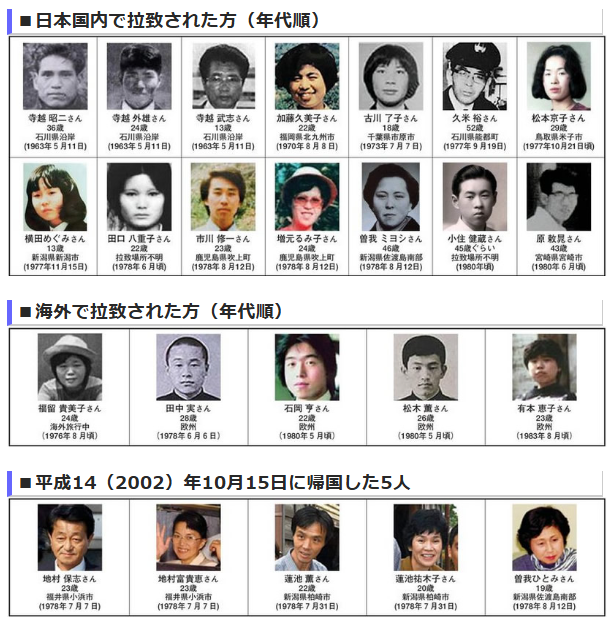
The Japanese government officially recognizes 12 abduction incidents involving 17 victims.
North Korea has officially admitted to abducting 13 of them. Five have returned to Japan, but regarding the remaining 12, North Korea claims that "eight have died and four never entered North Korea."
The victims were entirely ordinary citizens, such as young couples taken from beaches and Megumi Yokota, then 13, who was abducted on her way home from school (1977, Niigata). The abductions are said to have served purposes such as teaching agents the Japanese language and customs, and obtaining identities that agents could use to pass themselves off as Japanese.
In addition to the 17 people recognized by the government, there are said to be many "specific missing persons" whose abduction cannot be ruled out, and the actual number of victims is believed to be higher.
There was also a case in 1974 in which two young siblings of Korean nationality living in Japan were abducted.
Megumi Yokota (13 at the time)
She was abducted on November 15, 1977, in Niigata City, while on her way home from junior high school.
North Korea later explained that agents took her away because they feared she had become aware of their presence.
However, this is North Korea's account, and the full picture of the incident has not been made clear.
In the same year, Yutaka Kume and Kyoko Matsumoto also went missing.
In 1978, abductions of men and women were concentrated:
Yasushi Chimura and Fukie Hamamoto (Fukui Prefecture)
Kaoru Hasuike and Yukiko Okudo (Niigata Prefecture)
Shuichi Ichikawa and Rumiko Masumoto (Kagoshima Prefecture)
Hitomi Soga and Miyoshi Soga (Niigata Prefecture)
The Chimuras, the Hasuikes, and Hitomi Soga returned to Japan in 2002.
In 1980, an abduction took place for the purpose of impersonating a Japanese person.
Tadaaki Hara (43 at the time): Mr. Hara, a resident of Osaka Prefecture, was abducted to North Korea from Aoshima Beach in Miyazaki Prefecture in June 1980.
North Korean agent Sin Gwang-su used Mr. Hara's identity to fraudulently obtain a Japanese passport and carried out operations abroad, including operations against South Korea.
In 1983, abductions of Japanese nationals also occurred in Europe.
Keiko Arimoto (23 at the time)
Ms. Arimoto, who had been studying in the United Kingdom, was abducted in Europe in 1983.
The Sin Gwang-su Case
North Korean agent Sin Gwang-su abducted Tadaaki Hara, stole his identity, passed himself off as a Japanese national, and carried out operations in South Korea and elsewhere.
Mr. Hara was 43 at the time and lived in Osaka Prefecture. He worked at a restaurant.
Acting on instructions from North Korea, Sin and his accomplices carried out a plan to abduct Mr. Hara, a Japanese national.
They lured Mr. Hara, who lived in Osaka, to Aoshima Beach in Miyazaki Prefecture.
From Aoshima Beach, they put him on a spy ship and took him to North Korea.
Sin assumed Mr. Hara's identity and fraudulently obtained a Japanese passport.
Using that passport, he traveled abroad several times, setting up overseas operational bases for North Korea and conducting operations against South Korea, among other activities.
Japanese police have identified Sin Gwang-su as the principal offender in the abduction and Kim Kil-uk as an accomplice.
A defining feature of the Sin Gwang-su case is the operational technique known as hainori ("identity takeover").
Hainori means stealing or using the identity of a real, existing person in order to impersonate that person.
By holding a Japanese passport, he was able to enter foreign countries as a Japanese national and carry out his operations.
In 1985, South Korean authorities arrested Sin Gwang-su and other North Korean agents.
When the South Korean authorities made the case public in June of that year, Mr. Hara's abduction and the scheme to impersonate a Japanese national came to light.
Japanese police also dispatched officers to South Korea, obtained statements and other materials from the South Korean authorities, and conducted corroborating investigations in Japan.
As a result, in 1988, Japanese police concluded that the case was an abduction of a Japanese national by North Korea, and this was also disclosed in the Diet.
The Korean Air Bombing (Korean Air Flight 858)
On November 29, 1987, Korean Air Flight 858 exploded and crashed over the Andaman Sea off Myanmar (then Burma), killing all 115 people on board: 104 passengers and 11 crew members.
Flight 858 was a Boeing 707 on the route Baghdad → Abu Dhabi → Bangkok → Seoul.
According to the South Korean investigation and the later testimony of the surviving agent Kim Hyon-hui, Kim Hyon-hui and a male agent, Kim Sung-il, posed as a Japanese father and daughter, used forged Japanese passports, and boarded Flight 858 in Baghdad.
The two placed a Japanese-made radio containing a time bomb and a liquor bottle concealing liquid explosives in the overhead bin above their seats.
They set the bomb to go off in about nine hours and got off the plane alone at the first stopover, Abu Dhabi.
Flight 858 then exploded over the Andaman Sea on its way to Bangkok.
This sequence of events is also documented in detail in materials the South Korean government submitted to the United Nations.
The two fled from Abu Dhabi and eventually entered Bahrain.
However, the Japanese passports they were using aroused suspicion, and they were detained by the authorities.
When detained, the two attempted suicide using cigarettes laced with a cyanide compound.
Kim Sung-il died, but Kim Hyon-hui survived.
She was later transferred to South Korea.
Kim Hyon-hui initially denied being a North Korean agent, but in January 1988 she held a press conference in which she admitted that she was a North Korean agent and had planted the bomb on Flight 858.
According to Kim Hyon-hui's testimony and the South Korean government's investigation, the operation was carried out on the orders of Kim Jong-il, who at the time was consolidating power as Kim Il-sung's successor.
The materials the South Korean government submitted to the UN state that the order was conveyed to the agents on October 7, 1987, and that the aim was to disrupt foreign participation in the 1988 Seoul Olympics, to be held in South Korea.
The explanation is that North Korea sought to give the international community the impression that "South Korea is a dangerous country" and thereby cause national teams to withdraw.
Furthermore, at the time of the bombing, South Korea was on the eve of its presidential election of December 16, 1987.
It is therefore also believed that the bombing was intended to throw South Korean society into turmoil and heighten political instability.
Kim Hyon-hui testified to South Korean authorities that in North Korea she had been taught the Japanese language and Japanese customs by a Japanese woman who called herself Lee Un-hye.
That woman was none other than Yaeko Taguchi.
In 1978, Yaeko Taguchi lived in Toshima Ward, Tokyo, and worked at a restaurant.
She had two young children.
When she disappeared in 1978, her children were still at an age when they needed their mother.
The Japanese government has determined that Ms. Taguchi did not abandon her family of her own will, but that North Korea robbed her of her life in Japan.
The Abduction and Marriage of Hitomi Soga
Hitomi Soga has testified that she was suddenly attacked from behind, had her mouth covered, and was abducted while returning from shopping with her mother, Miyoshi.
On the evening of August 12, 1978, Hitomi and her mother Miyoshi had finished shopping at a nearby store and were walking home.
On the way, they noticed three men following them from behind.
As the distance gradually closed, mother and daughter looked back and felt uneasy. At that point, however, they apparently did not think they would be attacked.
When they were less than 100 meters from home, the three men suddenly rushed at them.
The three men attacked the mother and daughter and covered their mouths so they could not cry out.
They tied their hands and feet so they could not resist, put something like burlap sacks over them, and carried them to a river.
After being carried to the river, Hitomi heard a man and a woman talking at the scene.
The woman was speaking Japanese, but her Japanese sounded slightly off.
At around 5 p.m. the next day, the 13th, the boat arrived at a port.
Hitomi has testified that it was there that a Japanese-speaking woman first told her that the place she had been brought to was North Korea.
A striking feature of this case is that although mother and daughter were abducted together, they were subsequently separated, and Hitomi lived in North Korea for many years without knowing what had become of her mother.
In 2002, North Korea admitted to abducting Hitomi but claimed that her mother had never entered North Korea.
The Japanese government, however, does not accept this explanation.
According to materials released by the Japanese government, a female agent told Hitomi regarding her mother that "Miyoshi was sent back to Sado."
However, no evidence has been found to confirm that Miyoshi actually returned to Sado.
From this, the Japanese government points out that at least the perpetrators must have known what happened to her mother.
After her abduction, Hitomi came to live in a guest house run by a North Korean special agency.
According to what North Korea told the Japanese government in 2002, for about two years after her abduction Hitomi studied languages at the guest house and received instruction to help her adjust to life in North Korea.
Then, on August 8, 1980, she married Charles Jenkins, a former U.S. Army soldier.
Jenkins had deserted while serving in South Korea in January 1965 and crossed into North Korea.
North Korea Abducted Foreign Women to Marry Foreigners Living in the Country
Jenkins's main "jobs" in North Korea were as an English teacher and as an actor in propaganda films.
However, these were not jobs he chose for himself; they were assigned to him by the North Korean authorities.
The English teaching was particularly significant.
From 1981 to around 1985, Jenkins taught English to North Korean military personnel at the Military Foreign Language University in Pyongyang.
According to U.S. Army records, many of his students were officer candidates, and some were learning English in preparation for becoming agents operating abroad.
It was also English that brought him together with Hitomi Soga.
In 1980, North Korean authorities brought Soga to Jenkins's home and instructed him to "teach this woman English."
The two married about 38 days later.
At the time, the best-known former U.S. soldiers in North Korea were four American men, including Jenkins, and the North Korean authorities paired them not with North Korean women but with women of various foreign nationalities.
James Dresnok married Doina Bumbea of Romania, Jerry Parrish married Siham Shraiteh of Lebanon, and Larry Abshier married Anocha Panjoy, a Thai woman.
These pairings are unlikely to have been coincidental. In an interview with TIME, Jenkins testified that in the late 1970s the North Korean authorities adopted a policy of marrying American deserters to foreign women.
Since its founding, North Korea has had a nationalism that places very strong emphasis on the Korean people.
The UN Commission of Inquiry noted that the idea of a "pure Korean race" occupies an important place in North Korean society and that strong measures have been taken to prevent the birth of mixed-race children.
The UN report also explicitly states that one of the reasons foreign women were abducted was to marry them to foreign men and thereby prevent interracial marriages with ethnic Koreans.
Cases of North Korea–Linked Abductions Around the World
In 1978, four young women in Lebanon were deceived with promises such as being able to "work for a Japanese company," taken out of the country from Beirut, and ultimately sent to Pyongyang.
North Korean agents are said to have used fictitious job offers.
Anocha Panjoy, a Thai woman, disappeared in 1978 not in Thailand but in Macau, where she was working.
UN materials also cite her as a case of abduction by North Korea.
She later married the U.S. Army deserter Larry Abshier.
Doina Bumbea, a Romanian woman, is said to have been taken to North Korea around 1978, not from Romania but while living in Italy, after being offered art-related work, an exhibition, or similar opportunities in Japan.
She later married the U.S. Army deserter James Dresnok.
In South Korea, high school students and others were abducted from beaches. North Korean involvement is also suspected in the cases of Anocha Panjoy and a Chinese woman in Macau; the famous South Korean actress Choi Eun-hee and film director Shin Sang-ok in Hong Kong; and women from Malaysia, Singapore, Romania, and elsewhere.
Actress Choi Eun-hee and director Shin Sang-ok are said to have been brought to North Korea for Kim Jong-il's personal and national project of developing the North Korean film industry. In other words, it is better to think of the abductions as a set of separate projects running in parallel, each serving a different purpose.
The Former U.S. Soldier and Hitomi Soga Had a Habit of Drinking Coffee at Home
In October 2002, shortly after Soga temporarily returned to Japan for the first time in 24 years, it was reported that, describing her life in North Korea, she said, "In North Korea, we have bread and coffee for breakfast."
In other words, it seems safe to say that, at least around 2002, coffee was part of the breakfast routine in Hitomi Soga's household.
Soga's situation was somewhat unusual. In 1980 she married Charles Jenkins, a former U.S. soldier who had been in North Korea since 1965, and North Korean government materials state that the couple "lived with their living conditions guaranteed by the state."
It is therefore possible that she was in a position to obtain foreign food and luxury items more easily than ordinary North Korean residents.
She is said to have led a life close to that of a "full-time housewife," getting up around 6 a.m., making lunches for her daughters, and eating a breakfast of bread and coffee with her husband.
As for James Dresnok, during the period from Hitomi Soga's return to Japan in 2002 until Jenkins left North Korea in 2004, Jenkins said: "After my wife left, Dresnok came to my house every day. We talked over coffee."
コメント