
In the 1960s, North Korea sought to advance its domestic construction through the Chollima Movement while simultaneously attempting to overthrow the South Korean government to achieve Korean unification.
As part of this effort, it executed a plan to establish an underground revolutionary organization in South Korea, instigate a revolution led by workers, peasants, youth, and students, and provide support from the North.
However, the plan failed due to disruption by the South Korean government, leading to the purge and downfall of top military and intelligence officials in North Korea.
Rising to power in the aftermath and taking control of the military and intelligence leadership was Kim Il-sung’s son, Kim Jong-il, who became his designated successor.
Kim Jong-il was a dedicated gourmet who also preferred coffee over black tea.
North Korea’s Turn Toward Covert Operations Against the South (Post-1960)
In 1960, the year after the repatriation project of ethnic Koreans in Japan (Zainichi Koreans) to North Korea began, massive student- and citizen-led protests broke out in South Korea, forcing President Syngman Rhee to resign. This South Korean uprising is known as the "April 19 Revolution."
Having failed in his attempt to overthrow the South Korean government and unify the peninsula during the Korean War, Kim Il-sung began considering: "Even without an invasion by the North Korean military, might the South Korean people themselves be able to bring down their government?" The North Korean leadership closely observed the April 19 Revolution and evaluated the strength of the "revolutionary forces" within South Korea.
In reality, it was not underground communist organizations directed by the North that toppled the Rhee administration, but rather South Korean students and ordinary citizens. When these expectations were dashed by Park Chung-hee’s military coup the following year in 1961, Pyongyang shifted its strategy toward far more systematic covert operations.
Consequently, in the wake of the April 19 Revolution, the Workers' Party of Korea (WPK) reorganized the apparatus responsible for operations targeting the South and moved to rebuild an underground party network inside South Korea.
Another catalyst was the influence of the Cuban Revolution and the Vietnam War, which strengthened Pyongyang's conviction in armed struggle as a means of unification.
While pushback against Soviet Premier Nikita Khrushchev's doctrine of "peaceful coexistence" served as one justification for this militant line, it acted more as a tailwind than the primary origin.
On February 27, 1964, at the 8th Plenary Meeting of the 4th Central Committee of the WPK, North Korea articulated the strategy that would later be termed the "Three Revolutionary Capabilities":
1. Strengthen North Korea as a political, economic, and military "revolutionary base." This entailed the Four Military Lines (arming the entire populace, fortifying the entire country, converting all soldiers into cadre-level commanders, and modernizing all armed forces) alongside the *Byungjin* policy of parallel economic and national defense development.
2. Build an underground revolutionary organization in South Korea, organizing workers, peasants, youth, and students to launch a "national liberation democratic revolution against the US and the dictatorship." The North’s role was defined as providing "support."
3. International Revolutionary Capabilities: Forge stronger solidarity with the socialist bloc and the Third World to isolate the United States.
Regarding internal South Korean operations, the doctrine followed a clear progression: organize anti-government forces → exploit social grievances → forge a united front → ultimately ignite a revolution driven by the South Korean people themselves.
Implementing the "Three Revolutionary Capabilities" in the South: The Revolutionary Party for Reunification (RPR) Operation
The central figure in this operation was Kim Jong-tae.
According to South Korean records, a clandestine organization equivalent to a "Preparatory Committee for the Establishment of the Revolutionary Party for Reunification" was formed around March 1964, led by Kim Jong-tae, Kim Jil-nak, and Lee Mun-gyu.
The "Revolutionary Party for Reunification (RPR) Operation" was a major covert offensive conducted by North Korea in the 1960s to establish a secret revolutionary party inside the South affiliated with the WPK, aimed at collapsing the Park Chung-hee regime from within and paving the way for unification.
This went beyond standard espionage missions aimed at stealing state secrets; its critical objective was to foster a durable, long-term underground apparatus inside South Korea.
The focal point of this effort became the "Revolutionary Party for Reunification Incident," uncovered in 1968 by the Korean Central Intelligence Agency (KCIA).
The objective of the RPR was not an immediate, frontal armed assault on the South Korean government.
Instead, the strategy was to embed an underground network within South Korean society over an extended period and rapidly pivot toward full-scale revolution whenever a political crisis presented itself.
Investigation records from South Korean authorities indicate that operational directives, operational funding, wireless communications, ciphers, and covert maritime infiltrations were orchestrated from North Korea to organize former members of the Workers' Party of South Korea, progressive intellectuals, students, and youth.
The Academy of Korean Studies notes that Kim Jong-tae received directives and funding directly from Heo Bong-hak, North Korea’s chief of South Korean operations.
The Blue House Raid (The January 21 Incident)
From around 1966, DMZ breaches, infiltration by operatives and guerrillas, and armed clashes instigated by North Korea escalated dramatically across the Korean Peninsula.
Amid these tensions, on January 5, 1968, a 31-man North Korean detachment was placed in isolation near Sariwon, Hwanghae Province, where they conducted intensive drills focusing on breaching buildings and executing assassinations.
On January 13, reconnaissance bureau officers reportedly briefed them on their explicit objective: assassinate South Korean President Park Chung-hee.
This elite detachment belonged to Unit 124, North Korea’s specialized special operations force for anti-South missions.
On January 17, the 31 commandos infiltrated across the DMZ into South Korea, crossed the frozen Imjin River, and pressed south toward Seoul.
Moving through mountainous terrain, they disguised themselves in South Korean military uniforms.
Near Paju, they were spotted by two civilian woodcutter brothers.
Although the commandos released them unharmed, the brothers immediately alerted local authorities, placing South Korean military and police forces on high alert.
On the night of January 21, the detachment entered downtown Seoul and advanced to the vicinity of Changuimun and Jahamun gates, north of the Blue House—a mere 500 meters from their target.
At a temporary checkpoint near Jahamun, police officers intercepted and questioned the 31 men.
Suspicions arose over their explanations, and as tension spiked and their true identities were exposed, the North Korean operatives opened fire with submachine guns and hurled hand grenades.
A fierce gun battle erupted, forcing the commandos to abandon their joint assault on the Blue House and scatter toward the downtown area and Mount Bugak.
Superintendent Choi Gyu-sik, chief of the Jongno Police Station who led the interception at the checkpoint, was killed in the shootout.
Following the abortive assault, the South Korean military and police launched a massive dragnet across northern Seoul and Gyeonggi Province.
Subsequent South Korean tallies determined that out of the 31 infiltrators, 29 were killed, one (Kim Shin-jo) was captured alive, and one is believed to have escaped back to North Korea.
Kim Shin-jo was interrogated extensively, and his confessions provided vital intelligence regarding North Korean special forces operations and tactical objectives.
The Bust of the Revolutionary Party for Reunification
Kim Jong-tae did not limit his activities solely to the South; he utilized a secret liaison route centered around Imja Island to coordinate directly with North Korea.
After detecting this network, the KCIA arrested Kim Jong-tae and subsequently apprehended Lee Mun-gyu.
Searches of affiliated locations yielded cipher materials and codes used for covert communications with Pyongyang.
South Korean intelligence concealed Lee Mun-gyu’s arrest from the North, maintaining the facade that he was still active at large in order to intercept and manipulate North Korean communications.
Utilizing the seized cipher materials, South Korean authorities decrypted an "A-3" cipher directive transmitted from Pyongyang around August 4, 1968.
They mounted a counter-espionage deception plan—later referred to as "Operation Z"—to mislead North Korea into believing Lee Mun-gyu was still operating freely and thereby induce Pyongyang to dispatch an infiltration and liaison craft.
As a result, on August 20, an armed North Korean spy vessel approached the waters off Seogwipo on Jeju Island.
In a joint operation conducted by the military, police, and intelligence agencies, the craft was intercepted: 12 operatives aboard were killed, two were captured alive, and the vessel and an arsenal of weapons were seized.
On August 24, 1968, KCIA Director Kim Hyung-wook formally announced the cracking of the "Revolutionary Party for Reunification Incident."
The KCIA identified a total of 158 suspects involved, stating that 73 had been formally referred for prosecution while the remaining 85 were under active investigation.
The agency concluded that the RPR had systematically expanded its apparatus across South Korean academia, political circles, and civic organizations under direct orders from Pyongyang, laying the groundwork for a future popular uprising and the overthrow of the government.
The Uljin-Samcheok Armed Guerrilla Infiltration
Following these operations, North Korea attempted to establish guerrilla bases across the Taebaek Mountains in eastern South Korea to draw local populations into its revolutionary campaign.
In August 1968, the Reconnaissance General Bureau formulated a plan not only to construct military strongholds within the South, but also to recruit or abduct South Korean villagers, transport them to the North for political and operational indoctrination, and subsequently reinsert them back into the South.
Between October 30 and November 2, 1968, Pyongyang landed 120 armed commandos—divided into eight squads of 15 men each—in three successive waves along South Korea’s eastern coastline.
These commandos also hailed from Unit 124, the same outfit responsible for the Blue House raid.
A November 1968 intelligence analysis by the US Department of State suggested this mission was likely an attempt to test whether the rural guerrilla warfare tactics employed by the Viet Cong (National Liberation Front) in the Vietnam War could be replicated on the Korean Peninsula.
The commandos rounded up rural villagers to lecture them on North Korean political ideology and demand their participation in the revolution.
Reports documented that guerrillas assembled villagers, staged propaganda sessions, distributed South Korean currency, and coerced them into affixing thumbprints to documents pledging allegiance to the communist cause.
Records also noted the recovery of application forms for membership in the Workers' Party of Korea at several sites; the explicit intent was to conscript these villagers into future revolutionary cadres.
However, recruitment by an armed military unit inevitably relied on intimidation and brute violence.
According to the Academy of Korean Studies, commandos forcibly assembled civilians, indoctrinated them, and compelled them to sign documents pledging support for the guerrilla movement, executing residents who resisted.
Nevertheless, several residents managed to slip away and alert the police.
Early on the morning of November 3, villagers from Buk-myeon in Uljin County reported the presence of the armed group, prompting the South Korean government to raise its alert status that afternoon.
The South Korean government mobilized regular military units, the national police, and the Homeland Reserve Forces.
The guerrillas retreated deep into the rugged Taebaek Mountains, but facing the harsh winter elements and a severe breakdown in supplies, they were systematically hunted down. The large-scale counter-guerrilla sweep drew to a close by late December 1968.
According to tallies by the Academy of Korean Studies, 111 guerrillas were killed, 5 captured, 2 surrendered, and 2 were presumed to have escaped (records at South Korea's National Archives reflect slight variations in casualty and surrender figures).
Heavy casualties were also sustained on the South Korean side among soldiers, police officers, and civilians; subsequent US Army studies recorded 63 South Korean fatalities, including 23 civilians.
The underlying premise—that inserting armed North Korean guerrillas into rural South Korea would prompt local populations to rally and ignite a mass revolution—was put to the test in the field and ended in complete failure.
The Military Purge and the Rise of Kim Jong-il
In early 1969, in the immediate wake of the disastrous 1968 covert offensives against the South, a sweeping purge and reshuffle struck the North Korean military establishment. Minister of National Defense Kim Chang-bong and Party Secretary for South Korean Affairs Heo Bong-hak were purged.
In their place, Choe Hyon, a veteran commander from the anti-Japanese partisan campaigns, was appointed Minister of National Defense, while Oh Jin-woo consolidated his influence within the top military leadership.
From the late 1960s onward, Kim Jong-il had been placed in charge of cinema, literature, the arts, and propaganda.
In 1967, he became a section chief in the Party's Propaganda and Agitation Department; in 1971, he was appointed Director of the Culture and Art Department; and in 1973, he rose to Party Secretary in charge of Organization, Propaganda, and Agitation, concurrently serving as Director of the Organization and Guidance Department.
Why was managing culture, the arts, and propaganda so pivotal to securing the succession? In North Korea, the Propaganda and Agitation Department did not merely produce newspapers or motion pictures.
It was the nerve center dictating how Kim Il-sung was presented to the public, how ideological indoctrination was administered to party cadres, and how the regime's political legitimacy was constructed.
Through this portfolio, Kim Jong-il simultaneously bolstered Kim Il-sung’s cult of personality while positioning himself as the indispensable heir to Kim Il-sung’s ideology and revolutionary legacy.
Throughout the 1970s, as Kim Il-sung’s thought was formalized into "Kimilsungism," Kim Jong-il solidified his status as its sole faithful successor.
Following the downfall of Kim Chang-bong and Heo Bong-hak in 1969, Choe Hyon assumed the post of Minister of National Defense.
Choe had fought alongside Kim Il-sung during the anti-Japanese guerrilla struggle, and Oh Jin-woo was likewise a senior military pillar fiercely loyal to the leader.
These revolutionary elders threw their full weight behind Kim Jong-il’s succession.
Furthermore, under the Three Revolutions Team Movement launched in February 1973, young party members and university graduates were deployed across industrial plants, collective farms, and administrative organs.
Beyond overseeing production and ideological training on the ground, they possessed the mandate to supervise the conduct of existing cadres and report directly to the Party Central Committee.
Previously, the chain of command ran strictly as follows:
Kim Il-sung → Senior Cadres → Regional Party Organizations → Factories and Collective Farms
Through the Three Revolutions Teams, however, a parallel command and reporting network centered around Kim Jong-il was forged:
Kim Jong-il → Young Party Cadres → Regional Factories, Farms, and Administrative Organs
In September 1973, Kim Jong-il was appointed Party Secretary.
In February 1974, at the 8th Plenary Meeting of the 5th Central Committee of the WPK, he was elected to the Political Committee, formally becoming Kim Il-sung’s successor behind closed doors.
Kim Jong-il was 32 years old at the time.
His status as heir apparent, however, was not publicly unveiled to the domestic population until the 6th Congress of the Workers' Party of Korea in October 1980.
Kim Jong-il’s Gourmet Tastes and Passion for Coffee
In later years, Kim Jong-il became renowned for his palate and his deep appreciation for coffee.
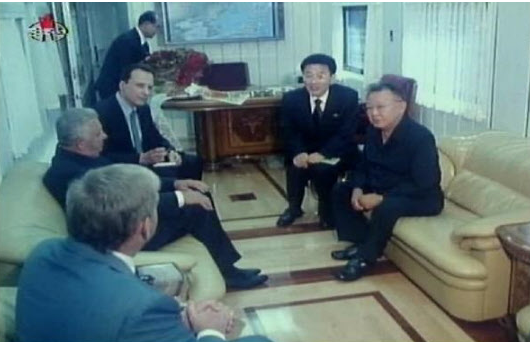
Konstantin Pulikovsky, the former presidential plenipotentiary envoy to the Russian Far Eastern Federal District who accompanied Kim Jong-il throughout his three-week, 20,000-kilometer cross-Russian train journey in 2001, offered a rare glimpse into the supreme leader’s private life and tastes in his memoir, *The Orient Express* (*Восточный экспресс*).
According to Pulikovsky’s recollections, the lifestyle aboard Kim Jong-il’s private armored train (often dubbed "The Sun") was lavish in the extreme, standing in stark contrast to the widespread deprivation inside North Korea at the time (which had just emerged from the Arduous March famine).
As the train traveled across Russia, stops and chartered flights were used to deliver an uninterrupted supply of premier Grand Cru wines from Bordeaux and Burgundy, fine cognacs such as Hennessy and Rémy Martin, live lobsters, and fresh caviar.
It is written that Kim Jong-un said he "likes salo (salted pork fat) and often drinks strong coffee."
The book reveals that Kim Jong-il's conversations during the journey centered heavily on gourmet dining and culinary arts; Pulikovsky also observed that all of Kim's meals were prepared using provisions brought directly from North Korea, with even leftover scraps bagged and shipped back to Pyongyang.
Onboard hospitality matched the standards of luxury European and Russian grand hotels and state guest houses.
Authentic coffee brewed from carefully curated whole beans alongside premium loose-leaf teas were served around the clock by personal chefs and dedicated female waitstaff.
During formal banquets, private film screenings, and late-night conferences, high-grade freshly brewed coffee was consistently served alongside fine wines and Western spirits.
Pulikovsky’s account closely corroborates the memoirs of Kenji Fujimoto (*Kim Jong-il's Chef*), who served as Kim Jong-il’s personal sushi chef for over a decade.
Premium ingredients and luxury goods—ranging from coffee beans and spirits to specialized seasonings and exotic fruits—were procured directly from their countries of origin and air-freighted into Pyongyang.
Kim possessed an extensive knowledge of and keen fascination with Western culinary and cafe culture.
Among the North Korean elite and foreign service personnel during the Kim Jong-il era, familiarity with Western and Russian cultures through diplomatic postings turned espresso, drip coffee, and imported instant coffee into symbolic luxury items reserved for the privileged class.
This affinity laid the groundwork for the modern expansion of cafe culture seen in Pyongyang today, marked by the emergence of Viennese-style coffeehouses and espresso bars inside upscale hotels.
コメント