
Following the armistice that brought an end to the active fighting of the Korean War, North Korea rebuilt its devastated land in a remarkably short period, aided by a coalition of communist nations led by the Soviet Union.
In 1956, however, tensions flared between the Soviet Union and China, splintering what had been a collaborative communist bloc.
With this alliance beginning to fracture, the regime of Kim Il-sung—originally established with robust Soviet backing—started pivoting toward self-reliance.
It sought to ramp up domestic production grounded in the Juche ideology of independence, self-sustenance, and self-defense.
Even so, North Korea faced chronic labor shortages driven by war casualties and widespread defections to the South. This urgent need to replenish the workforce served as the backdrop for the repatriation campaign that brought ethnic Koreans residing in Japan (Zainichi) to North Korea.
At the time, drinking coffee was virtually unheard of among ordinary North Koreans, apart from a few venues catering to foreigners.
Yet, having grown fond of Japanese coffee shop culture and receiving instant coffee in care packages from relatives back in Japan, some returnees continued to drink coffee in their new homes.
Shifts in the Communist Bloc Prompted by Khrushchev’s De-Stalinization
Following the death of Joseph Stalin in 1953, a fierce power struggle unfolded among Georgy Malenkov, Lavrentiy Beria, Vyacheslav Molotov, and Nikita Khrushchev, lasting until roughly 1958.
Amid this turmoil, Khrushchev delivered his "Secret Speech" denouncing Stalin in 1956.
He condemned Stalin’s personality cult, arbitrary rule, unlawful persecution and purges of military and party leaders, and the widespread use of torture and false accusations.
This speech triggered profound reverberations across Eastern Europe.
In Hungary, László Rajk—a prominent communist official executed in 1949 under fabricated espionage charges during the Stalin era—was officially rehabilitated, and his remains were reinterred on October 6, 1956.
In Poland, Władysław Gomułka, who had been purged under Stalin’s rule, was restored to power.
In Hungary, a student demonstration for democratization erupted on October 23, quickly escalating into a nationwide revolution that brought the reformist Imre Nagy to the premiership.
The Nagy government moved rapidly toward democratization and liberalization, pushing to dismantle the one-party dictatorship, withdraw from the Warsaw Pact, and declare Hungarian neutrality.
However, while the Soviet Union had repudiated Stalin, it had by no means renounced communism or its sphere of influence.
Soviet forces militarily intervened, occupied Budapest, and arrested Nagy.
Following a secret trial orchestrated by the KGB, Nagy was executed by hanging on June 16, 1958.
János Kádár, who replaced Nagy, thoroughly crushed the protesters and suppressed the democratic movement.
Under the Hungarian Socialist Workers' Party, the one-party communist dictatorship remained firmly in place.
The Sino-Soviet Split
In the spring of 1956, China’s Mao Zedong initially showed a degree of support for criticizing Stalin’s errors.
Mao himself had long harbored deep frustration with Stalin’s policy toward China.
In meetings with the Soviet ambassador, Mao spoke candidly about Stalin’s misjudgments and heavy-handed interference in the Chinese Revolution.
Following the uprisings in Poland and Hungary, however, the Chinese leadership rapidly grew wary.
They came to believe that an outright repudiation of Stalin could unravel the very foundations of the socialist system itself.
The crux of Khrushchev’s denunciation was the "cult of personality."
He targeted the entire system that deified Stalin as an infallible leader—one where the leader's decrees superseded the party, dissent was eliminated, and immense power was concentrated in the hands of a single individual.
For the Chinese leadership, this critique hit dangerously close to home, as it risked inviting the inevitable question: "What about the personality cult surrounding Chairman Mao?"
North Korea Purges the Soviet and Chinese Factions, Consolidating Kim Il-sung’s Dictatorship
In June and July of 1956, Kim Il-sung embarked on a tour of the Soviet Union and Eastern Europe. During these visits, Nikita Khrushchev pressed him firmly to address his personality cult and reform his political and economic governance.
Upon Kim’s return, party cadres from both the Soviet-aligned faction and the Yan'an faction—who had operated in Yan'an, China—mounted an open challenge, arguing that Kim's cult of personality was untenable and that inner-party democracy needed to be restored.
This opposition came to a head during the Plenary Session of the Central Committee of the Workers' Party of Korea on August 30–31, 1956 (an event known as the August Faction Incident). However, Kim held the backing of the party majority and turned the tables, swiftly ousting his critics. Several of them fled across the border into China.
Viewing Kim’s crackdown as an overreach, the Soviet Union and China dispatched a joint high-level delegation to Pyongyang in September 1956, led by Soviet Deputy Premier Anastas Mikoyan and Chinese Defense Minister Peng Dehuai. They demanded that Kim Il-sung:
- Reinstate the purged officials
- Release those under arrest
- Tolerate internal party dissent
Kim initially conceded, convening another party meeting to walk back several of the earlier punitive decisions.
To Kim, however, this intervention was intensely humiliating, and he regarded it as an unacceptable breach of North Korean sovereignty.
While Kim acquiesced on the surface, he resumed purging his rivals as soon as the Sino-Soviet delegation departed.
Ultimately, every major competing political faction—the Soviet faction, the Yan'an faction, and the domestic faction—was systematically wiped out.
By the late 1950s, the Workers' Party of Korea had effectively transformed into a monolithic party centered entirely on Kim Il-sung. In the end, the de-Stalinization wave triggered by Khrushchev only served to entrench and intensify Kim’s absolute dictatorship.
The Chollima Movement
Having purged the pro-Soviet and Yan'an factions in the August Faction Incident, Kim Il-sung sought to offset declining foreign aid through mass mobilization and consolidate an independent path—a drive that would later crystallize into the Juche ideology.
At the December 1956 Plenary Session of the Central Committee of the Workers' Party of Korea, Kim initiated the Chollima Movement, a mass mobilization campaign for economic construction that gained full momentum around 1958. Named after a mythical winged horse said to cover a thousand li (roughly 400 kilometers) in a single day, the movement operated under the slogan "Let us advance at the speed of Chollima," aiming to fast-track post-war reconstruction and socialist industrialization.
The Chollima Movement demanded an enormous supply of labor.
For a nation that had lost a vast portion of its population during the Korean War, welcoming ethnic Koreans from Japan (Zainichi)—many of whom were skilled and educated—offered clear pragmatic benefits: a vital influx of both manpower and capital.
Against this backdrop, Kim Il-sung issued a statement in September 1958 officially welcoming the repatriation of Zainichi Koreans.
The Zainichi Korean Community in Post-WWII Japan
In August 1945, with the collapse of Japanese colonial rule, approximately two million people of Korean heritage were residing in Japan.
While the vast majority returned to the Korean Peninsula, several hundred thousand remained behind.
In the immediate wake of liberation, local Korean self-governing associations cropped up across Japan.
Bringing these decentralized groups under a single umbrella, the League of Koreans in Japan (known as Chōren) was inaugurated on October 15, 1945. Before long, however, communist figures such as Kim Chon-hae, along with activists close to the Japanese Communist Party (JCP) and left-wing nationalists, seized commanding influence within the league.
Unlike its contemporary counterpart, the JCP of that era had tilted sharply toward an armed, revolutionary posture.
In response, multiple anti-communist organizations formed in opposition to Chōren. These rival groups eventually coalesced on October 3, 1946, founding the Korean Residents Union in Japan (known as Mindan) at Tokyo's Hibiya Public Hall.
The geopolitical landscape soon fractured permanently: in August 1948, the Republic of Korea (South Korea) was established in the American-occupied southern half of the peninsula, followed in September by the Democratic People’s Republic of Korea (North Korea) in the Soviet-occupied north.
Mindan aligned itself with the South, while Chōren threw its support behind the North.
Before long, Chōren was forcefully dissolved by the Japanese government at the behest of the Supreme Commander for the Allied Powers (GHQ), which branded it an anti-occupation, violent organization. Reorganizing its dissolved elements, the pro-North faction established the Democratic Front of Koreans in Japan (Minsen) in 1951.
Around 1954, North Korea began heavily emphasizing the status of Zainichi Koreans as "overseas citizens of the Republic." The Kim Il-sung regime questioned Minsen’s existing orientation, asking, in essence: "Why are Koreans taking direction from the Japanese Communist Party and fighting for a Japanese revolution? As Koreans, should you not be working toward the Korean revolution and the reunification of our homeland?"
Echoing this critique, Han Dok-su and other key figures broke with Minsen and repudiated the JCP line, founding Chongryon (the General Association of Korean Residents in Japan) in 1955.
Chongryon would go on to serve as the chief driving force behind the repatriation project to North Korea.
Chongryon’s Promotion of the Zainichi Repatriation Project
In September 1955, shortly after the formation of Chongryon, an official delegation visited Pyongyang and met with Kim Il-sung. Kim expressed strong support for Han Dok-su, urging the Zainichi movement to move away from overthrowing the Japanese government as its primary goal and instead align directly with North Korea’s political line—focusing on opposition to the United States and the Syngman Rhee regime, as well as advancing Korean reunification.
Beginning in the late 1950s, North Korea funneled educational aid and scholarships to Chongryon-affiliated ethnic schools. Through instructional materials, films, cultural exchanges, and sponsored visits to the homeland, the regime systematically deepened its ties with the Zainichi community.
By late 1958, Chongryon began championing resettlement in North Korea not merely as an individual migration choice, but as a mass campaign of "repatriation to the socialist motherland." Leveraging its local branches, ethnic schools, rallies, and official newspapers, Chongryon promoted promises such as:
Guaranteed employment in the motherland
ree provision of housing
Universal access to education and medical care without financial worry
The chance to participate in building a socialist nation
In November 1959, the Propaganda Department of Chongryon’s Central Standing Committee published the second volume of its handbook, Materials for Returnees. The pamphlet claimed that people "call the northern half of the Republic a paradise on Earth and enjoy happy lives," heavily accentuating ample food supplies, readily available housing, and steadily rising living standards.
The Repatriation Project: An Aspiration for Liberation from Discrimination
Around 1959, when the repatriation project began, Zainichi Koreans in Japan were subjected to severe discrimination as well as systemic and institutional marginalization.
This hostile environment was a decisive factor that made the campaign's promise—that moving to North Korea would liberate them from discrimination—deeply persuasive.
Under Japanese colonial rule, Koreans living in Japan had been treated as Japanese nationals.
However, in 1952, following the entry into force of the San Francisco Peace Treaty, they were stripped of their Japanese nationality and classified as foreign nationals.
Consequently, by the late 1950s, Zainichi Koreans were barred from the National Pension system, National Health Insurance, and child allowances due to nationality clauses—exclusions that, in many cases, persisted until Japan ratified the UN Refugee Convention in the 1980s.
Access to public housing was likewise restricted.
Employment opportunities in civil service and major corporations were virtually nonexistent, and private firms routinely denied them jobs based on nationality and ethnic origin.
As a result, many were driven into self-employment, day labor, and marginalized informal industries, driving their welfare dependency rates far higher than the national average for Japanese citizens.
Consequently, the Japanese government and several local municipalities quietly welcomed the repatriation project as a way to relieve the public welfare burden.
Deep-seated social prejudice permeated everyday life, from apartment rental rejections and marriage discrimination to schoolyard bullying, forcing many to conceal their Korean heritage simply to survive.
This pervasive sense of entrapment—coupled with deep distrust toward the South Korean government and Chongryon's relentless promotion of North Korea as a "paradise on Earth"—convinced tens of thousands to depart for the North, even though the vast majority originated from the southern half of the peninsula.
Japanese Media Endorsements of the Repatriation Project
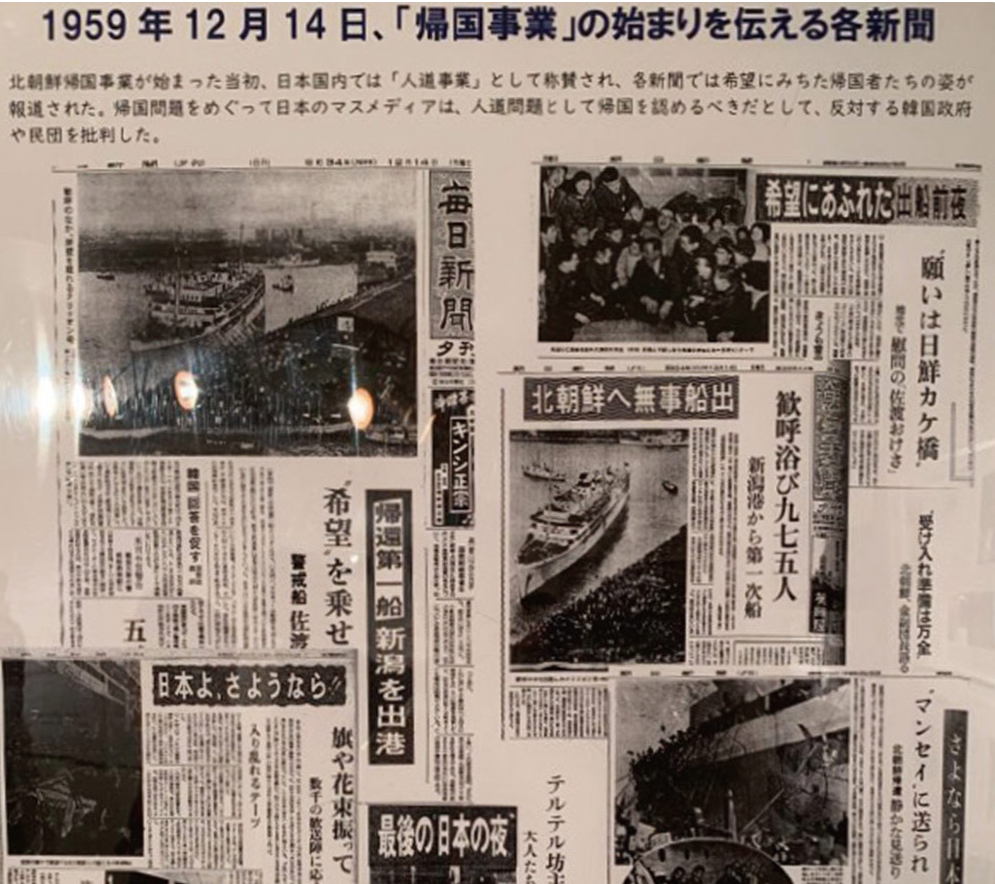
Major Japanese media outlets—including the Asahi, Yomiuri, Mainichi, and Sankei newspapers, alongside the Kyodo News agency—consistently reported on North Korea’s postwar reconstruction and the repatriation campaign in a positive light.
The physical reconstruction of Pyongyang was indeed genuine: newly built apartment complexes, broad avenues, the Moranbong Theatre, and Kim Il-sung University rapidly sprang up from the rubble of the Korean War, heavily subsidized by aid from the Soviet Union, China, and Eastern bloc nations.
Japanese society framed the repatriation project primarily as a humanitarian issue.
Against the backdrop of the severe poverty and institutional discrimination Zainichi Koreans endured in Japan, North Korea appeared to be a far better alternative.
Coverage of early returnees reinforced this impression. Media reports regularly featured welcoming ceremonies at Chongjin Port and newly allocated apartments; from 1960 onward, they often showcased images of early arrivals seemingly thriving and working with vigor.
A major cultural touchstone of this period was Goro Terao’s 263-page book, North of the 38th Parallel (Sanpachisen no Kita), published by Shin Nihon Shuppansha in April 1959, based on his visit to North Korea in September 1958.
While Terao did not entirely omit North Korea's poverty and backwardness, a defining characteristic of his work was framing every hardship as a temporary growing pain of socialist construction that would soon be overcome.
Terao was particularly captivated by the furious pace at which war-torn North Korea was erecting factories and residential quarters.
He asserted that North Korea was overcoming its backwardness at the speed of a Chollima (a mythical winged horse).
He went so far as to predict that upon completing its Five-Year Plan, North Korea would surpass the standard of "Japan from two years ago" in nearly every sector except steel production.
Terao offered a remarkably euphoric forecast, writing that Japan would only be able to claim the title of "the leading industrial nation of the Orient" for another year or two at most.
Terao also predicted that North and South Korea would achieve reunification in some form by roughly 1963 or 1964.
This assertion proved crucial for the Zainichi community.
More than 90 percent of Koreans living in Japan at the time traced their roots to the southern half of the peninsula. Many initially hesitated, reasoning: "I am from Gyeongsang Province or Jeju Island, so North Korea is not my home."
However, if one believed that the peninsula would reunify within a few years, it became rational to conclude: "I can go to the North for now, and it will soon be reunited with my hometown in the South anyway."
The book frequently employed the device of interviewing ordinary citizens on the street, all of whom testified that their lives were steadily improving.
Belgian historian Adrien Carbonnet observed that this appearance of authenticity—gathering testimony directly from everyday locals—lent the book immense credibility, serving as a decisive factor that spurred southern-origin Zainichi Koreans to leave for the North.
Indeed, Kim Jong-guk, who later defected from North Korea, testified that it was precisely after reading North of the 38th Parallel that he began filing the paperwork to repatriate.
Mindan and the South Korean Government: Fierce Resistance and Direct Action Against the Repatriation Project
Mindan (the Korean Residents Union in Japan) was among the fiercest opponents of the repatriation campaign that began in 1959.
At the time, the overwhelming majority of Zainichi Koreans traced their origins to the southern half of the Korean Peninsula—modern-day South Korea.
In fact, an estimated 97 percent of those targeted for repatriation were originally from the South. From the perspective of Mindan and the South Korean government, these individuals' true homeland was the Republic of Korea, not the North.
On February 13, 1959, the Japanese cabinet adopted a policy permitting repatriation to North Korea provided it was based on an individual’s free will.
The South Korean government fiercely protested the decision.
Seoul viewed Tokyo’s official facilitation of the migration as an unconscionable act of handing over South Korean citizens to a communist regime.
Japan's own Diplomatic Bluebook records that the South Korean side denounced the policy as "forced deportation" and maintained fierce resistance right up until the embarkations began.
Mindan launched an extensive counter-propaganda campaign, issuing dire warnings:
- Personal freedom will vanish under a communist regime.
- Once you set foot in North Korea, you can never return to Japan.
- Do not fall for Chongryon's deceitful propaganda.
Mindan mobilized its entire organizational apparatus, resorting to direct action that included sabotaging rail lines to halt repatriation trains.
Just before the first ship departed in December 1959, an incident occurred in which activists attempted to block a train bound for Niigata, resulting in eleven arrests.
Tensions escalated further at the Niigata Red Cross Center, a staging facility where returnees were processed, had their intent verified, and completed departure formalities before boarding ships at the Port of Niigata.
A plot to bomb the facility was uncovered.
Two men, Cha Jin and Lee In-gi, were arrested, and dynamite was seized. While often categorized as part of the radicalization of Mindan’s anti-repatriation struggle, evidence has never confirmed that Mindan’s central leadership officially ordered the bombing; subsequent investigations pointed to covert operations coordinated through South Korean intelligence channels, notably involving Kim Yeong-hwan, an intelligence officer stationed at the South Korean Mission in Tokyo.
In response to Seoul's outrage, the Japanese government pushed back, arguing that the policy was not an act of diplomatic recognition of North Korea, but rather a fundamental question of an individual's freedom to choose their place of residence.
Tokyo maintained its official position: the operation was strictly a humanitarian resettlement undertaken voluntarily, not a forced deportation.
The Reality After Repatriation
For the returnees themselves—roughly 93,000 people who crossed over believing promises of a "paradise on Earth" free from concerns over food, clothing, and housing—the reality awaiting them was a world away from the propaganda.
Countless testimonies from defectors recount how returnees suffered from severe poverty and discrimination, with many ultimately cast into political prison camps (kwalliso).
Under North Korea’s Songbun caste system, returnees were classified as an untrustworthy group tainted by their time in a capitalist country, placing them under constant state surveillance. While North Korea claimed to be an egalitarian socialist society, it operated under one of the world's most rigid and unforgiving social classification systems, dividing the populace into three primary tiers:
The Core Class (Haeksim): Descendants of those who fought alongside Kim Il-sung in the anti-Japanese partisan struggles, bereaved families of soldiers killed in the Korean War, and top party and military cadres.
The Wavering Class (Dongyo): Ordinary pre-war peasants, laborers, and a portion of returnees from China and Japan.
The Hostile Class (Choktae): Former landlords, capitalists, practicing Christians and Buddhists, families of defectors to South Korea, and the majority of returnees from Japan.
In the eyes of the North Korean authorities, Zainichi returnees had breathed the air of a capitalist society; they were viewed as potential spies and placed squarely within the hostile class, subject to intense suspicion.
Returnees were effectively severed from family members left behind in Japan, and even Japanese spouses who had accompanied their husbands were barred from temporary visits back home for decades. Recent research corroborates that the vast majority of the over 93,000 returnees never set foot in Japan again.
Around 1961 to 1962, families in Japan began receiving puzzling, cryptic letters from relatives who had departed earlier. Whispers that reality did not match the regime's claims quickly spread, leading to a dramatic plunge in the number of repatriation applicants.
Because outgoing letters were thoroughly inspected and censored by North Korean authorities, writing candidly—such as "there is no food," "I want to come home," "do not come here," or "it is politically dangerous"—carried immense peril. The United Nations Commission of Inquiry on Human Rights in the DPRK (COI) formally confirmed that correspondence bound for Japan was routinely intercepted and censored.
The UN report documents an instance where a father in Japan wrote to his relatives in North Korea saying, "I am thinking of sending my daughter over to join you." The reply he received abruptly took on a coded tone. The family in North Korea wrote back, "Children belong with their parents," among other indirect statements. Unable to write directly, "Under no circumstances send your daughter here," the family relied on veiled language, which the father in Japan understood as an urgent warning.
In another instance, a returnee in North Korea showed the reverse side of a postage stamp affixed to a letter sent to his older brother in Japan. Hidden beneath the stamp was a handwritten plea: "Dear brother, we do not even have the freedom to go outside. Please, brother, never come here."
I Repatriated to the North This Way, but Have Since Escaped and Returned" — Tongna Story: )
To circumvent the censors and convey a warning not to come, returnee Eiko Kawasaki repeatedly wrote to her family: "Let us meet together once my younger brother graduates from university and gets married, along with his bride." At the time, her brother was only a fourth-grader in elementary school; university graduation and marriage were far off in the distant future. By relentlessly invoking a timeline decades away, she subtly signaled to her family that they must stay away.
Remittances to Returnees and Coffee
Despite being marketed as a "paradise on Earth," reality in North Korea proved harsh, and returnees soon began writing letters pleading for supplies and money from relatives back in Japan. Seeing returnees as a valuable source of hard currency, the North Korean authorities quietly condoned and even encouraged contact with their families abroad.
Relatives in Japan wired funds through Chongryon-affiliated financial institutions and travel agencies, or brought cash and Japanese goods—such as clothing, home appliances, bicycles, and medicine—directly aboard the repatriation vessel Mangyongbong (and later the Mangyongbong-92 from 1992 onward) during visits to North Korea. Postal parcels were also heavily utilized.
Inside North Korea, these remittances were exchanged for foreign exchange certificates redeemable only at specialized "hard-currency shops" (Waehwasangjeom) or converted into local currency, allowing the regime to skim hefty transaction fees and pocket massive foreign exchange margins. The flow of funds worked like this: relatives in Japan sent Japanese yen → North Korean banks absorbed the genuine foreign currency into state reserves → returnees were handed domestic-only Foreign Exchange Certificates (Pakkontong) → returnees redeemed them at state-run foreign exchange shops. Through this cycle, the regime systematically funneled hard currency directly into state coffers.
The receipt of remittances created a stark divide in living standards among returnees. Those with family in Japan were often called Yapon-saram ("the Japanese"). They lived with a pronounced dual identity: subject to intense political surveillance on one hand, yet enjoying relative economic privilege on the other.
Memoirs by returnees and Japanese spouses describe the realities of domestic life, noting that boiling water was entirely a manual chore. Households relied on coal briquettes (yeontan) and firewood, while urban dwellings occasionally used electric hot plates during the hours when electricity was running. Gas pipelines were virtually nonexistent. Because the power grid was so erratic, coal stoves and firewood remained the only practical choice; most families boiled water once or twice a day—morning and evening—and stored it in vacuum flasks.
Living in constant fear of "surveillance" and "informant" and deprived of "freedom," if the remittances from Japan contained Japanese ingredients and seasonings, I would make inari sushi and ohagi, and enjoy curry and instant coffee, which are hard to come by in North Korea.
Against this backdrop, instant coffee became one of the most prized items sent in care packages during the 1980s and 1990s. Coffee itself was an extraordinary luxury in North Korea. Rather than drinking it themselves, recipients frequently used it as a high-value gift, offered it as a bribe to party and state officials, or sold it at local black markets (jangmadang) to raise desperately needed cash.
コメント