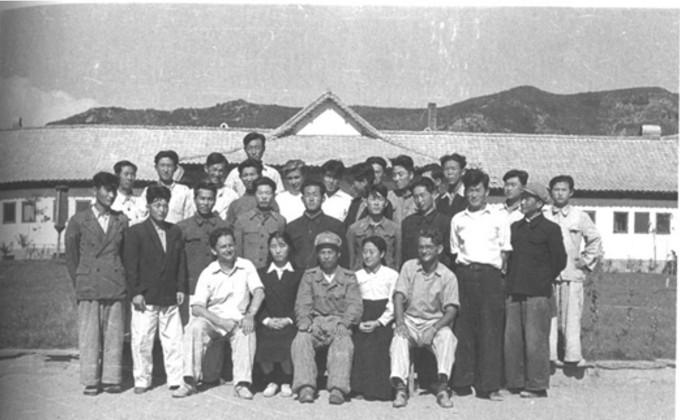
After the Korean War armistice, in order to rebuild the devastated country, North Korea received engineers from the Soviet Union, China, and Eastern European countries.
In particular, some Eastern European countries have a coffee-drinking culture, and people from those countries also drank coffee in North Korea.
Rebuild from devastation after the Korean War
The devastation was close to total.
The US bombing campaign, which ran essentially unopposed after 1951, destroyed most of the country's urban fabric — Pyongyang was largely rubble, and the majority of significant towns had lost most of their buildings. I
North Korea’s reconstruction after the Korean War was remarkably rapid.
Between roughly 1953 and the early 1960s, the country went from widespread wartime destruction to a rebuilt industrial economy with new apartment districts, factories, hospitals, railways, and power facilities.
But this was not simply a North Korean “self-reliance” success story: enormous assistance from the Soviet Union, China, East Germany, Czechoslovakia, Poland, Hungary, Romania, and other socialist states was crucial.
When the armistice was signed on 27 July 1953, North Korea faced an extraordinary reconstruction problem.
Cities such as Pyongyang, Hamhung, Wonsan, Sinuiju and Chongjin had suffered extensive bombing, while factories, railways, bridges, mines, power stations and housing had been damaged or destroyed.
Within days of the armistice, Kim Il Sung was already asking Moscow for large-scale economic assistance.
The reconstruction therefore had to happen on several fronts simultaneously.
Rebuild housing and entire cities, restore mines, steelworks, chemical plants and power stations, repair railways and bridges, restore agriculture, train engineers and technicians, rebuild hospitals and schools.
The government organized the first major phase through the Three-Year Postwar Reconstruction Plan (1954–1956).
Its official goal was initially to restore production to approximately the prewar 1949 level, but Kim Il Sung's government also used reconstruction to accelerate heavy industrialization.
Heavy industry received priority over consumer goods and agriculture.
So rather than merely rebuilding what had existed in 1950, North Korea tried to build a much more thoroughly socialist industrial economy.
Factories were enlarged or replaced with newer facilities, and economic activity became increasingly controlled by the state.
By the end of the 1950s, most major industrial production had recovered to or surpassed prewar levels, although sectors such as fertilizer and chemicals sometimes recovered more slowly.
The Soviet Union supplied industrial reconstruction
The USSR was extremely important, especially for heavy industry, machinery, technical expertise and large industrial installations.
Moscow helped North Korea restore industrial capacity while training North Korean engineers and specialists.
Soviet assistance fitted naturally with North Korea's strategy because the northern half of Korea had already inherited much of colonial Korea's heavy-industrial infrastructure—mines, hydroelectric facilities, chemical plants and metal industries.
But the Soviet Union was only one participant.
The reconstruction program was unusually international perhaps the only occasion on which the USSR, China, Eastern Europe and Mongolia cooperated on a socialist development project of this scale.
Foreign assistance represented roughly one-third of North Korea's 1954 financial budget.
China's role was enormous—and sometimes underestimated
China provided particularly important assistance.
After the fighting stopped, large numbers of Chinese People's Volunteer Army troops remained in North Korea.
They did not simply perform military duties: Chinese soldiers participated in rebuilding roads, railways, bridges, irrigation systems and buildings.
At its peak, 34 Chinese divisions remained in North Korea, although many withdrew in 1954–55 and the remainder left by 1958. Their labor represented a huge source of manpower that North Korea did not have to finance itself.
China also supplied materials, goods, technical specialists and training.
Research based on Chinese and Soviet archives argues that Chinese aid was comparable to, and in some areas may have exceeded, Soviet assistance during the 1950s.
Eastern European countries effectively divided reconstruction projects among themselves
One of the most fascinating aspects was that different socialist countries specialized in particular reconstruction projects.
For example, contemporary plans assigned:
East Germany Hamhung reconstruction, factories, electrical equipment, printing facilities
Czechoslovakia factories, vehicle-related facilities, cement works and power stations
Poland railway repair facilities, mines and transport equipment
Hungary chemical and machine plants
Romania cement, acetylene and brick-production facilities
Bulgaria textiles, food and other goods
USSR heavy industry, machinery, technology and large industrial projects
China labor, materials, infrastructure, training and economic aid
1954 U.S. intelligence assessment already documented many of these planned projects.
Eastern European medical teams also remained after the war.
Doctors and specialists from countries including Hungary, Romania, Bulgaria, Czechoslovakia, Poland and East Germany helped operate hospitals, train Korean medical personnel and transfer medical knowledge.
So reconstruction involved not only factories—it involved rebuilding an entire institutional system.
Who drunk cofee under Reconstruction from the Korean War
Postwar North Korea contained a substantial population of Soviet and Eastern European specialists :
engineers, architects, geologists, doctors, industrial advisers and military technicians.
Pyongyang was the administrative center where many of these missions, embassies and technical organizations were based.
The Soviet Union, East Germany, Czechoslovakia, Poland, Hungary and others all supplied technical personnel during reconstruction.
After the Korean War, coffee gradually became known in North Korea through foreign diplomats living in Pyongyang.
That is significant because diplomats were part of the same expatriate socialist-bloc milieu as visiting specialists and advisers.
So we can imagine a Soviet engineer visiting his embassy or a Polish or Czech technician attending an official reception and encountering coffee without difficulty.
On 16 May 1957, Soviet ambassador A. M. Puzanov recorded that Kim Il Sung discussed a recently concluded trade agreement with Indonesia.
North Korea was to export zinc, lead, cement, glass, fertilizer and other goods and import, among other things:rubber, tea, vegetable oil, coconut products, coffee and quinine.
It means coffee was not merely something that an ambassador occasionally brought in his suitcase.
The North Korean state was actively arranging commercial imports of coffee during the reconstruction period.
The quantities and intended consumers are unfortunately not stated.
But given how scarce foreign exchange was, it is unlikely that imported coffee in 1957–58 was intended for universal mass consumption.
Foreign residents did not necessarily rely on the same shops and ration system as ordinary Pyongyang citizens.
Archival accounts of the foreign diplomatic community show separate or semi-separate supply arrangements.
During the early 1950s, for example, foreign missions sometimes obtained provisions from special diplomatic shops, the Soviet community's shops, or through supply trips to China.
Hungarian diplomatic records describe staff going into Manchuria to purchase food when local supplies were inadequate.
By the reconstruction period, conditions had improved greatly, but the basic distinction remained: foreign specialists were a privileged category for provisioning purposes.
That makes coffee considerably more plausible in a foreign engineer's residence or canteen than in an ordinary Pyongyang worker's home.
The Korean engineer who was working with the foreign engineer was drinking coffee.
Thousands of Soviet, East German, Czechoslovak, Hungarian, and Polish technicians were in the country through the 1950s, concentrated exactly where Korean engineers were — the Hamhŭng chemical complex, power stations, machine plants, the design institutes in Pyongyang. Those missions brought their own supplies and had access to embassy stores. Coffee at a technical meeting, a foreign colleague's apartment, or an official reception was a realistic occurrence for a Korean engineer working alongside them.
Foreign engineers in Japan and Korean engineers trained abroad
A large cohort of the DPRK's technical cadre was educated in the USSR and Eastern Europe in the 1950s. Whatever else Moscow or Dresden gave them, it gave them exposure to the habit. Whether they could sustain it back home is another matter — and note that Kim Il Sung recalled and screened many of these students around 1958–62 precisely because foreign-educated cadres were seen as politically contaminated. Conspicuous foreign tastes weren't a safe thing to display in those years.
So the honest picture is two parallel material worlds in the same city: a small foreign population maintaining an approximation of home consumption behind compound walls, and a Korean population — engineers included — for whom coffee was something encountered at the boundary between the two, if at all.
コメント