Under Japanese rule before World War II, coffee shops operated in Pyongyang, North Korea, and coffee was consumed there.
However, with the start of the Pacific War, Japan prohibited the import of coffee. Subsequently, under Soviet rule, coffee may have been consumed in some Soviet occupation facilities, but tea was the main beverage. Then came the Korean War. American soldiers on the North Korean front drank coffee on a daily basis.
Start of Korean War
Kim Il Sung sent the Korean People’s Army across the 38th parallel on 25 June 1950 because he believed he had a rare opportunity to destroy Syngman Rhee’s government and reunify Korea under communist rule.
It was not simply an order imposed on him by Stalin; archival evidence indicates that Kim himself repeatedly pushed Moscow for permission to invade. Stalin had actually refused him several times in 1949.
The 38th parallel had originally been created in 1945 as an occupation boundary between Soviet and American forces after Japan's surrender. By 1948, however, two rival Korean governments existed:
DPRK in Pyongyang — Kim Il Sung
Republic of Korea in Seoul — Syngman Rhee
Both governments claimed to represent all Korea, rather than accepting the other Korea as a legitimate permanent state. Armed clashes were already occurring around the border before the full-scale war began.
Kim therefore saw an invasion less as conquering a foreign country and more as completing a Korean civil struggle through military reunification.
When Kim met Stalin in Moscow in April 1950, he argued that the war could be won rapidly.
Kim expected that Communist guerrillas and other opponents of Rhee in South Korea would support the North and that a popular uprising might accompany the invasion.
The North also possessed a major conventional military advantage. Soviet assistance had given it tanks, artillery and aircraft, while Washington had deliberately withheld heavy offensive weapons such as tanks from the South Korean army partly because it feared that Rhee himself might launch an attack northward.
This explains the remarkable speed of the initial offensive: Seoul fell only three days after the invasion.
Throughout 1949, Stalin refused Kim's requests because he feared that an invasion might provoke the United States and because he was uncertain that North Korea could win.
But the strategic environment changed dramatically during 1949–50.
The Communist side had recently enjoyed several major successes:
August 1949: USSR successfully tested an atomic bomb.
October 1949: Mao Zedong's Communists won the Chinese Civil War and founded the People's Republic of China.
June 1949: most American combat troops had withdrawn from South Korea.
Kim therefore approached Stalin again.
During their April 1950 discussions, Kim convinced Stalin that victory would probably be quick. Stalin gave conditional approval, but insisted that Mao Zedong also agree, because China might have to assist North Korea if the Americans intervened.
Mao reluctantly accepted the plan
Kim then went to Beijing in May 1950.
Mao had reservations—especially about possible American intervention—but after learning that Stalin had approved the operation, he ultimately accepted Kim's plan.
Kim also had reason to believe that Washington might not fight for South Korea.
American combat forces had largely withdrawn in 1949, and Korea was not viewed in Washington as important in the same way as Japan.
The U.S. State Department's historical account notes that Kim's government assumed South Korea was not considered a vital American strategic interest.
However, there's an important misconception here.
You sometimes hear that Secretary of State Dean Acheson's January 1950 "defensive perimeter" speech effectively gave Kim and Stalin a green light because Korea appeared to lie outside America's Pacific defense line.
The irony is that his initial military judgment was partly correct: North Korea nearly conquered the South. By September 1950, South Korean and American forces had been driven into the small Pusan Perimeter.
His catastrophic mistake was political: the United States did intervene—and intervened massively.
# The Course of the Korean War
June 25, 1950
Roughly 100,000 North Korean troops poured across the 38th parallel, launching a massive surprise attack. They quickly overwhelmed South Korean forces and captured the capital, Seoul, within days.
The United Nations Security Council authorized a military coalition (providing 90% of the military personnel from the U.S.) to defend the South.
August - September 1950
U.N. and South Korean forces were pushed to the brink of defeat, pinned into a small, 5,000-square-mile defensive rectangle in the southeastern corner of the peninsula around the port of Pusan.
September 15, 1950
U.S. General Douglas MacArthur orchestrated an audacious amphibious landing at Inchon, 150 miles behind North Korean lines.
The tactical masterstroke severed North Korean supply lines, allowing U.N. forces to break out of Pusan, recapture Seoul, and push North Korean forces all the way up to the Yalu River (the Chinese border).
October - November 1950
Feeling threatened by the approaching U.N. forces, hundreds of thousands of Chinese troops crossed the Yalu River into North Korea.
This massive counter-offensive routed U.N. troops, forcing them into a hasty and brutal retreat through the harsh winter, and pushing the front line back south of Seoul.
1951 - July 27, 1953
By mid-1951, the front line stabilized near the original border at the 38th parallel, settling into a grueling trench-warfare stalemate. After two years of negotiations, an armistice was finally signed, ending the fighting and establishing the heavily fortified Demilitarized Zone (DMZ).
The war was devastatingly lethal.
It is estimated that nearly 3 million people lost their lives, at least half of which were civilians whose cities and towns were caught in the crossfire and subjected to heavy bombing campaigns.
Because an armistice was signed rather than a formal peace treaty, North and South Korea technically remain at war today.
The Demilitarized Zone created in 1953 still serves as the de facto boundary between the two nations, making it one of the most heavily fortified frontiers in the world.
# Destruction of Pyongyang
Pyongyang was bombed extensively throughout the Korean War, and it was one of the most heavily hit cities of the conflict.
The US Far East Air Force began striking Pyongyang within weeks of the war's outbreak in June 1950, initially with B-29s aimed at what were classed as military-industrial targets: the city's rail marshalling yards, arsenal, airfield, and factories.
After China entered the war in late 1950, the campaign shifted. Restrictions on attacking urban areas were loosened, and incendiary raids were authorized.
Pyongyang was firebombed in early January 1951.
Later came the largest raids of the war: "Operation Pressure Pump" on 11 July 1952 involved over 1,200 sorties against targets across the capital, and an even larger raid followed on 29 August 1952.
In May 1953, in the war's closing months, US aircraft breached irrigation dams north of Pyongyang, flooding rice fields and rail lines — a tactic that remains among the most debated of the campaign.
By the 1953 armistice, most estimates put the destruction of Pyongyang at roughly 75% or more of its built area. Air Force commanders themselves spoke candidly about the scale — Curtis LeMay later said they had burned down essentially every town in North Korea.
Across the whole country, US forces dropped somewhere around 635,000 tons of ordnance, including tens of thousands of tons of napalm, exceeding the tonnage used in the entire Pacific theater of WWII.
# Coffee Cunlture in North Korea While Korean War is only to UN Army
For U.S. soldiers, coffee was almost the opposite of a luxury. Soluble/instant coffee was part of military field rations. U.S. military sources confirm that the small packets of instant coffee used during World War II continued to be issued during the Korean War.
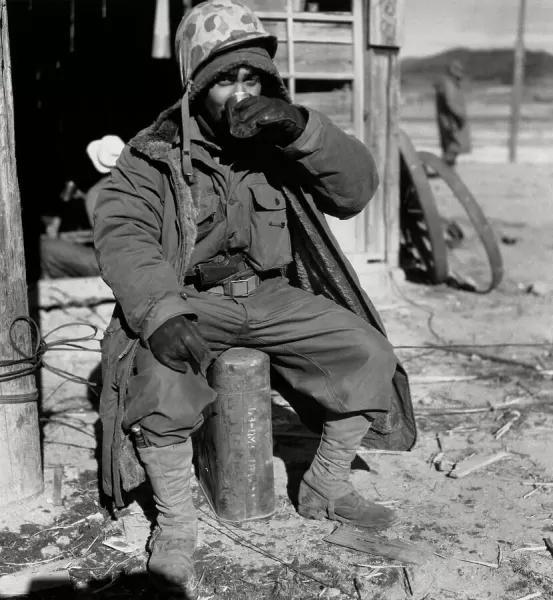
So a soldier sitting somewhere near the front in 1951 might have had a small metal cup of hot instant coffee prepared beside a tent, truck or field kitchen.
In the 1951–53 C-ration system, soluble coffee could be accompanied by separate sugar and powdered milk, meaning that soldiers could drink it black or make something resembling a simple sweet, milky instant coffee.
The photograph above is a good visual example: a U.S. soldier drinking coffee at Hagaru-ri in North Korea in November 1950, during extraordinarily cold conditions.
In an environment like that, coffee was caffeine, warmth and a small psychological comfort rather than a sophisticated culinary experience.
American military supplies—including instant coffee—circulated beyond the bases and units themselves.
Academic research on Korean coffee culture notes that instant coffee from American military rations became a valuable black-market commodity during and around the Korean War.
Therefore, Koreans who previously regarded coffee as an expensive drink associated with hotels, intellectuals or Westernized elites suddenly encountered a very different form:
powder + hot water = coffee.
It was cheap to prepare, required no grinder or brewing apparatus, and could easily be transported.
This helped transform coffee from something associated mainly with urban dabangs into something that could eventually be consumed in homes, offices and workplaces. Korean cultural histories consequently treat the Korean War and American military presence as a major catalyst in the popularization of instant coffee.
After the 1953 armistice, coffee culture expanded remarkably quickly.
As reconstruction began, dabangs multiplied; one Korean cultural history estimates that by the late 1950s there were more than 3,000 coffee shops in South Korea, roughly one-third of them in Seoul.
while South Korea was being flooded with American military instant coffee during 1950–53, North Korea was cut off from precisely this American supply network.
That divergence may be one of the reasons why the history of everyday coffee consumption developed so differently on the two sides of the peninsula.
Soviet advisors drank tea.
The Chinese People's Volunteers, who made up the bulk of the manpower from late 1950, were famously underfed — their field ration was largely chaomian, a parched flour-and-salt mixture eaten dry, sometimes with snow.
Coffee wasn't a scarce luxury in that army; it simply wasn't in the supply concept at all.
Meanwhile the north was under sustained bombing that flattened its cities, so the café culture is somewhat moot — there weren't functioning commercial districts to have one in.
コメント