From now on, I talk about Coffee stroy of North Korea.
Formerly , I talked about the series of Korea coffee story.
But after world war II part, this is about only about South Korea.
In the fact, in Korean Peninsula, one more country exists, the Democratic People's Republic of Korea(DPRK).
Korea had been a Japanese colony since 1910.
When Japan surrendered in 1945, the US and USSR hastily agreed to split the peninsula at the 38th parallel to accept the surrender — a line drawn in a matter of hours, meant to be temporary.
During this period, coffee culture had all but vanished in North Korea; it existed only to a very limited extent, perhaps within certain facilities of the Soviet occupation forces.
Korea Kim Il Sung, the First Leader of North Korea
After Japan surrendered in August 1945, Soviet forces occupied Korea north of the 38th parallel.
They needed Korean officials who could establish a friendly government while remaining responsive to Soviet instructions.
Kim Il Sung appeared suitable because:
- He had fought Japanese forces in Manchuria.
- He had spent the early 1940s in the Soviet Union.
- He had served as an officer in the Soviet Red Army’s 88th Brigade.
- Soviet officers already knew him and considered him politically dependable.
- At 33, he was young and lacked a large independent political organization that could resist Soviet control.
Soviet authorities, ultimately with Stalin’s approval, selected Kim as the leader they would promote in northern Korea.
The Library of Congress describes him as having been chosen because Moscow expected him to follow Soviet direction.
Kim returned to Korea in September 1945 with other Korean veterans of the Soviet 88th Brigade.
Most ordinary Koreans did not yet know him.
On 14 October 1945, the Soviet authorities presented him at a large public rally in Pyongyang as a prominent anti-Japanese resistance leader.
Soviet officers stood beside him, and the event effectively launched his public political career.
When the Soviets arrived, northern Korea already had local people’s committees and respected nationalist leaders.
Cho Man-sik opposed the proposed international trusteeship over Korea, which Moscow supported.
In early 1946 the Soviet authorities removed him from political life and placed him under detention.
Cho’s removal eliminated the northern politician with the strongest independent popular standing. Kim, by contrast, supported Soviet policy and benefited directly from the confrontation.
In December 1945, the Soviets placed Kim at the head of the northern branch of the Korean Communist Party.
In February 1946, he became chairman of the Provisional People’s Committee of North Korea, effectively making him the chief Korean administrator in the Soviet occupation zone.
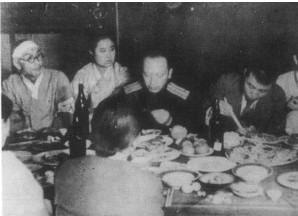
The Red Army House is a social club for the occupation forces.
After the Soviet occupation of northern Korea in August 1945, the Red Army established in Pyongyang a Soviet Officers’ Club, more precisely the Soviet military institution usually called a House of Officers (Дом офицеров, Dom ofitserov).
It was not primarily a Korean café or nightclub.
It was a military cultural and social center for Soviet officers and their families attached to the Soviet 25th Army, whose headquarters were in Pyongyang.
When the Soviet 25th Army occupied northern Korea in August 1945, Pyongyang became its principal headquarters city.
Soviet forces were not merely combat troops; they brought with them an entire military administrative and cultural infrastructure.
An archival-based history published by the Russian Ministry of Defense's Military Historical Journal states that every field army in the Primorye Military District had its own army newspaper, House of Officers, and Red Army song-and-dance ensemble.
For the 25th Army specifically, the army newspaper was Krasnoe Znamya ("Red Banner"), and the army also had a House of Officers.
The headquarters of the 25th Army was in Pyongyang.
So the Pyongyang Soviet Officers' Club was essentially one component of the 25th Army's permanent garrison infrastructure.
There is a slight terminology problem.
Before 1946 these institutions were normally called Houses of the Red Army — Дом Красной Армии.
After the postwar reorganization they became Houses of Officers — Дом офицеров.
An American delegation of the U.S.-Soviet Joint Commission traveled from Seoul to Pyongyang.
After meetings and a large political demonstration, the Americans were taken to the Soviet Officers' Club at 8:30 p.m.
The official American report says that they were entertained there by:“a chorus of about 30 voices and an orchestra, all of the Red Army.”
The audience also included Soviet officers and their dependents, and the report explicitly notes that no Koreans were present among the guests.
That little detail is important.
It indicates that, at least for this particular diplomatic entertainment, the club functioned as a distinctly Soviet social space inside Pyongyang, rather than as a Soviet-Korean public cultural center.
It probably looked less like what we would today call an "officers' bar" and more like a small military palace of culture.
A typical Soviet House of Officers contained an auditorium or cinema, meeting rooms, reading facilities and spaces for concerts, lectures and social activities.
Soviet military Houses of Officers were explicitly intended for the cultural recreation of soldiers, officers and their families.
There is another intriguing piece of evidence concerning the Pyongyang institution.
There were also Korean staff members, but it was a facility for the Russian occupation forces.
A Russian-language recollection concerning a Soviet Korean family describes a Korean man obtaining work after liberation as an artist at the House of Officers, while his nephew obtained work there as an assistant projectionist. The passage describes the projectionist operating films for the institution.
Because this is a personal recollection rather than an administrative record, it should be treated somewhat cautiously.
But it fits perfectly with the normal organization of a Soviet House of Officers.
The 1947 American report describes an occasion at which the attendees were Soviet officers and dependents and there were no Korean guests.
That does not mean Koreans never entered the building. The recollection about a Korean artist and Korean assistant projectionist suggests that local Koreans could work there. And Soviet Koreans—ethnic Koreans from the USSR serving as translators, propagandists and administrators—were closely integrated with the Soviet occupation administration.
The distinction therefore seems to have been approximately:
social membership/audience → predominantly Soviet personnel and families employees/translators/technical staff → could include Koreans and Soviet Koreans
For ceremonial occasions, selected Korean political leaders may also have been admitted, although I have not yet found strong documentation proving that Kim Il Sung, for example, regularly socialized at this particular club.
The club is interesting because it shows that Soviet personnel in Pyongyang existed to some degree in a parallel Soviet social world.
The 25th Army had not just military headquarters but newspapers, printing facilities, cultural ensembles and the Officers' House. It even had a department responsible for trade and everyday-service enterprises.
The possibility that coffee was served in Soviet Houses of Officers
There are several reasons why coffee is quite plausible.
Soviet Houses of Officers were not merely theaters. They commonly incorporated dining or buffet facilities; surviving descriptions of Soviet officers’ houses include dedicated dining/buffet rooms.
And Soviet urban hospitality culture certainly included coffee by the 1940s—for example, Moscow’s wartime/postwar cocktail establishments offered coffee-based drinks alongside other refreshments.
The important qualification is that coffee was not the default Soviet hot drink in the way tea was. Real coffee was an imported, relatively scarce commodity in the USSR, particularly during and immediately after World War II. Therefore, for an ordinary daily refreshment counter in Pyongyang, I would rank the possibilities roughly as:
tea → much more likely
coffee or coffee substitute → possible
real imported coffee served routinely to everyone → less likely
There is also a second route by which coffee could have been available: pre-1945 Japanese colonial stocks and commercial infrastructure. Pyongyang had been a substantial Japanese colonial city, and coffee was already known in urban Korean/Japanese restaurants, hotels and cafés before liberation. Soviet occupation forces requisitioned and reused existing urban buildings and supplies. I have not found evidence showing that the Officers’ Club inherited a particular café's coffee stocks, however, so that part remains inference rather than documentation.
Coffee wasn't part of military provisioning. The wartime ration norms specify tea and sugar — one gram of tea and 35 grams of sugar per day — with no coffee anywhere in the schedule. In Soviet civilian life it was an import scarcity item, and the substitute drinks were the normal thing: chicory was the most common replacement, along with barley and rye "coffee," which had a smoky, astringent taste and were often blended with chicory. These weren't improvised — they were a standardized industrial product category under OST NKPP 493, approved by the People's Commissariat of the Food Industry on 29 May 1939, and they spread especially widely after the Second World War. So if something called "coffee" was poured in a Soviet garrison establishment in 1946, the odds strongly favour a кофейный напиток of roasted barley, acorn, or chicory.
That leaves three routes by which real coffee could plausibly reach a House of Officers table, in rough order of likelihood: a Voentorg delivery from the Union for a senior establishment (occupation garrisons were supplied with goods civilians at home struggled to get); trophy stocks from captured Japanese depots, though this is thin given the five-year import ban; and American channels — there was regular US–Soviet contact during the Joint Commission period in 1946–47, and the American zone had coffee in abundance.
The standard breakdowns of food shipments list 617,000 tons of flour, 610,000 tons of sugar, 240,900 tons of canned stew plus 469,400 tons of other canned goods, 100,300 tons of egg powder, and 92,500 tons of dried and canned milk — the famous items, none of them coffee. And there was no institutional pull for it:
the Red Army ration specified tea, not coffee.
The macro picture confirms the scarcity, too. Soviet coffee imports were wrecked by the war and the postwar rationing system, and only returned to the pre-revolutionary level of about 12 tonnes a year by 1950 — a trivial national volume, which is part of why coffee stayed a curiosity in the USSR until the 1960s–70s.
コメント