
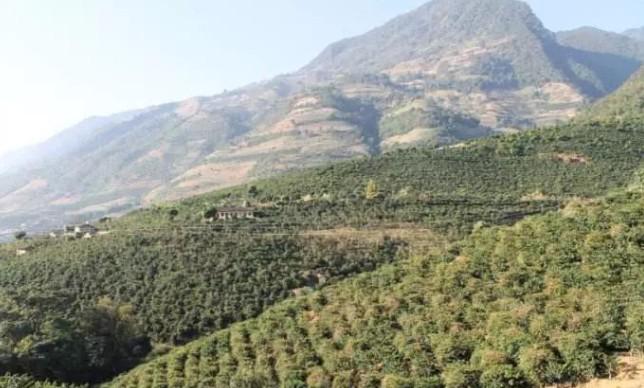
Coffee producing regions
Coffee is produced in China in Yunnan, Guangdong, Hainan. However, Yunnan is currently the largest coffee-producing region.
Because Yunnan combined the right ecology for Arabica with the right political-economic buildup, while Hainan fit Robusta better and Guangdong evolved into a trade/industry/consumption hub rather than a major farm base.
That is the core reason. Yunnan now accounts for roughly 98–99% of China’s coffee production in the academic literature, and its main zones are places like Pu’er, Baoshan, Dehong, and Lincang.
The biggest advantage was terrain and altitude.
Yunnan has extensive mountain zones where coffee can be grown from roughly 760 to 1,640 meters in places like Xinzhai, with Arabica planted higher up and lower zones still usable for other varieties.
That kind of elevation is much closer to the profile associated with quality Arabica than China’s hotter, flatter southern coastal zones.
FAO’s Yunnan material and other studies consistently point to Yunnan’s highland environment as a major structural advantage.
The coffee industry's resurgence under the reform and opening-up policy
As Chinese society shifted towards a reform and opening-up policy, everything changed, and the coffee industry in Yunnan Province attempted a fresh start with government support.
The coffee factory of Yunnan Provincial Agricultural and Commercial Company visited Shanghai for an inspection, and subsequently hired Mr. Zhang Baocun as a technical advisor in 1983.
Zhang Baocun was the founder of CPC Coffee, the predecessor of Shanghai Coffee Factory, which was the only coffee factory operating in China during the Cultural Revolution.
He founded CPC Coffee in 1935, before the war, when China was still a capitalist country.
However, after the Communist Party came to power, he, a businessman from the capitalist era, was arrested in 1950 for holding capitalist ideals and spent 24 years in prison.
Later, when Deng Xiaoping came to power and China adopted a reform-and-opening socialist market economy system, he made a comeback in the coffee industry.
Zhang Baocun founded a coffee company called Yunling Coffee in Yunnan Province, but returned to Shanghai after his office was destroyed in an unexpected fire.
Start of the growth of the coffee industry in Yunnan
In 1983, as momentum grew to promote the coffee industry in Yunnan, Xiong Xiangru was allocated 6 mu of coffee land and began cultivating coffee. The following year, he started trading coffee.
Driven by its reform and opening-up policy, China was actively seeking to attract foreign enterprises. In the coffee industry as well, Maxwell House entered the Chinese market in 1985, followed by Nestlé in 1987.
Under these circumstances, he gave up his farm in 1987 and started a private trading business dealing in coffee and rubber. Eventually, in his coffee business, he took charge of the team formerly led by Zhang Baocun and began supplying wholesale coffee beans to Nestlé.
This is what started the growth of the coffee industry in Yunnan.
(Note: "mu" (亩) is a Chinese unit of land measurement, with 6 mu equaling approximately 1 acre.)
Nestlé's expansion into China
Nestlé's entry into China unfolded gradually, shaped by China's own opening to foreign investment after 1978.
Nestlé actually had a presence in China much earlier in the 20th century through imports and a Shanghai trading office, but like other foreign companies it withdrew after the 1949 revolution.
Its modern expansion really began in the 1980s once Deng Xiaoping's reforms created openings for foreign joint ventures.
The pivotal moment came in 1987, when Nestlé signed an agreement with the local government of Shuangcheng in Heilongjiang province to build a milk factory.
This factory began operations in 1990, producing powdered milk and infant formula, which were their original products.
What made this project notable was Nestlé's "milk district" model: rather than relying on an unreliable supply chain, the company helped local farmers improve dairy herds, built collection points, and even constructed rural roads.
Within a decade, the number of farmers supplying the factory grew from a few hundred to tens of thousands, and Shuangcheng became one of China's significant dairy production areas.
Why Nestlé decided to develop Yunnan's coffee industry
Nestlé chose Yunnan because it was the part of China that best matched what the company needed for Arabica coffee: the right altitude, mild subtropical climate, strong day–night temperature differences, and suitable soils.
Those conditions made Yunnan one of the few places in China where large-scale, good-quality Arabica could realistically be grown.
The company's expansion strategy has relied heavily on building local agricultural supply chains from scratch and aggressively acquiring established domestic brands.
Just as important, Yunnan already had a small but existing coffee-growing base, and in the reform era local authorities were open to expanding it through outside cooperation.
Nestlé’s own reporting says it had been working in Yunnan since 1988, and by the early 1990s it was helping develop Yunnan as a viable coffee origin through farmer training, processing support, and buying stations.
So the decision was not only about agronomy but also a supply-chain decision.
Nestlé wanted a reliable domestic source of coffee in China with better control over volume, quality, and traceability.
Its China reports explicitly say the Yunnan program was designed to assure a secure volume of good-quality coffee, improve farm management and yields, and let farmers sell directly to Nestlé’s buying stations.
Nestlé did not mainly create huge company-owned plantations there.
In Yunnan, it mostly developed a network of smallholder suppliers, training centers, labs, and procurement stations, then bought beans from local growers.
コメント