
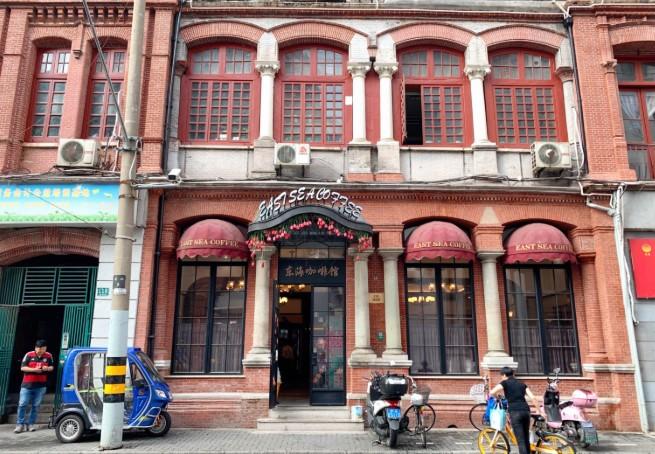
Deng Xiaoping's reform and opening-up policy began at the end of 1978, leading to the construction of numerous Western-style hotels, such as the Jianguo Hotel in Beijing. These hotels began selling Western cuisine, coffee, and cola.
Meanwhile, Shanghai, with its long-established coffee culture and numerous coffee houses even before World War II, saw almost all of its coffee shops disappear during the Cultural Revolution, with only one exception. However, after the reform and opening-up, coffee houses gradually revived.
The only coffee house that remained open during the Cultural Revolution was Shanghai Coffee House. In 1988, the famous pre-war Shanghai coffee house, Mars Coffee House, was revived as Donghai Coffee House.
■Shanghai Coffee House: The Only Coffee House to Continue Operating During the Cultural Revolution
Shanghai Coffee House was operated by Shanghai Coffee Factory, the only coffee roasting factory in China during the Cultural Revolution.
Shanghai is a unique city within China, a place where sailors from foreign ships and visitors from friendly countries (such as Albania and African nations) would stop by, albeit in small numbers. Therefore, it seems that the shop itself was intentionally kept open under government control as a "space to maintain appearances externally."
Originally, it was one of the few places in China where coffee was popular, and it continued to operate even during the Cultural Revolution.
■Shanghai Coffee Factory and CPC Coffee Founder Zhang Baocun
Zhang Baocun, the founder of CPC Coffee, the predecessor of Shanghai Coffee Factory, was originally successful in the coffee business before the company was nationalized.
However, in 1950, the year after the founding of the People's Republic of China, upon returning from a business trip to Hong Kong, where he had business dealings, he was sentenced to three years in prison for "historical counter-revolutionary crimes."
Shortly after his release, Zhang Baocun was sentenced again to 12 years in prison in 1958 and sent to a prison and labor camp in Qinghai Province.
The second conviction was due to a private loan he made to one of his former employees, who had already become an executive of a state-owned enterprise at the time.
He would spend 24 years in prison.
During that time, CPC Coffee was nationalized and became Shanghai Coffee Factory, and the Shanghai Coffee House it operated became the only coffee house in Shanghai to continue operating.
In other words, this coffee house survived partly because of forces that took advantage of the new regime after China's transition from the Republic of China to the People's Republic of China.
Zhang Baocun was a successful businessman under Chiang Kai-shek's regime in the Republic of China, but the common sense of that era no longer applied under Mao Zedong's regime in the People's Republic of China. Perhaps Shanghai Coffee House was able to continue operating by adapting to the new system under Mao's regime?
■About Donghai Coffee House
It was founded in 1934, during the time when Shanghai was known as the "Paris of the East" and was at its most prosperous as an international city.
It was opened by a Soviet (White Russian) Jewish person, and its original name was not "Donghai Coffee House," but "Mars Cafe (马尔斯咖啡馆 / Mars Cafe)."
At that time, Shanghai was home to a large influx of "White Russians" who had fled the 1917 Russian Revolution, and Jews who had escaped persecution in Europe.
They opened Western-style restaurants and cafes in the concession areas (foreign settlements), bringing authentic European cafe culture to Shanghai.
Mars Cafe was born against the backdrop of this influx of Western culture by European immigrants and the fashionable trends of Shanghai's youth at the time.
Mars Cafe is said to have served Russian cuisine, borscht, cakes, and Western-style pastries, suggesting that it opened not merely as a coffee stand, but as a Russian-style Western restaurant.
It opened near the intersection of Nanjing East Road and Shashi 1st Road (around the current Central Shopping Mall area), which was Shanghai's busiest main street at the time.
It was located in the most vibrant commercial district, where the latest trends from around the world converged.
■After the founding of the People's Republic of China, Mars Cafe was converted into Donghai Hotel
However, after 1949, cafes run by foreigners began to be sold to Chinese people, and after 1956, the number of cafes further decreased due to "public-private partnerships" (a form of nationalization).
In the case of Donghai, it was renamed "Donghai Hotel" after the Jewish owner returned to China in 1954.
It is thought that, amidst the departure of foreign owners and the trend of public-private partnerships, it effectively became a state-run restaurant.
Many Western-style cafes after the public-private partnerships stopped serving Western food and either switched to Chinese cuisine or disappeared. Famous places like "Tian'e Pavilion" (天鹅阁) transformed into a Chinese breakfast shop serving popular items like flatbreads, fried dough sticks, and soy milk, and eventually disappeared.
The renaming to "Hotel" suggests a transformation from a coffee specialty shop to a general restaurant.
When the Cultural Revolution began, eating Western food or drinking coffee was branded as "bourgeois," and the 13 remaining Western restaurants and coffee shops in Shanghai were ordered to close and forced to switch to Chinese cuisine.
The only one that remained was "Shanghai Coffee Shop" (Tongren Road).
Even Shanghai Coffee Shop sold pan-fried dumplings and wontons to survive during the Cultural Revolution.
It is believed that Donghai was among these 13 shops, and it is highly likely that they were forced to stop serving coffee.
According to contemporary testimony, a man who brewed coffee at home had his house ransacked by Red Guards after a neighbor reported the aroma, and he was subjected to two "struggles" (public humiliation).
That man was forced to give up coffee and switch to cocoa, which has a weaker aroma.
In an era when drinking coffee itself was considered a bourgeois act, it's unlikely that a Western-style cafe like Tokai would have remained unscathed.
■Changes in Tokai Restaurant's Menu
In the 1930s, Mars Coffee Shop primarily served Russian-influenced Western cuisine, including Russian dishes and borscht.
After the Tokai Restaurant stage in 1954, Tokai Coffee House in 1988 was a shop offering "coffee, Western snacks, and Western cuisine."
Furthermore, around 1980, and after its revival, representative menu items included Qing Ka (black coffee), Nai Ka (milk coffee), Bing Jie Ling Ka Fei (iced coffee), Hong Hui Niu Rou (braised beef), Zha Zhu Pai (fried pork), Xiang Xia Nong Tang (country-style soup), and Can Bao (bread rolls).
In other words, the focus shifted from the pre-war "Western Cuisine Restaurant with a strong Russian influence" to a Shanghai-style coffee shop that emphasized coffee and pastries while retaining some Western dishes, starting in 1988.
After the reform and opening-up policy, state-owned food and beverage companies were required to incorporate market principles and the needs of citizens.
Therefore, in response to the voices of citizens nostalgic for the former modern Shanghai culture and the new consumer needs of young people, the state-owned enterprise took the lead in deciding to change the sign from "Donghai Hotel" back to the old "Donghai Coffee House." Tokai Coffee uses freshly ground coffee beans from Hainan Island and Yunnan Province, filling the shop with an irresistible aroma and attracting customers not only from nearby areas but also from far away.
コメント