
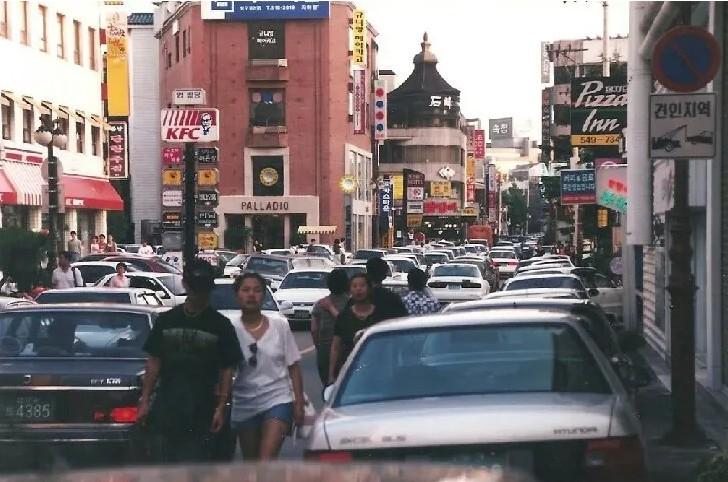
In the second half of the 20th century, Korean coffee culture was centered around the dabang (tea house). However, in the 1990s, traditional dabangs began to decline,
and coffee shops and cafes began to open more frequently.
In 1987, South Korea's military regime ended, and the country became a democracy with a directly elected president. The 1988 Seoul Olympics symbolized South Korea's economic development.
The liberal atmosphere and economic development brought about by this democratization also brought changes to the Korean coffee industry.
From the early to mid-1990s, Apgujeong-dong in Gangnam was Seoul's most fashionable area.
Spring-day shopping, dotted with sophisticated cafes frequented by wealthy young people, emerged.
Backed by their parents' immense wealth, young people began driving imported cars, wearing international brands, and enjoying extravagant spending.
These young people were known as the Orange Tribe. There are various theories about the origins of the Orange Tribe, but one explanation is that the pop and flashy image of the color orange in fashion and lifestyle at the time meant they symbolized a bright and eye-catching new generation culture.
They were active around the area of the first McDonald's in Korea, located across from the Hyundai Department Store Apgujeong main branch.
Apgujeong Rodeo Street, modeled after Beverly Hills in the United States, was lined with high-end boutiques, import shops, and sophisticated cafes, making it Korea's trendiest area.
The K-pop system, which now dominates the world, also took shape in Apgujeong during this period.
SM Entertainment established its headquarters (studio) in the area and produced first-generation idols such as H.O.T. and S.E.S.
■Bodyguard
A coffee shop symbolizing this area during this period was Bodyguard.
The cafe's name comes from the 1992 film "The Bodyguard," starring Kevin Costner and Whitney Houston, which was a huge hit in Korea.
It was located in a highly visible spot near the entrance to Apgujeong Rodeo Street.
At a time when cafes around universities charged around 500-1,000 won per cup, the cafe's prices were several times higher (over 5,000 won).
Even so, luxury cars were lined up in front of the cafe, and the interior was always packed with young people dressed in the latest fashions.
It was truly a place to confirm class and status.
It is often said to be the setting for the Orange Tribe's legendary pickup technique: asking the waiter to bring an "orange juice"** to the table of the person you liked, and if the person drank it, you were paired.
It was known as Korea's first "transparent cafe" at the time, with a glass curtain wall.
The bright, spacious space, with tables and lighting, offered a modern and stylish atmosphere that contrasted with the traditional, dark teahouse (dabang). The cafe's high ceilings and sophisticated interior gave it the feel of a movie set.
There are many stories of beautiful men and women who worked part-time or frequented the cafe at the time being scouted by entertainment agencies and becoming stars.
It was sometimes criticized in news programs and newspapers as a "hotbed of excessive consumer culture" and a symbol of its excessive "flashyness" and "youth deviance," but this only served to further strengthen its aspirations among young people at the time.
Other cafes in the area include:
■Haru (하루)
Haru is remembered as the most sophisticated and modern space in the Cheongdam-dong area, near Apgujeong, in the 1990s.
A striking interior: While wood grain and red velvet were the norm in taverns at the time, Haru featured a modern, inorganic interior reminiscent of exposed concrete.
The café's windows were so large that customers could "watch" the people walking along Rodeo Street outside, while at the same time allowing passersby to "watch" the "stylish customers" inside.
It was a gathering place for the more artistically inclined among the orange tribe, as well as people in the advertising and fashion industries.
■Café de Flora
The terrace seating was reminiscent of the Parisian cafes in Cheongdam-dong, and for young people at the time, the "European style" was a major aspiration.
This was Gangnam's most famous "sofa cafe with telephone" in the late 1990s, and even before the widespread use of mobile phones (around 1997-98), it was equipped with pay phones and notepads.
It was a culture of customers leaving notes for each other, such as "X, I'm waiting on sofa number 3" or "I've been to Haru, so I'll come here next."
This is a scene similar to that depicted in the popular 2012 Korean TV drama "Reply 1997."
■Jardin (쟈뎅)
Known as Korea's first specialty coffee shop, **Jardin (쟈뎅), opened its first store in Apgujeong in 1988.
Jardin (then called "Jardin Coffee Town") opened in Apgujeong just before the 1988 Seoul Olympics and was Korea's first place to specialize in "brewed coffee from whole beans."
Until then, instant coffee with sugar and creamer was the norm in Korea. Jardin's arrival established the concept of "cafes" in Korea, using the highest quality beans and serving coffee in a sophisticated atmosphere.
It's also said that Jardin was the driving force behind the popularity of "hazelnut coffee."
At a time when many people still found authentic black coffee too bitter, Jardin's introduction of fragrant flavored coffee captivated many Koreans.
コメント