
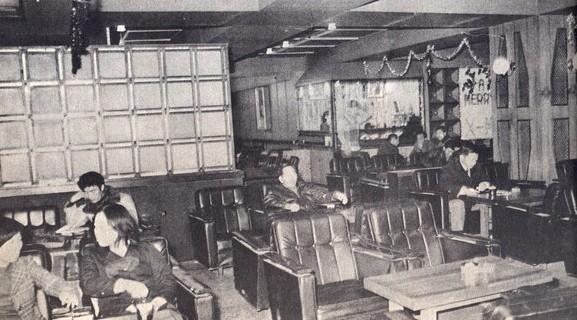
After the Korean War, society gradually stabilized. Instant coffee, brought in by the U.S. military, became widespread, and so did coffee.
This marked the development of Korea's unique "dabang" culture.
In 1956, "Hakrim Chaya" opened in Dongseong-dong, where Seoul National University's College of Liberal Arts and Sciences was located.
At the time, the College had 24 lecture rooms, and Hakrim Chaya was nicknamed "25 Lecture Rooms," a space for serious intellectuals.
As university students flocked to dabang, the music played there shifted to pop songs.
Record players were installed in dabang, and by the mid-1960s, music teahouses with DJ booths appeared in Myeongdong, Jongno, and Chungmuro.
Dabang also served as offices for struggling businessmen.
Since telephones were rare at the time, small business owners would use tavern telephones to conduct business.
The cashier who answered the phone played a role similar to that of a secretary.
There's even a joke that when a phone call comes in saying, "Mr. Kim, there's a call!" five or six customers will rush out at once.
However, the spread of tabangs also had a negative impact. Competition between dabangs for customers intensified, leading to the emergence of new occupations such as "face hostess" (face hostess) and "cashier."
The number of teahouses that lured young women from the provinces to Seoul and commercialized their sex lives also rapidly increased.
Some tabangs even sold alcohol, imitating the decadent cafes of the Japanese colonial era.
Donghwa Foods, established in May 1968, began producing "Maxwell House" brand instant coffee in June 1970.
Instant coffee was a welcome addition to teahouse operators' lives. Imported coffee beans were expensive and shunned as a luxury item.
Instant coffee, on the other hand, was readily available domestically and at a low price.
When coffee beans became difficult to obtain, tabang owners were found to be selling "fake coffee" made from American coffee grounds, sawdust, bean flour, eggshells, and other ingredients.
Furthermore, the "comfit incident" occurred, in which coffee beans were mixed in with less than the prescribed amount and cigarette butts to enhance the flavor.
Instant coffee not only solved the problem of procuring green beans, but, more importantly, made it easy for people to brew coffee without hiring a highly paid chef.
However, in December 1976, Tozai Foods developed the world's first easy-to-drink beverage, "Coffee Mix," making it easier to brew coffee at work, and the number of tabang customers began to decline.
In 1977, Lotte Industries imported 400 coffee vending machines from Japan's Sharp and began selling them in Korea.
The spread of coffee vending machines also made it easier to obtain coffee without having to go to a tabang or have it delivered.
As they searched for a way forward, teahouses split into two main types.
Teahouses catering to younger generations sought to survive by employing popular DJs and transforming into music-focused cafes.
Meanwhile, teahouses targeting middle-aged and older customers installed large TVs to broadcast sports and news, and improved the services of their madams and cashiers.
It was around this time that they also hired large numbers of cashiers wearing heavy makeup and flashy clothing to improve delivery services.
Local history collector Lee Sang-gil recalls, "Teahouses were the center of every aspect of daily life back then.
"In the 1970s, when television was still a novelty, people would gather at teahouses to watch the wrestling matches of 'Headbutt King' Kim Il" he recalls.
In the 1970s, teahouse proprietresses and cashiers were special figures symbolic of the era. Because they had to converse with customers, they were required to have a certain level of education and sophisticated skills.
Kim Gwang-sik, an essayist who served as manager of the Peninsula Hotel in Busan, said, "There were many dabangs around the hotel.
If you wore hanbok, you were a madam, and if you wore Western clothes, you were a cashier." He added, "Cashiers were so popular that they would be kicked out if they had a boyfriend, as they would lose customers."
Dabang cashiers would carry thermoses and cups wrapped in "bojagi" (wrapping cloth) and travel by scooter or bicycle to deliver coffee to offices, mahjong parlors, and even construction sites.
In the 1990s, businesses known as "ticket dabang" became widespread, especially in rural areas. Some dabangs also functioned as intermediaries for prostitution, which tarnished the social image of dabangs as a whole.
This strengthening image of sexual prostitution was one of the reasons why the younger generation avoided dabangs and moved toward cleaner, more modern cafes.
These coffee shops avoided the term "dabang," which had a tarnished image, and instead opened simply as coffee shops.
コメント